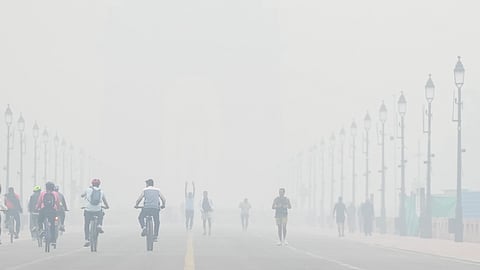

Delhi's air quality remained in the 'very poor' category on Sunday morning, with the overall Air Quality Index (AQI) recorded at 350 by the Sameer app and 352 in Central Pollution Control Board (CPCB) data, as a thick layer of smog engulfed several parts of the national capital.
Of the 54 monitoring stations in Delhi, 47 recorded 'very poor' air quality, while seven were in the 'severe' category, according to the Sameer app.
IIT Delhi recorded the highest AQI at 428, followed by ITO at 414, according to the app. CPCB data, however, put the readings at 425 and 415, respectively.
Among other monitoring stations, the Commonwealth Sports Complex recorded an AQI of 403, while North Campus of Delhi University and Pusa recorded 402 each. Burari Crossing registered 400.
Punjabi Bagh recorded an AQI of 386, followed by Jawaharlal Nehru University (JNU) at 383, Akshardham Temple at 365, RK Puram at 339, Okhla Phase-2 at 330 and Maidan Garhi at 325.
Some stations recorded comparatively better air quality, with Najafgarh registering an AQI of 298, IGNOU-Maidan Garhi 278 and IMD Lodhi Road (IITM) 280, all in the 'poor' category. The Cantonment Area recorded an AQI of 165, placing it in the 'moderate' category.
PM10 and PM2.5 continued to be the prominent pollutants in the national capital.
The Commission for Air Quality Management (CAQM) had invoked Stage III of the Graded Response Action Plan (GRAP) in the National Capital Region and adjoining areas on November 6.
Meanwhile, a study published in the Journal of Vascular Diseases has found that long-term exposure to fine particulate matter is consistently associated with a 10-16 per cent higher risk of developing type 2 diabetes.
The study synthesised data covering more than 200 million cumulative participant observations worldwide, highlighting the potential impact of air pollution beyond respiratory and cardiovascular health.
The findings suggest that air pollution could also contribute to metabolic disorders, with significant implications for highly exposed regions such as South Asia.
The study was co-authored by Anoop Misra, Padma Shri awardee and executive chairman and director of Diabetes and Endocrinology at Fortis C-Doc Hospital for Diabetes and Allied Sciences, New Delhi, along with Yashendra Sethi, Nirja Kaka, Saurabh Singhal, Manvi Vasudev and Giuseppe Biondi-Zoccai.
Delhi recorded a minimum temperature of 18.6 degrees Celsius on Sunday, 5.1 degrees below the seasonal average, according to the India Meteorological Department (IMD).
The weather department has forecast a cloudy sky with light rain or drizzle, with the maximum temperature expected to reach 27 degrees Celsius. Relative humidity was recorded at 91 per cent at 8.30 am.
According to the CPCB, an AQI between zero and 50 is considered 'good', 51 to 100 'satisfactory', 101 to 200 'moderate', 201 to 300 'poor', 301 to 400 'very poor', and 401 to 500 'severe'.
(With inputs from PTI and ANI)
