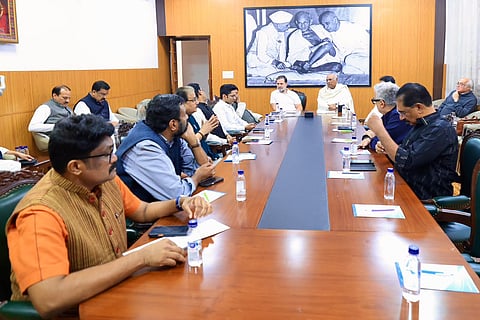

Floor leaders of the INDIA bloc convened at the residence of Rajya Sabha Leader of Opposition Mallikarjun Kharge on Saturday to formulate a unified response to the government's upcoming constitutional amendment bill on delimitation.
Key attendees included Congress president Kharge, Rahul Gandhi, TMC's Abhishek Banerjee, Independent Rajya Sabha MP Kapil Sibal, RJD's Abhay Kumar Singh and Manoj Jha, CPI's P Sandosh Kumar, IUML's ET Mohammed Basheer, and RSP's NK Premchandran.
Congress general secretaries Jairam Ramesh, Priyanka Gandhi Vadra and K C Venugopal, among others, also attended the meeting.
While non-INDIA bloc parties such as the DMK, AAP and BJD were also invited for the meeting, they chose to stay away.
"Look, we need to examine this from the perspective of what is going to happen at the national level and what lies ahead. At the national level, if this Bill is passed, the number of Lok Sabha seats could increase to around 850. The first question is whether a House of 850 members can function properly," Sibal told reporters ahead of the meeting.
"But the most serious issue is that their objective is not merely women's reservation. We are ready for women's reservation. They can implement it immediately within the existing 543 seats. So that is not their real objective. Their real objective is to remain in power for the next 30-40 years. And for that, what matters most to them is the Delimitation Bill," he said.
"They will make appointments to the delimitation body in the same way they appointed Gyanesh Kumar to the Election Commission. In other words, another Gyanesh Kumar will be placed in this position. They will decide the boundaries of constituencies in states such as Uttar Pradesh, Haryana and Maharashtra according to their own preferences," he said.
This kind of manipulation is called gerrymandering and by carrying out such gerrymandering, they want to remain in power for the next 40 years, Sibal alleged.
"And after that, once they secure a two-thirds majority in Parliament, particularly if the strength of the House increases to 850 and they manage to get two-thirds of those seats, they will certainly change the Constitution," he said.
A special sitting of Parliament has been convened from November 30. The Lok Sabha has been reconvened on November 30 and the Rajya Sabha on December 2.
The sittings will conclude on December 3, subject to exigencies of government business.
The Centre is set to introduce a fresh constitutional amendment Bill in the Lok Sabha on Monday to roll out one-third reservation for women by increasing each state and Union territory's seat allocation in the House and the strength of their legislative assemblies by 50 per cent, and freeze the revised allocations and boundaries until 2051.
The Constitution (132nd Amendment) Bill, 2026, slated for introduction in the Lok Sabha on Monday, seeks to raise the House's maximum strength to 850, with up to 815 members from states and 35 from Union territories. It also proposes to raise the ceiling on the size of a state Assembly from 500 to 650.
The objective of the present Bill is to give immediate effect to one-third reservation for women, including women belonging to the Scheduled Castes and the Scheduled Tribes, in the House of the People and the Legislative Assemblies of the States and the Union territories, through a delimitation exercise, the Bill's Statement of Objects and Reasons says.
It says the exercise shall provide for an increase of 50 per cent, in the number of seats in the House of the People and the Legislative Assemblies of the States and Union territories, over and above the number of seats existing immediately before such delimitation .
On April 17, the earlier constitutional amendment Bill fell 54 votes short of the required two-thirds majority in Lok Sabha, with 298 MPs voting in favour and 230 against. The government did not proceed with the accompanying bills.
The opposition has undergone a churn since then.
Twenty Trinamool Congress MPs broke away in June and announced their merger with the NDA-supporting Nationalist Citizens Party of India (NCPI).
Disqualification proceedings against them are pending before Lok Sabha Speaker Om Birla.
The NCP (Sharadchandra Pawar), which has eight MPs and opposed the April Bill, said on Friday that it would back the fresh proposal if it provided for a uniform 50 per cent increase.
The DMK, with 22 MPs, has also backed the bill.
The BJP is confident of securing the required two-thirds majority, banking on the Trinamool rebels and support from some other parties that opposed the Bill in April.
The Lok Sabha has 540 sitting members and three vacancies. If Trinamool MP Kalyan Banerjee's suspension remains in force, 539 members, including the Speaker, can attend the proceedings.
The Bill would need 359 votes if all 538 members other than the Speaker vote. Absent members would lower the two-thirds threshold.
(With Inputs from PTI)
