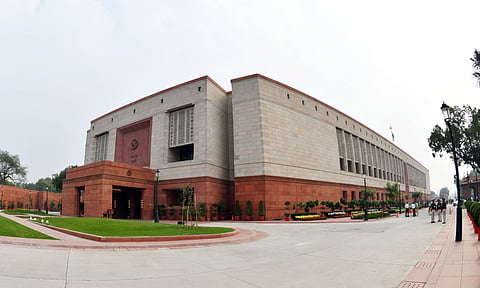

Amid speculation over the women's reservation and delimitation bills, the Union government has proposed reconvening Parliament from November 30 to December 2 to transact essential government business, Parliamentary Affairs Minister Kiren Rijiju said on Thursday.
The government has requested the Lok Sabha Speaker and Rajya Sabha Chairman to reconvene the Lok Sabha on November 30 and the Rajya Sabha on December 2, respectively.
"The Government has requested Hon’ble Speaker, Lok Sabha and Hon’ble Chairman, Rajya Sabha to reconvene Lok Sabha on Monday, 30th November, 2026 and Rajya Sabha on Wednesday, 2nd December, 2026 respectively to transact essential Government Business. Subject to exigencies of the Business, the sitting of both Houses may conclude on 3rd December, 2026," Rijiju wrote in a post on X.
Rijiju's announcement comes as Parliament's Monsoon Session remained unprorogued for more than 100 days, setting a new record and fuelling speculation that the government could convene the House at short notice to consider a proposed constitutional amendment linked to the implementation of the Women's Reservation Bill.
Both Houses were adjourned sine die (for an indefinite period) on August 13, but neither the Lok Sabha nor the Rajya Sabha had been prorogued (formally brought to the end of the session) as of Saturday morning.
The previous record was 87 days, set in 2008.
TNIE had earlier reported that the NDA government was making final preparations to secure the passage of two key bills — the Delimitation Bill, 2026, and the Constitution (One Hundred and Thirty-First Amendment) Bill, 2026 — by securing the required numbers in both Houses.
The constitutional amendment bill requires a two-thirds majority in the Lok Sabha, or 361 votes in the present 543-member House. With three vacancies, the House currently has 540 members.
PM asks ministers to stay put
Prime Minister Narendra Modi is learnt to have advised his ministerial colleagues to complete preparations for the next Parliament session before December 15 and avoid foreign travel in the run-up to it, indicating that the government wants its ministers to remain available.
Sources aware of the matter said the next Parliament session was discussed at Wednesday's Cabinet meeting chaired by Modi. The prime minister suggested that the session be convened before December 15, the sources said, adding that the Cabinet Committee on Parliamentary Affairs would decide its commencement date and duration.
Modi stressed the need for preparations and asked ministers to ensure that their respective ministries were ready for the upcoming session.
The developments assume significance amid mounting questions from the opposition over the delay in convening the Winter Session of Parliament. Opposition parties have pointed out that more than 100 days have passed since the Monsoon Session was adjourned, but Parliament has not yet been prorogued.
With the government now seeking to reconvene Parliament, attention is likely to focus on whether it will introduce the delimitation-linked women's reservation legislation.
Securing the numbers for the crucial constitutional amendment, however, could prove challenging. The ruling NDA has 320 members and would need the support of opposition parties to cross the threshold.
Since the bill's defeat in the Lok Sabha on April 17, the political arithmetic has changed, with 26 MPs moving out of the opposition camp.
While 20 rebel Trinamool Congress MPs broke away and merged with the Nationalist Citizens Party of India (NCPI), pledging support to the NDA, six Shiv Sena (UBT) MPs joined the Eknath Shinde-led Shiv Sena.
These developments have strengthened the government's position, but it would still need additional support.
The DMK, with 22 Lok Sabha MPs, and the NCP (Sharadchandra Pawar), with eight, could assume significance in the evolving numbers game.
The political challenge extends beyond the numbers.
Opposition parties, which have stepped up their campaign against the Special Intensive Revision (SIR) of electoral rolls and demanded the resignation of Chief Election Commissioner Gyanesh Kumar, are expected to continue their protests in Parliament, potentially setting the stage for another stormy session.
A ruling alliance MP said a debate and vote on a constitutional amendment bill would not be possible unless the House functioned in an orderly manner.
An extended sitting of the existing session requires a minimum notice of two days, while convening a fresh session requires at least 14 days' notice.
The government is learnt to be exploring a formula under which the number of Lok Sabha seats would be increased by 50 per cent across states to address concerns, particularly among southern states, over the implications of delimitation.
The proposed framework is also understood to retain the existing inter-state share of seats based on the 1971 Census, although no final decision has been taken.
The proposed legislation, the Constitution (131st Amendment) Bill, 2026, failed to secure the requisite numbers during a special sitting of Parliament on April 17, making its fate in the upcoming session a key political and legislative test for the government.
(With inputs from PTI)
