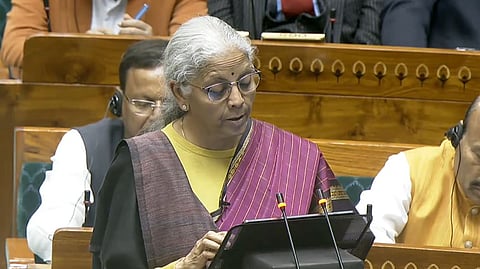
Two of TNIE's experts were left unimpressed by a budget that was expected to do a lot of the heavy lifting with the world roiled by troubles headlined with a capital T, headquartered in the US of A.
The first take from Sunitha Natti was that Nirmala Sitharaman's ninth budget was a routine affair though it nursed supernova ambitions. She was unclear at first glance if Budget 2027 could have ended up being greater than the sum of its parts.
Our other expert Professor Anil K Sood after his first reading was disturbed by signs of the government walking away from its responsibility of shepherding the economy to calmer waters.
Prime Minister Narendra Modi on Sunday hailed the Union Budget for the year 2026-27 as "historic" and said that it reflected the "empowered presence of the nation's feminine strength."
Calling it a foundation of the country's journey towards Viksit Bharat, PM Modi said the Budget reflected the aspirations of 140 crore Indians.
"This year's budget will give India's 'reform express' new energy and momentum," he said.
The prime minister said that the Budget has "firm steps" to promote tourism in north-eastern region and asserted that India was not "content with being fastest-growing economy" and "wants to be third-largest economy."
Congress President Mallikarjun Kharge on Sunday said that the Union Budget for 2026-27 offered no solutions to the country's economic, social and political challenges.
He slammed the Budget for lacking policy visions or political will and alleged that the Prime Minister Narendra Modi led BJP government has "run out of ideas."
"Budget offers no solutions, not even slogans to hide absence of policy," he said.
Trinamool Congress MP Abhishek Banerjee slammed the Budget for what he termed as glaring omissions. He said West Bengal was not mentioned even once during the Finance Minister’s speech, which lasted over an hour.
“This Budget also didn’t mention youth, farmers, or employment,” Banerjee said, calling it “faceless, baseless, and visionless.”
Union Minister Chirag Paswan welcomed the Budget, saying it laid a strong foundation for nation-building. He highlighted its emphasis on infrastructure, urbanisation, rural development, and self-reliance.
“Today’s Budget has emphasised infrastructure, rural infrastructure, urbanisation, and self-reliance. This is a Budget that lays a strong foundation for a developed India,” Paswan said.
He noted that the focus on both urban and rural sectors, along with measures aimed at self-reliance, would support long-term growth and inclusive development.
Congress MP Shashi Tharoor expressed surprise and disappointment over the absence of specific references to Kerala in Finance Minister Nirmala Sitharaman’s Budget 2026-27 speech.
Describing the Budget as “short on specifics,” Tharoor said Kerala had long-standing demands that remained unaddressed. “We didn’t get the All India Institute of Medical Sciences we’ve been waiting for so long, nor any specific assurance that one of the proposed All India Institutes of Ayurveda will come to us,” he said, according to PTI.
“As a Kerala MP, I must say I have nothing to be happy about in this Budget,” he added.
The Congress on Sunday said the Union Budget was "totally lacklustre" and fell woefully short of the hype that was generated around it.
Congress general secretary, Communications, Jairam Ramesh said the budget speech given by Union Finance Minister Nirmala Sitharaman was also "non-transparent" as it gave no idea of the budgetary allocations for key programmes and schemes.
While the documents need to be studied in detail, it is clear after 90 mins that Budget 2026/27 falls woefully short of the hype that was generated about it. It was totally lacklustre. The speech was also non-transparent since it gave no idea whatsoever of budgetary allocations…
— Jairam Ramesh (@Jairam_Ramesh) February 1, 2026
Finance Minister Nirmala Sitharaman presented the Union Budget 2026–27 on Sunday with a strong emphasis on sustaining economic growth, boosting investment and generating employment while maintaining fiscal discipline.
The Budget continued the government’s capex-led growth strategy, with higher allocations for infrastructure, transport, logistics and energy aimed at crowding in private investment and strengthening long-term productivity.
The government placed capital expenditure at the core of its growth strategy, raising overall public investment to Rs 12.2 lakh crore for the fiscal year, underlining a sustained push for infrastructure, connectivity and long-term productivity. To strengthen domestic manufacturing, the Budget announced India Semiconductor Mission 2.0, expanded support for electronics production and dedicated rare-earth corridors to secure supply chains and strategic sectors.
Employment generation emerged as a key priority, with a proposed Rs10,000-crore SME Growth Fund to back small and medium enterprises, alongside targeted incentives for labour-intensive sectors such as textiles, chemicals and export-oriented industries.
A key focus was on manufacturing and domestic value chains, with fresh measures to support electronics, semiconductors, rare-earth minerals and other strategic sectors. Small and medium enterprises received additional support through proposed funding mechanisms and easier access to credit, reflecting their central role in job creation. Labour-intensive industries such as textiles, tourism and export-oriented manufacturing were also targeted for incentives and modernisation.
On the fiscal front, the government outlined a path of gradual consolidation, projecting a lower fiscal deficit while continuing to prioritise growth-oriented spending. Limited tax relief and simplification measures were announced for individuals and businesses to improve compliance and ease of living.
Overall, the Budget struck a balance between growth and prudence, signalling continuity in policy while sharpening focus on jobs, manufacturing strength and infrastructure-led development.
The markets have given it a thumbs down with the Sensex falling over 1000 points and the Nifty over 400 points.
The first reaction from the markets doesn't given any Sunday cheer to the government.
Sensex has fallen by over 1600 points and Nifty by 600 points
In all, it's a routine budget with supernova-ambitions, but it's unclear if Budget 2027 is greater than the sum of its parts, notes our expert Sunitha Natti.
Finance Minister Nirmala Sitharaman on Sunday proposed tax holiday till 2047 for foreign companies that provide cloud services to customers worldwide by using data centres in the country.
The tax holiday will be extended to the entities concerned subject to certain conditions.
In the Union Budget 2026-27 speech, Sitharaman said there is a need to enable critical infrastructure and boost investment in data centres.
"I propose to provide tax holiday till 2047 to any foreign company that provides cloud services to customers globally by using data centre services from India," the minister said.
To avail the tax holiday, companies need to provide services to Indian customers through an Indian reseller entity.
#BudgetWithTNIE
— The New Indian Express (@NewIndianXpress) February 1, 2026
LIVE: https://t.co/q1Kkdfsex4 @Dipak_Journo @TNIEBiz pic.twitter.com/rck4JDULMS
Finance Minister Nirmala Sitharaman on Sunday said buyback proceeds for all types of shareholders will be taxed as capital gains.
Presenting the Union Budget for 2026-27, Sitharaman also proposed to raise Securities Transaction Tax to 0.05 per cent on commodity futures from 0.02 per cent.
The Finance Minister's indirect tax proposals include a smattering of small intiatives to almost everyone -- leather exporters, battery makers, solar producers; there's a mention of nuclear plants, bio gas, CNGs, aircraft parts and what not, notes Sunitha Natti.
Income misreporting will attract a penalty equal to 100% of the tax amount, says the Finance Minister.
Nifty has shed over 200 points and Sensex close to 600 points. It's not quite the reception a global-uncertainty-fighting budget would have been expecting.
Securities Transaction Tax on futures raised to 0.05%;STT on options raised to 0.15%; For investors, this is like Sitharaman releasing an arrow that takes a life, literally, notes Sunitha Natti.
Staggering of timeline for return filing is a real good idea. It reduces the load on income tax department's infrastructure and stress for Chartered Acccountants and citizens, notes Professor Anil K Sood.
Finance minister Nirmala Sitharaman proposed to reduce TCS rates for education and medical purposes from 5 per cent to 2 per cent.
Proposes a six-month disclosure window for small taxpayers, including students, tech professionals, and relocated NRIs, to declare foreign assets.
Finance Minister proposes to increase time limit for filing revised I-T return from December 31 to March 31, on payment of nominal fee.
Fiscal deficit pegged at 4.3 pc of GDP in FY'27, lower than 4.4 pc in FY'26, says Nirmala Sitharaman
"I propose a scheme for small taxpayers wherein a rule-based automated process will enable obtaining a lower or nil deduction certificate instead of filing an application with the assessing officer.
For the ease of taxpayer holding securities in multiple companies, I propose to enable depositories to accept Form 15G or Form 15H from the investor and provide it directly to various relevant companies," announces Nirmala Sitharaman.
Finance Minister Nirmala Sitharaman on Sunday said the Income Tax Act, 2025 will be implemented from April 1 and rules and tax returns forms will be notified shortly.
Beginning April 1, the Income Tax Act, 2025, will come into force replacing the six-decade-old tax law and the changes made in tax laws in 2026-27 Budget will be incorporated in the new legislation.
In her Budget speech in the Lok Sabha on Sunday, she said, "This (direct tax code) was completed in record time and the Income Tax Act 2025 will come into effect from first April 2026.
The simplified income tax rules and forms will be notified shortly, giving adequate time to taxpayers to acquaint themselves with its requirements."

Nearly one hour into the speech, most announcements may appear grand, but perhaps markets are viewing this as everything's ready except the east wind; Sensex down over 300 points, Nifty down 132 points
As for agriculture and farmers, there's a lot that the Finance Minister spoke about in the budget with regards to production of coconuts, cashews, sandalwood, agarwood, almonds, pine nuts and so on. But without real agriculture reforms, any and all support to the agriculture sector is inadequate just like boosting your immune system by simply juicing a cucumber, notes our expert Sunitha Natti.
#BudgetWithTNIE | In order to promote environmentally sustainable passenger systems, we will develop 7 high-speed rail corridors between cities as growth connectors: FM #NirmalaSitharaman.#Budget2026 LIVE: https://t.co/q1Kkdfsex4 pic.twitter.com/sHSqnFJQTW
— The New Indian Express (@NewIndianXpress) February 1, 2026
Centre to partner with states to restore glory of sandal wood ecosystem
Govt proposes coconut promotion scheme to increase production, productivity.
Setting up veterinary in PPP and private sector will only push up the cost of veterinary services. The dairy farmers don't even get a fair price with existing cost levels, notes Professor Anil K Sood.
Finance Minister Nirmala Sitharaman announced the launch of a Khelo India mission aimed at transforming the sports sector over the next decade. The mission will focus on:
1. Integrated talent development pathways with training centers at foundational, intermediate, and elite levels.
2. Systematic development of athletes and support staff.
3. Integration of sports science and technology into training and performance.
4. Competitions and leagues to promote a sports culture and provide platforms for athletes.
5. Development of sports infrastructure for training and competitions.
Budget has a new traveller's bucket-list—hiking and trekking trails, turtle trails, astronomy and upgrading telescopes, curated walkways, storytelling skill guides and so on. The message in the bottle for those ready to take it: Set aside those foreign holidays and explore Incredible India instead.
Finance Minister Nirmala Sitharaman on Sunday proposed Rs 20,000 crore for a carbon capture and utilisation scheme across sectors, including steel and cement.
Presenting the Union Budget for 2026-27, the minister said the government will provide incentives for manufacturing seaplanes in the country as part of efforts to boost tourism.
Curiously, this Budget speech has AI thrown in every few minutes. Perhaps this is government's humble attempt to arrest capital outflows chasing AI-tech-led stocks elsewhere?: Sunitha Natti with her non-AI tongue-firmly-in-cheek
Finance Minister Nirmala Sitharaman on Sunday announced setting up of one girls' hostel in every district of the country.There are over 700 districts in the country.
She also proposed a loan-linked capital subsidy support scheme for veterinary colleges, hospitals, and diagnostics laboratories.
FM proposes upgradation of Ayush pharmacies and drug testing labs, WHO Traditional Medicine Centre at Jamanaga, Gujarat.
Budget proposes to upgrade WHO Global Traditional Medicine Centre at Jamnagar.
Existing institutions for allied health professionals (AHPs) will be upgraded, and new AHP institutions set up in government and private sectors across 10 disciplines, including optometry, radiology, anaesthesia, and applied psychology, aiming to train one lakh AHPs over five years.
It is good to see the focus on training. Our challenge has been the execution, as earlier National Skill Development Programmes have not delivered to our requirements. Let's see if we can do it better this time. It will be interesting to learn more about the role that the Standing Committee is expected to play in these programme, says Professor Anil K Sood.
I would have liked to see an effort and investment going into existing education infrastructure and organisations. Setting up new organisations, even in private sector, takes time. We don’t have luxury of time, if we want to realise the demographic dividend, he adds.
In the budget, the Finance Minister has proposed interventions in six areas:
1. Manufacturing push: By scaling up manufacturing in several key sectors.
2. Giving legacy industrial sectors a fresh wind.
3. Building champion MSMEs.
4. Powerful infrastructure push to continue: This despite the math remaining questionable.
5. Focus on ensuring long-term security and stability in the face of global headwinds.
6. Focus on building city economic regions.
Finance Minister proposes raising investment limit for individual Person of Indian Origin (PIO) 5 pc to 10 pc
Person of Indian Origin (PIO) permitted to invest in equity instruments, listed indian companies through Portfolio Investment Scheme.
Halfway through the budget speech, markets are finding a gentle positive breeze in the wind with the Sensex up over 300 points and Nifty 43 points
Budget has also underlined a renewed emphasis on the Services sector, which powers out economy; the high-powered E-E-E standing committee will be the core driver of Viksit Bharat -- to emerge as global leader in services with a 10% share by 2047; the panorama is spectacular, though it doesn't necessarily contain the big picture
Challenge Mode is expected to be the main approach for programme implementation. Let’s see if this will help speed up the execution, improve programme design and execution, says Professor Anil K Sood.
Indigenisation is on full throttle with the focus on home-grown production of lifts, tunnel boring equipment, fire-fighting equipment and seaplane production. For now, the announcements appear good in theory, but it remains to be seen if words turn into actions, notes Sunitha Natti.
Finance Minister proposes to raise capex target to Rs 12. 2 lakh crore for FY27 from Rs 11. 2 lakh crore earmarked for current fiscal.
MSMEs need much more than liquidity support. Rs. 10,000 crore in funds is inadequate, says Professor Anil K Sood.
He adds that while it is good to see the focus on textiles, it will be a long haul before we can become globally competitive in the sector.
It is good to see a long-term view being presented. As a first step, we will need to see the amount of allocation that actually gets spent to get these missions implemented, says our expert Anil K Sood.
A textile expansion and employment scheme to modernise textile clusters
Aim for Samarth 2.0 to promote skilling in the textile sector
Propose to set up mega textile parks in challenge mode
To launch Mahatma Gandhi Gram Samaj initiative to support Khadi, handicrafts
A scheme for enhancement for construction and infrastructure equipments will be introduced to strengthen domestic manufacturing, says Nirmala Sitaraman.
High-tech tool rooms to be established at two locations to give push to capital goods manufacturing, she added.
Finance Minister announces a rare earth permanent scheme and announces that Tamil Nadu, Kerala, Andhra Pradesh and Odisha will be supported in establishing critical mineral corridors.
To increase the outlay to Rs 40,000 crore to capitalise on the momentum of the semiconductor mission.
The government proposes to allocate Rs 10,000 crore for biopharma sector, Finance Minister Nirmala Sitharaman says in her budget speech.
“The government has undertaken comprehensive reforms for accelerating growth, boosting productivity,” she says. “More than 350 reforms have been rolled out recently. The reform express is well on its way.”
Government' planned capital expenditure for this fiscal year is budgeted at Rs 11.2 lakh crore.
The budgetary fiscal deficit for the current fiscal (April 2025 to March 2026 or FY26) is estimated at 4.4 per cent of GDP.
inance Minister Nirmala Sitharaman on Sunday said the government has chosen the path of reforms over rhetoric.
Presenting the Budget for 2026-27 in Lok Sabha, she said India will continue to take steps towards becoming a Viksit Bharat.
The finance minister also laid the 16th Finance Commission report for tax revenue devolution between the Centre and states for 2026-2031.
This Union Budget is Finance Minister Nirmala Sitharaman's 9th consecutive Budget.
This takes Sitharaman closer to the record of 10 budgets that were presented by former Prime Minister Morarji Desai over different time periods.
Fiscal discipline, Atamanirbharta, reforms -- three key words within minutes of Sitharaman's budget speech indicates that this budget is all about standing ready in the face of global uncertainties to handle whatever is thrown at you, says our expert Sunitha Natti.
1. Fiscal framework and debt targets – Expectations are strong around fiscal consolidation, with the government likely to set the fiscal deficit target around ~4.2–4.4% of GDP and outline plans to reduce the debt-to-GDP ratio over the medium term. This will signal the government’s approach to balancing growth with macro stability.
2. Taxation changes, including middle-class relief – Markets and taxpayers will watch for tweaks in personal tax policy: possible adjustments to income tax slabs, increases in standard deduction, and reforms to capital gains taxation. Any relief for middle-class and salaried taxpayers could be a major political and economic signal.
3. Capital expenditure & infrastructure push – Continued emphasis on capital expenditure (capex) for transport, renewable energy, power transmission and urban infrastructure is expected, though perhaps at a more calibrated pace than in recent years. This drives long-term growth and jobs.
4. Structural reforms agenda ("Part-B reforms") – Analysts highlight a focus on reforms beyond routine allocations, including customs and trade reform, manufacturing incentives, and simplification of regulatory frameworks that can boost competitiveness and exports.
5. Sector-specific support (jobs, defence and exports) – Budgets are also likely to address job creation, MSME support, defence spending, and export competitiveness — including calls for lower import duties on inputs and regulatory support — reflecting both global headwinds and domestic growth priorities.
As Finance Minister Nirmala Sitharaman prepares to present the Union Budget at 11 am, opposition leaders arriving at Parliament voiced sharp criticism and low expectations.
Priyanka Gandhi (Congress)
Priyanka Gandhi said she has “not many expectations” from the Budget and added, “but let’s see.”
Akhilesh Yadav (Samajwadi Party)
SP chief Akhilesh Yadav terms it a “deform budget, not a reforms budget.” He alleged that it caters only to “5% of the country’s population” and accused the BJP of benefiting its own people.
Sachin Pilot (Congress)
Sachin Pilot criticised the government’s priorities, saying the BJP has failed to focus on issues that matter on the ground. He pointed to MGNREGA, alleging that new laws have effectively weakened the scheme, with an average of only 35 days of work being provided.
Kalyan Banerjee (Trinamool Congress)
TMC MP Kalyan Banerjee launched a strong attack, claiming the government has “exhausted the nation’s finances” and accused Prime Minister Modi of “pretending to be a saint after selling the country.”
Sanjay Singh (Aam Aadmi Party)
AAP MP Sanjay Singh questioned the government’s record on employment, recalling the promise of two crore jobs per year. He asked what happened to the promised 24 crore jobs over 12 years and demanded clarity on future plans for youth employment.
The Union Cabinet headed by Prime Minister Narendra Modi on Sunday approved the Union Budget 2026-27.
Following the approval, Finance Minister Nirmala Sitharaman will present her ninth record Budget in the Lok Sabha that comes in the backdrop of global uncertainties and slowdown in exports. This is the third Budget of the BJP-led NDA government in its third term in office.
Sitharaman had in her first Budget in 2019 replaced the leather briefcase -- which was in use for decades for carrying Budget documents -- with a traditional 'bahi-khata' wrapped in red cloth.
This year's Budget would also be in paperless form.
Gross GST collections rose 6.2 per cent to over Rs 1.93 lakh crore in January, mainly on higher revenues from imports, sources said on Sunday.
Total refunds declined 3.1 per cent to Rs 22,665 crore.
Net Goods and Services Tax (GST) revenues, however, grew 7.6 per cent to about Rs 1.71 lakh crore in January.
Cess collection (from tobacco products) in January stood at Rs 5,768 crore.
This compares to Rs 13,009 crore in collections in January last year when a cess was levied on luxury, sin and demerit goods such as cars, and tobacco products.
Effective September 22, 2025, GST rates on about 375 items were slashed, making goods cheaper.
VIDEO | Delhi: PM Modi arrives at Parliament ahead of Budget presentation.#Budget2026WithPTI #UnionBudgetWithPTI
— Press Trust of India (@PTI_News) February 1, 2026
(Full video available on PTI Videos -ptivideos.com) pic.twitter.com/Srxn9fMR11
Ahead of presenting her ninth consecutive Budget, Finance Minister Nirmala Sitharaman on Sunday called on President Droupadi Murmu.
The President extended her best wishes to the Union Finance Minister and her team for the presentation of Budget. Murmu offers the customary ‘dahi-cheeni’ to FM Sitharaman.
Union Minister for Finance and Corporate Affairs Smt Nirmala Sitharaman along with Minister of State for Finance Shri Pankaj Chaudhary and senior officials of the Ministry of Finance called on President Droupadi Murmu at Rashtrapati Bhavan before presenting the Union Budget. The… pic.twitter.com/XhBbxwFeAS
— President of India (@rashtrapatibhvn) February 1, 2026
Unlike previous years, this time the Finance Minister will focus more on the Part B of the Budget speech. Part B typically place the emphasis on both short-term and long-term goals of the government .
Five key expectations from the Union Budget 2026:
1. A continued push for fiscal discipline while sustaining growth, with a credible roadmap to lower the fiscal deficit and manage public debt without compromising development spending.
2. Higher capital expenditure on infrastructure such as roads, railways, urban transport, power and logistics to drive investment, job creation and long-term productivity.
3. Select tax relief measures for individuals, especially the middle class and salaried taxpayers, along with simplification and rationalisation of capital gains and compliance rules.
4. Stronger support for manufacturing, MSMEs and exports through incentives, easier credit, and reforms that improve ease of doing business and global competitiveness.
5. Increased focus on employment generation, skilling, digital and emerging technologies such as AI, and targeted support for agriculture and the rural economy to boost consumption.
Stock market benchmark indices Sensex and Nifty fluctuated in a narrow range in early trade on Sunday ahead of the Budget 2026-27 presentation.
After opening the day on a positive note, the 30-share BSE Sensex later fluctuated and quoted 13 points up at 82,282.82.
The 50-share NSE Nifty skidded 7.90 points to 25,312.75 after opening marginally higher.
Gold and silver prices plunged up to 9 per cent in futures trade on Sunday, hitting their lower circuit levels ahead of the Union Budget for 2026-27, as investors extended profit booking after the recent record-breaking rally.
The rout extended for the second straight day, with the April contract for gold futures declining Rs 13,711, or 9 per cent, to Rs 1,38,634 per 10 grams, touching its lower circuit level in the futures trade on the MCX. In the previous session, the yellow metal plunged Rs 31,617, or 17.2 per cent, to close at Rs 1,52,345 per 10 grams, after hitting a record high of Rs 1,93,096 per 10 grams on Thursday.
On the Multi Commodity Exchange (MCX), silver futures also suffered a heavy setback as traders continued to book profits at elevated levels, with the March contract nosediving Rs 26,273, or 9 per cent, to Rs 2,65,652 per kilogram -- its lower circuit level.
On Friday, the white metal slumped Rs 1,07,968, or 27 per cent, to close at Rs 2,91,925 per kg, also touching its lower circuit level.
The sharp sell-off followed Thursday's record peak of Rs 4,20,048 per kg.
It is an undisputed fact that India has made only limited progress in creating sustainable livelihood opportunities. Youth unemployment and underemployment remain stubbornly high, women’s workforce participation is low, and when women do work, they are often confined to low-paying jobs. At the same time, the quality of employment, and consequently the quality of earnings has not improved for a vast majority of workers, Anil K. Sood writes in our Pre-Budget column.
Against this backdrop, we expect the Union Budget to do the following:
Stop investing in vanity projects: Stop investing in new vanity projects (bullet trains, metros in smaller towns, nuclear power, etc.) and be willing to abandon the current ones, if they are not expected to lower the cost of living or that of doing business.
Abandon unviable projects: Abandon projects that have become unviable on account of cost and time overruns.
Prioritise quality of life: Allocate resources to projects that help improve the quality of life for our households, e.g., sanitation, healthcare, nutrition, education, technical skills for everyday needs, etc. If we cannot provide our youth the opportunity to earn, the least we can do is to provide for a healthy life. An increase in capacity for delivering public services helps generate employment across skills levels too.
Invest in urban infrastructure: Invest in urban infrastructure projects that help lower the transportation cost burden, save time, and reduce pollution that is killing people at an ever-faster rate. Urban infrastructure projects will have far more significant impact than any bullet train project.
Enable the eighth pay commission: Allow and encourage eighth pay commission to assess the impact of upward structural shift in cost of living and enhance wages of government employees. Any increase in government sector wage encourages the private sector to pay a higher wage, which enhances our ability to invest in our future.
Focus on capital productivity: Focus on capital productivity, as we cannot afford to waste capital at our stage of development. Our growth in labour productivity has been higher than that in capital productivity and, therefore, the chances of wage-led inflation are low.
VIDEO | Union Finance Minister Nirmala Sitharaman shows the digital tablet, containing the Budget document, enclosed in a traditional red 'bahi-khata' style pouch. #Budget2026WithPTI #UnionBudgetWithPTI
— Press Trust of India (@PTI_News) February 1, 2026
(Full video available on PTI Videos - https://t.co/n147TvrpG7) pic.twitter.com/YfF1S9zpvz
For the first time in India’s fiscal history, the Union Budget will be presented on a Sunday. Finance Minister Nirmala Sitharaman is scheduled to table the Budget for 2026–27 in the Lok Sabha at 11 am today.
Why February 1 matters
Since 2017, the Union Budget has been presented on February 1, following a reform introduced by the BJP-led NDA government. Earlier, the Budget was traditionally presented on the last working day of February, a practice inherited from the colonial period.
Advancing the Budget date was intended to give ministries and State governments more time to plan, allocate, and implement expenditure before the new financial year begins on April 1.
Past instances and precedents
While this is the first time a Union Budget will be presented on a Sunday, there have been earlier adjustments when Budget Day coincided with a holiday. In 1999, when February 28 fell on a Sunday, then Finance Minister Yashwant Sinha presented the Budget a day earlier, on February 27, a Saturday, in the Atal Bihari Vajpayee-led NDA government.
That Budget was significant for another reason as well. Until then, Union Budgets were presented in the evening, around 5 pm. Sinha broke from that tradition by presenting the Budget at 11 am, a change that has since become the norm.
Union Minister of State for Finance Pankaj Chaudhary said that over the past 11 years, Union Budgets under the Prime Minister’s leadership have reflected the aspirations of the people and focused on national progress.
He added that today’s Budget continues this journey, aligning strongly with the vision of building a Viksit Bharat by 2047.
VIDEO | Union Budget 2026: Union Minister of State for Finance Pankaj Chaudhary (@mppchaudhary) says, "Over the past 11 years, the Budgets presented under the leadership of the Prime Minister have reflected the aspirations of the people and have been aimed at taking the country… pic.twitter.com/kXlcTnfAqg
— Press Trust of India (@PTI_News) February 1, 2026
VIDEO | Union Minister Nirmala Sitharaman arrives at Finance Ministry ahead of presenting the Budget.#Budget2026WithPTI #UnionBudgetWithPTI
— Press Trust of India (@PTI_News) February 1, 2026
(Full video available on PTI Videos - https://t.co/n147TvrpG7) pic.twitter.com/F9VJooQ4zc
