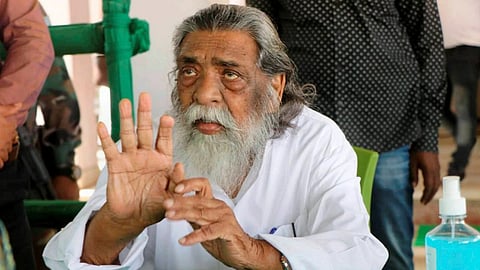

RANCHI: The founder patron of JMM, who dominated Jharkhand politics for over four decades, passed away during treatment at a hospital in New Delhi at the age of 81 on Monday. Though he became Chief Minister of Jharkhand thrice, his early life remained quite challenging and full of struggle.
Born on January 11, 1944, at Nemra village under Gola Block of Ramgarh, Shibu Soren was fondly called Shivlal in his childhood, but he was enrolled in the primary school as Shivcharan Manjhi. After receiving his primary education at the village school, he moved to a state-sponsored high school in Gola block, where he continued his studies while staying in a tribal hostel.
Despite belonging to the tribal community, his father, Sobaran Manjhi, was highly educated and worked as a teacher. Sobaran was involved in various activities for the upliftment of his community and raised his voice against the exploitation by moneylenders.
As Sobaran gradually became a prominent voice among the tribals and continuously opposed the oppression by ‘mahajans’, he was allegedly killed by them on November 27, 1957. This incident became a turning point in the life of Shibu Soren, who was just 13 years old at the time.
Shaken by his father’s murder, Shibu Soren left his studies and began opposing the moneylenders. This was no easy task, as many villagers were deeply indebted. He was disturbed to see tribal lands being seized over unpaid debts, with villagers tricked into giving thumb impressions on blank papers under the influence of alcohol.
These incidents inspired Shibu Soren to launch a movement against the moneylenders. As he raised his voice, more people started joining him. At the same time, he began spreading awareness against the consumption of alcohol and hadia (rice beer).
His social reform movement and resistance to the moneylenders gained traction across Gola and neighbouring areas like Bokaro and Dhanbad. Between 1972 and 1976, the movement gained momentum. He succeeded in reclaiming tribal land taken by moneylenders. His assertive approach won him admiration within the tribal community.
Eventually, Soren became a widely popular figure — at his call, thousands would gather with bows and arrows to harvest crops from seized lands. He also built an ashram at Pokhariya under Tundi block of Dhanbad, known as Shibu Ashram. People began calling him “Guruji” out of love and respect.
However, his political identity took root in Santhal Pargana, where he earned the title “Dishom Guru” — or Guru of the nation. In 1972, Soren and his colleagues decided to form a political party. This led to the formation of the Jharkhand Mukti Morcha (JMM).
Shibu Soren first contested elections in 1977 but faced defeat. Undeterred, he contested again in 1980 and began his political ascent. He went on to serve as Member of Parliament from Dumka Lok Sabha seat seven times.
He played a pivotal role in the campaign for a separate Jharkhand state. Devoting his entire political career to the cause, he led a sustained movement that eventually led to the creation of Jharkhand from Bihar in 2000.
