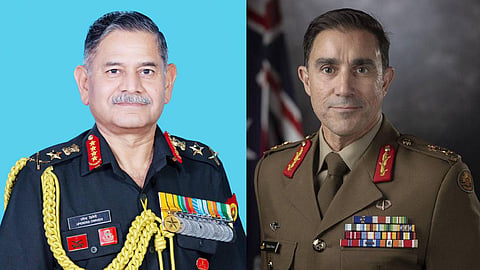

NEW DELHI: Training together forges personal connection and enduring friendship and this is often true in the realm of military. The forthcoming visit of Lieutenant (Lt) General (Gen) Simon Stuart, Chief of Army, Australian Army, from 10 to 14 August 2025, offers a living example of this principle.
Gen Upendra Dwivedi, Chief of the Army Staff, Indian Army, and Lt Gen Stuart trained together at United States Army War College during the year 2015, forging a professional bond that has matured alongside their respective careers.
Sources in the Army said, "This shared academic background not only provides a strong foundation for mutual trust but also enables a deeper strategic understanding, paving the way for more meaningful cooperation between the two armies."
As The New Indian Express earlier reported, Lt Gen Stuart will engage in high-level discussions with General Upendra Dwivedi, Chief of the Army Staff, Indian Army and other senior officials of the Ministry of Defence.
Amidst the continuing efforts to boost the India- Australia military ties Lt Gen Stuart and Gen Dwivedi, from classmates to counterparts, will add up in strengthening defence ties.
In the realm of defence diplomacy, shared training experiences between military leaders often sow the seeds for enduring partnerships that outlast with political cycles and strategic shifts.
"When military commanders train together in their formative or mid-career stages, they develop not just professional competence but also a deep, personal understanding of each other's countries, cultures, and armed forces," sources added.
This "Alumni Connect" becomes a unique instrument of strategic soft power, building trust, facilitating candid dialogue and enabling seamless cooperation in times of both peace and crisis, said the sources.
Pitching in towards training the officer cadets of the friendly foreign countries (FFCs), India's premier military institutions like Indian Military Academy (IMA), National Defence College (NDC), Defence Services Staff College (DSSC), and National Defence Academy (NDA) have, for decades, welcomed officers. Many of these alumni have risen to the highest ranks in their militaries, becoming ambassadors in uniform for India's professional ethos.
The Alumni Roll
Sri Lanka - 8 senior officers, including current and retired Chiefs, trained in India; 9 senior officers from Nepal; 6 senior officers from Bangladesh; 6 senior officers from Malaysia; 2 senior officers from Bhutan; 3 senior officers from Nigeria; and 2 senior officers from Australia.
Notable examples include the Sri Lankan Army Chief, an alumnus of IMA and the School of Artillery, and the Sri Lankan CDS, a graduate of NDC.
Chiefs and senior commanders from Bhutan, Nepal, Bangladesh, Maldives, France, Tanzania, South Korea, New Zealand, Namibia, Kenya, Fiji, and Thailand and others also share this common bond with the Indian Army.
The example of the bond forged during such training manifested during the recent visit of the Commander of the Sri Lankan Army.
Overwhelmed by his homecoming to the Indian Military Academy in June this year, Lt Gen Lasantha Rodrigo, Commander of the Sri Lankan Army said to the passing out Officer Cadets, "Looking at your faces, I see my younger self. This place doesn't just train officers; it forges bonds that last a lifetime."
It was in December 1990 that General Rodrigo was commissioned as part of the 87th IMA Course and rose to command one of the most battle hardened armies in the sub-continent.
While addressing the passing out course the Reviewing Officer said, "I am deeply honoured and moved to the point of tears to stand before you as the first IMA alumnus to return as the Commander of the Sri Lanka Army and review this parade."
This alumni network works both ways. Indian officers, too, have attended prestigious institutions abroad at the Army War College (USA), Royal College of Defence Studies (UK), Ecole de Guerre (France) bringing back global perspectives while building enduring ties with their peers overseas.
A long history of military exchanges
Indian Army officers have themselves been shaped by professional military education abroad-Field Marshals KM Cariappa and SHFJ Manekshaw were alumni of the Imperial Defence College, UK, while
General Upendra Dwivedi attended the Army War College, USA, among the many officers of the Indian Armed Forces. As per the sources, "Such exchanges equip officers with broader strategic perspectives, operational best practices, and a shared vocabulary for addressing global security challenges."
Recognising its diplomatic value, the Indian Army has begun formalising Alumni Connect initiatives maintaining databases, organising reunions, and encouraging continued professional engagement through think tank collaborations such as the Centre for Land Warfare Studies (CLAWS) and its recently renewed five-year MoU with the Australian Army Research Centre (AARC).
Digital platforms like the "Friends for Life" portal are also being explored to sustain ties long after the course photographs have faded.
Terming the alumni connection as an enabling bond with a lasting effect, the sources said that "in today's complex security environment, where partnerships must balance strategic competition with cooperation, Alumni Connect is more than nostalgia, it is a strategic enabler."
Officers who once shared barracks and classrooms now sit across negotiating tables or lead joint operations, carrying with them the trust and mutual respect forged in their training days.
As India aspires to play a greater role in regional and global security architectures from the Indo-Pacific to UN peacekeeping, the quiet and enduring influence of these personal bonds will remain an indispensable tool of military diplomacy.
Lieutenant General Stuart's visit will therefore be more than a series of official calls and ceremonial welcomes; it will be a reunion of two military professionals whose shared past strengthens the foundation of India-Australia defence ties.
"In the language of soldiers, trust built in fatigues lasts a lifetime and in the language of diplomacy, it often lasts even longer," the source said.
