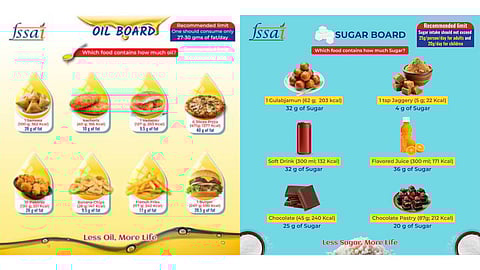

NEW DELHI: Following implementation across CBSE schools, ‘oil and sugar boards’ will be displayed in all government offices, including various ministries, hospitals, railway stations, and even airports, to promote healthy lifestyles and combat non-communicable diseases (NCDS).
These informative posters and digital boards highlight the harmful impacts of the amount og sugar and oil present in popular food items, including samosas, kachori, pizza, pakoras, banana chips, burger, soft drink, and chocolate pastry.
Official sources told TNIE that the Union Health Ministry, which launched the initiative, has asked the Food Safety and Standards Authority of India (FSSAI) and the Indian Council of Medical Research-National Institute of Nutrition (ICMR-NIN), who have prepared these ‘sugar and oil boards,’ to suggest a “model healthy meal’ that can be served in canteens and eateries of these public institutions, instead of the current oily and sugary meals and snacks.
Announcing the launch of the initiative, the FSSAI, the apex food regulator of India, under the health ministry, posted on X on Thursday, “Inspired by Hon'ble PM @narendramodi's vision for a healthier India! @MoHFW INDIA has launched an innovative behavioural change strategy-widespread promotion of Sugar and Oil Boards.”
“These boards are vital in helping everyone make informed choices and #StopObesity #EatRightIndia,” said the post, which also displayed the ‘oil and sugar boards.'
The boards recommend that people consume only 27-30 gms of fat every day and that their sugar intake should not exceed 25g per person per day for adults and 20g for children.
The decision to display the ‘oil and sugar boards’ comes after the Central Board of Secondary Education (CBSE) directed all affiliated schools to establish "sugar boards" in May to educate students about the dangers of excessive sugar consumption. CBSE launched the initiative to combat rising health concerns like childhood obesity and type 2 diabetes, which have been linked to high sugar intake.
Welcoming the move, Dr Arun Gupta, Pediatrician and Convenor of Nutrition Advocacy in Public Interest (NAPi), a national think-tank on nutrition consisting of independent medical experts, paediatricians, and nutritionists, said, “It is heartening to see the centre’s recognition that consumption of foods products high in sugar, salt or fat (HFSS) is a leading factor for obesity and non-communicable diseases.”
However, he said, efforts to put up such boards are good, but to reduce the demand for HFSS foods, the government needs to introduce policy interventions on pre-packaged ultra-processed food products, which are always high in the nutrients of concern and remain hidden.
“These are aggressively and deceptively advertised and mislabeled. Therefore, to achieve a meaningful reduction in the consumption of HFSS, the government should ban its advertisements, put warning labels on HFSS products, and consider health taxes on them,” he told TNIE.
Officials said some ministries, including the health ministry, located in Nirman Bhavan, have started displaying these oil and sugar boards in their canteens and have also started serving healthy food like ‘satu,’ ‘millet,’ ‘corns,’ ‘coconut water,’ ‘green tea,’ instead of sugary milk tea and health shakes.
On Thursday, the All India Institute of Medical Sciences (AIIMS), Rishikesh, also issued an office memorandum on the display of these boards. In its notice, it said that, in compliance with the health ministry letter dated June 21 to all departments, they are directing the prominent display of ‘oil and sugar boards’ within their premises.
“This initiative is part of the National Programme for Prevention and Control of non-Communicable Diseases and aligns with the Hon’ble Prime Minister’s appeal to adopt a healthy lifestyle under the Fit India Movement,” the letter said.
Though the initiative is voluntary, many ministries, departments and institutions are getting ready to display these boards. Officials added that the Chandigarh airport has already exhibited these boards.
On June 7, on the occasion of World Food Safety Week, Union Health Minister J P Nadda announced that ‘oil and sugar boards’, developed by FSSAI, will be widely promoted across schools, workplaces, and public institutions. The boards aim to serve as powerful visual advocacy tools that clearly display clear, relatable information about hidden sugars and fats in everyday food items, he had said.
On June 21, Union Health Secretary Punya Salila Srivastava wrote and proposed to all secretaries, ministries, and departments of the government of India to display ‘sugar and oil boards’ as an initiative to promote healthier dietary habits in various settings.
“These boards serve as visual behavioural nudges in schools, offices, public institutions, etc., displaying key information about hidden fats and sugars in everyday foods.”
She also proposed that they print health messages on all official stationery - letterheads, envelopes, notepads, folders - and publications to reinforce daily reminders on fighting obesity.
Srivastava also suggested to promote healthy meals and physical activity in offices through nutritious, healthier food options (more fruits, vegetables, and low-fat options, and by limiting availability of sugary drinks and high-fat snacks) and active workplace initiatives (such as encouraging use of stairs, organizing short exercise breaks, and facilitating walking routes).
On July 8, ICMR-NIN also posted on its official X handle, “Thanks to Hon’ble @PMOIndia @narendramodi ji's push for healthier workplaces, @MoHFW_INDIA has urged all govt offices to prominently display Sugar Boards. Sharing the Sugar Boards to display in offices. Tag us in your stories/posts.”
As per NFHS-5 (2019-21), over one in five adults in urban areas are overweight or obese.
As per The Lancet Global Burden of Disease 2021 obesity forecasting study, published in 2025, the number of overweight and obese adults in India is projected to rise from 18 crores in 2021 to 44.9 crores by 2050, making it the country with the second-highest global burden.
Obesity significantly raises the risk of NCDs such as diabetes, hypertension, heart disease, and certain cancers.
It also affects mental health, mobility, and quality of life, and imposes a heavy economic burden through increased healthcare costs and productivity losses.
Referring to the Lancet report, Prime Minister Modi has urged people to reduce at least 10 percent of the oil in their food and to do regular physical exercise.
