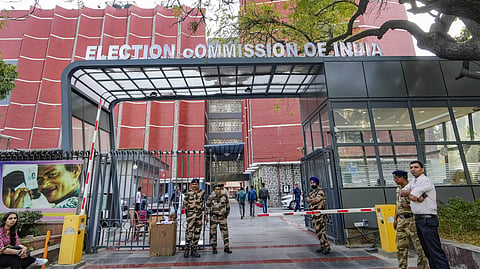

NEW DELHI: The Election Commission of India (ECI) on Sunday announced that it has successfully completed the first phase of the Special Intensive Revision (SIR) of electoral rolls in Bihar, which involved the collection of enumeration forms.
The announcement comes a day before the Supreme Court is set to hear a batch of petitions challenging the ECI’s decision to carry out the revision exercise.
The enumeration, which took place from June 24 to July 25, 2025, saw participation from over 7.24 crore electors out of a total of 7.89 crore.
According to the ECI, the process marks one of the most extensive voter verification campaigns in the state’s history, with a significant focus on inclusivity and transparency ahead of the high-stakes Bihar Assembly elections.
In an official statement, the ECI revealed that 65 lakh voters will be excluded from the upcoming draft electoral rolls to be published on August 1. These exclusions include 22 lakh deceased voters, 36 lakh who have either permanently relocated or were not traceable, and 7 lakh who were registered at multiple places.
The revision drive aimed to ensure that “no elector is left behind” through targeted outreach to first-time voters, urban residents, migrants, senior citizens, and persons with disabilities (PwDs), the poll panel said.
“The initiative also witnessed a strong political response, with all 12 major parties participating. Notably, the number of Booth Level Agents (BLAs) surged by over 16 percent, with CPI(M) and Congress registering more than a 100 percent increase in BLA nominations. CPI(M) reported a dramatic 1083 rise, while the BJP led in absolute numbers with over 53,000 BLAs, followed by RJD and JD(U),” it said.
Noting that digital engagement was one of the key features of the campaign, the poll panel said, “Nearly 29 lakh voters submitted forms via the ECI’s website and mobile app. Over 5.7 crore SMS alerts were sent to voters, with the total reaching 10.2 crore throughout the campaign.”
The ECI will now launch a special enrolment campaign from August 1 to September 1, focusing on youth turning 18 by October 1, it said, adding that officials and volunteers will assist senior citizens and PwDs with documentation.
The draft rolls, available both online and offline on August 1, will be open for claims and objections for one month. Any deletions will require a formal speaking order, and appeals may be filed under Section 24 of the Representation of the People Act, 1950.
The extensive campaign is being lauded as a benchmark for electoral transparency and inclusion, it noted.
Following the completion of Phase 1 of the Special Intensive Revision in Bihar, the Election Commission on Sunday criticised what it called “false narratives” suggesting that the draft electoral roll to be published on August 1 would be the final list.
The Commission said it was “not able to understand” why such claims were being made when “a full one-month period from August 1 till September 1 is available to point out wrongful inclusion or wrongful exclusion of any name.”
“Why not ask their 1.6 lakh booth-level agents to submit claims and objections from August 1 till September 1?” the EC remarked, in a pointed reference to political parties raising concerns. Booth-level agents, appointed by parties, assist booth-level officers during the revision process.
“Why are some persons trying to give an impression that the draft list is the final list, which it is not, as per special intensive revision orders?” the Commission stated.
Opposition parties in Bihar, including the Congress, RJD, CPI(M), and CPI(ML) Liberation, have alleged that the ongoing revision may disenfranchise eligible voters due to lack of documents and could unfairly target those opposed to the ruling alliance. At a joint press conference, Congress leader Abhishek Manu Singhvi said the exercise had turned into a “citizenship test” and urged the Commission to reconsider. “This is not a matter of political obstinacy. It is not a matter of institutional arrogance,” he said.
The BJP rejected the opposition's claims, alleging that they were attempting to “rob” Indian democracy by defending “foreign infiltrators.” Party spokesperson Sudhanshu Trivedi said the SIR process aimed to bring about necessary changes in the voter rolls through a transparent mechanism and claimed that opposition parties have historically benefitted in areas where demographic changes were driven by such infiltration.
(With inputs from PTI)
