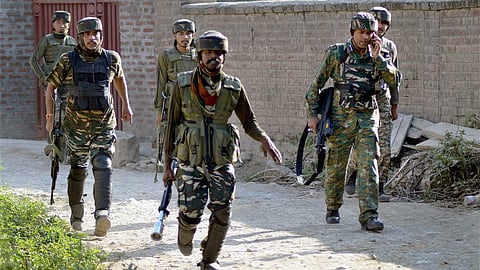

Pakistani troops have once again violated the ceasefire along the Line of Control (LoC) in Jammu and Kashmir, continuing a series of unprovoked attacks across multiple sectors. This marks the 12th consecutive night of such provocations, heightening the already volatile situation between the two nations.
The latest round of shelling by Pakistani forces, which began late last night, has prompted a swift and calibrated response from the Indian Army.
The exchange of fire is a direct result of escalating tensions between India and Pakistan after the deadly terror attack in Pahalgam on April 22 that claimed 26 lives.
The firing exchanges are taking places in five districts out of seven border districts of Jammu and Kashmir. So far, there has been no firing reports along International Border in Samba and Kathua districts.
The latest round of cross-border firing further undermines the ceasefire agreement reached in February 2021, which is now largely seen as ineffective due to Pakistan's frequent violations across the 740-km-long LoC.
Since the night of April 24, hours after India suspended the Indus Waters Treaty in response to the Pahalgam terror attack, Pakistani troops have repeatedly targeted Indian positions along the LoC, beginning in the Kashmir Valley and quickly expanding to the Jammu region.
Pakistan has taken retaliatory steps, including blocking its airspace for Indian carriers, shutting down the Wagah border crossing, and halting bilateral trade.
Islamabad has also issued stark warnings, declaring that any diversion of water from the Indus River would be considered an “Act of War.”
The India-Pakistan border stretches over 3,300 kilometers, divided into three segments: the International Border (IB), spanning about 2,400 km from Gujarat to Akhnoor in Jammu; the 740-km-long Line of Control (LoC) that divides Jammu and Kashmir; and the 110-km-long Actual Ground Position Line (AGPL), which separates the Siachen Glacier region.
