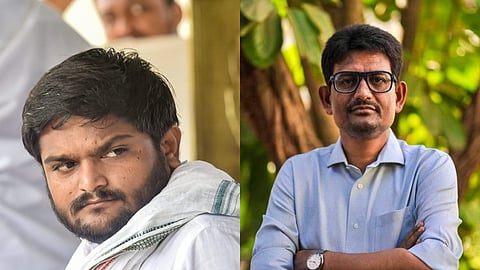

AHMEDABAD: The Gujarat cabinet expansion under Chief Minister Bhupendra Patel has left several ambitious turncoat leaders out in the cold. Hardik Patel and Alpesh Thakor, once fiery faces of agitations that shook the BJP, now find themselves sidelined within the very party they joined to climb higher. With other Congress defectors also excluded, the BJP has sent a clear political message: the path to power runs through party loyalty, not past glory.
The Bhupendra Patel 3.0 cabinet expansion has landed like a political thunderbolt for several former Congress leaders who crossed over to the BJP, hoping for a ministerial berth. In one calculated move, the BJP has curtailed the ambitions of prominent turncoats, signalling who really holds the reins of power within Gujarat’s ruling party.
The two names drawing the most attention are Hardik Patel and Alpesh Thakor. Hardik, once the fiery face of the Patidar agitation, rattled the BJP, and Alpesh, who rose from the OBC movement with a loyal grassroots base, entered the BJP hoping to leverage their political capital. However, when the cabinet list was announced, both were left out, fueling speculation about their future relevance.
Their exclusion was part of a broader pattern. Raghavji Patel and Balwantsinh Rajput, two former Congressmen who had previously held ministerial positions, were also dropped. For the BJP, it was a clean pruning of past imports to make way for loyalists and fresh faces.
Hardik Patel’s political journey has been especially symbolic. Once a force that challenged the BJP from outside, he joined the party after leading the Patidar reservation movement. After joining Congress and then the BJP, he positioned himself as a rising power in his Viramgam constituency through high-profile social media campaigns and fiery statements. However, the BJP’s leadership viewed it differently. By keeping him out, the party sent a quiet but firm reminder that agitation leadership does not guarantee cabinet power.
Alpesh Thakor’s setback is equally revealing. Once supported by OBC, SC, and ST communities during the reservation movement, he established himself as a community leader before joining Congress. He later resigned and joined the BJP, reportedly aiming for the Deputy Chief Minister post.
However, when the cabinet list was finalised, Vav MLA Swaroopji Thakor was included. The message was unmistakable: leading mass movements does not guarantee a ministerial position within the BJP.
C.J. Chavda’s story completes the pattern. Once part of Congress’s “JCB trio” alongside Jagdish Thakor and Baldevji Thakor, he left a secure Congress position to join the BJP, hoping for a cabinet berth after his Vijapur victory. But his name was cut in favour of Sanjay Singh Mahida, selected under the Kshatriya community quota. Chavda’s ministerial ambitions have been left on hold indefinitely.
The reshuffle has faced strong criticism from Congress, with leaders arguing that Hardik and Alpesh, who once mobilised thousands against the BJP, betrayed their communities by switching sides only to be sidelined. Within the BJP, however, the move is viewed as a strategic assertion of power discipline, emphasising that loyalty to the party outweighs past accomplishments.
In Gujarat’s political landscape, agitators who once roared against the establishment now stand outside the gates of power, waiting, watching, and learning the hard rules of the BJP’s game.
