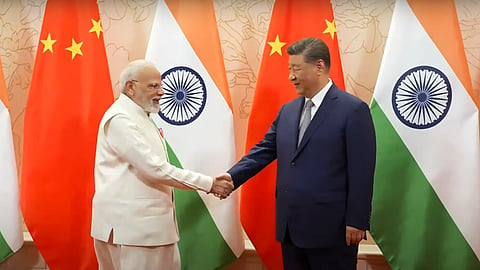

NEW DELHI: Aiming for long-term stability in India-China relations amid disrupted global trade and shifting geopolitical alignments triggered by US tariffs, Prime Minister Narendra Modi on Sunday noted with President Xi Jinping that the two countries must pursue strategic autonomy and their ties should not be viewed through the lens of a third country.
“Our cooperation impacts 2.8 billion people and holds global significance,” Modi said, underlining that relations must be grounded in “mutual trust, respect, and sensitivity.”
“Prime Minister noted that India and China both pursue strategic autonomy, and their relations should not be seen through a third country lens. The two leaders deemed it necessary to expand common ground on bilateral, regional, and global issues and challenges, like terrorism and fair trade in multilateral platforms,” the External Affairs Ministry said.
Modi pointed to a “positive direction” in ties since their October 2024 meeting, which led to a new border management agreement. “We are committed to advancing our relationship with mutual trust, respect, and sensitivity at its core.”
The meeting, held on the sidelines of the Shanghai Cooperation Organisation (SCO) Summit in Tianjin, came days after the United States imposed 50% tariffs on key Indian goods, citing New Delhi’s energy trade with Russia. The bilateral talks signalled both countries’ intent to recalibrate ties on their own terms — without being influenced by Western economic pressure.
President Xi Jinping echoed this sentiment in his opening remarks: “The dragon and the elephant must come together. The world is undergoing transformation. It is vital for China and India to be friends, good neighbours, and work together as part of the Global South.”
On trade and investment, both leaders recognised their economies’ potential to anchor global trade stability amid rising protectionism and supply chain disruptions. They agreed to expand trade and investment, reduce India’s trade deficit, and enhance transparency and predictability in cross-border commerce.
Modi also reiterated that India and China are “partners, not rivals”, and that their differences should not become disputes. He emphasised the importance of border peace, referencing successful disengagement and the recent consensus between Special Representatives to resolve the boundary issue “fairly and reasonably”.
A key outcome of the talks was an agreement to strengthen people-to-people ties, including the expansion of direct flights and visa facilitation, building on the resumption of the Kailash Manasarovar Yatra.
Modi also invited Xi to attend the 2026 BRICS Summit in India, which Xi welcomed, offering Beijing’s support for India’s BRICS presidency.
Later, in a separate meeting with Politburo Standing Committee member Cai Qi, Modi shared his vision for bilateral ties. Cai reaffirmed China’s commitment to expanding exchanges in line with the consensus reached by the two leaders. Cai, an important leader in the Chinese Communist Party, was to host a dinner in honour of the Prime Minister on behalf of President Xi as a special gesture, but due to the paucity of time they met for a discussion.
Modi, Putin bilateral meet today
Prime Minister Narendra Modi will hold bilateral talks with Russian President Vladmir Putin on Monday on the sidelines of the SCO summit. The prime minister will also address the summit on Monday
