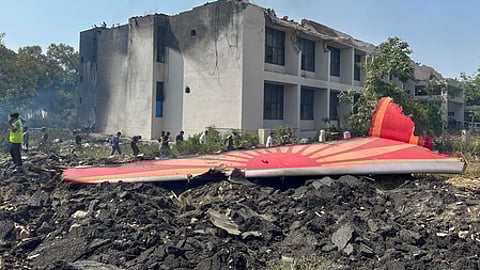

NEW DELHI: The Supreme Court on Wednesday directed the Centre and the Directorate General of Civil Aviation (DGCA) to submit a detailed status report within three weeks on the investigation into the June 12, 2025 Ahmedabad plane crash.
The direction came while hearing a plea filed by Pushkaraj Sabharwal, the 88-year-old father of the late Captain Sumeet Sabharwal, who was the pilot-in-command of the ill-fated Air India flight, along with the Safety Matters Foundation and the Federation of Indian Pilots (FIP). The petitioners have sought the constitution of a panel for a judicially monitored probe into the accident.
The bench, headed by Chief Justice of India (CJI) Surya Kant, asked the Union of India to apprise it of the progress made in the investigation so far. “What is the procedural protocol followed? Please inform us within three weeks,” the CJI told Solicitor General Tushar Mehta.
Appearing for the Centre and the DGCA, Mehta submitted that the inquiry was in its final stages and that the report would be prepared soon.
The CJI-led bench observed that the tragedy was deeply unfortunate. “Let us all be very careful while making any kind of remark against any particular brand of aircraft. Yes, Dreamliners were once considered among the best,” Justice Surya Kant remarked.
Explaining the delay in completing the probe, Mehta told the court that certain aircraft components had to be sent abroad for testing. “Procedures adopted in foreign jurisdictions are also being studied. Those who lost their lives were of various nationalities, and that aspect is also being considered,” he said.
Counsel for Pushkaraj Sabharwal requested that if the report is filed before the court, it be submitted in a sealed cover, citing concerns that the deceased pilot’s family had already faced undue vilification.
In an earlier hearing, the apex court had observed that the pilot should not be blamed for the crash. “It is extremely unfortunate that this crash took place, but you (Pushkaraj) should not carry this burden that your son is being blamed. Nobody can blame him for anything. No one in India believes it is the pilot’s fault,” the court had said, noting that the preliminary report made no insinuations against the pilot.
Pushkaraj has alleged that the investigation being conducted by the Aircraft Accident Investigation Bureau (AAIB) lacks independence.
“This is not an independent investigation. It should have been independent. It has taken four months,” his counsel submitted, urging the court to order a judicially monitored probe under Rule 12 of the Aircraft (Investigation of Accidents and Incidents) Rules, which mandates impartiality in accident investigations.
A 267-page writ petition was filed in the Supreme Court on October 10 last year against the Union of India, the DGCA and the Director General of the AAIB. Pushkaraj Sabharwal, a Mumbai resident, is the first petitioner, and the FIP is the second. They have requested that a committee headed by a retired Supreme Court judge, along with independent aviation experts, be constituted to ensure a fair, transparent and technically sound investigation.
The Boeing 787-8 crash on June 12 claimed 260 lives. The preliminary report released by the AAIB on July 12 drew sharp criticism from pilot bodies and victims’ families, as it attributed the accident to ‘human error’ by the cockpit crew.
The petitioners have termed the AAIB report “profoundly flawed”, alleging that it disproportionately focused on the deceased pilots, who are no longer able to defend themselves, while failing to adequately examine technical and procedural causes.
“Selective disclosure against the crew impedes root cause discovery and threatens future flight safety, calling for a neutral judicial lens,” the petition stated.
The plea further alleged critical inconsistencies in the report, particularly regarding the deployment of the emergency generator, the Ram Air Turbine (RAT), prior to the crash. According to the petitioners, RAT deployment indicates a potential electrical or digital malfunction, contradicting the report’s inference that pilot actions initiated the power loss.
They contended that the investigation failed to provide time-stamped correlation between RAT deployment and crew inputs, and did not adequately examine the possibility of faults in the Common Core System (CCS), which integrates avionics, flight controls, power distribution and software.
The petition also questioned the report’s claim that both fuel control switches moved from ‘RUN’ to ‘CUTOFF’ within one second and reverted shortly thereafter. “Such near-synchronised manual actuation is implausible under take-off conditions, especially if the RAT had already deployed before any crew action. This strongly suggests an automatic or corrupted digital command, not human intervention,” it stated.
Attributing the incident to deliberate pilot error without first ruling out electronic malfunction is procedurally unjust and logically unsound, the petitioners argued, adding that it reverses causation by blaming the pilots for what may have been a symptom of systemic failure rather than its trigger.
