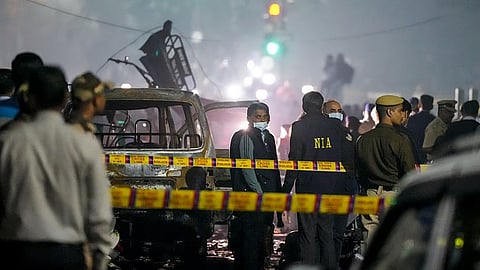

NEW DELHI: A United Nations counter-terrorism monitoring team has identified the Pakistan-based militant group Jaish-e-Mohammed (JeM) in a recent report, linking it to the deadly blast at Delhi’s historic Red Fort in November 2025 and the April 2025 terror attack in Pahalgam. The report also raises fresh concerns over the group’s evolving survival strategies, including the creation of an unlisted women-only wing to support its operations.
In its latest submission to the UN Security Council, the Analytical Support and Sanctions Monitoring Team said that one Member State reported JeM had claimed responsibility for a series of attacks and was connected to the 9 November 2025 explosion at the Red Fort, which killed 15 people. The report also referred to the 22 April 2025 attack in Pahalgam that left more than two dozen people dead.
The Red Fort, a UNESCO World Heritage Site and symbol of Indian sovereignty, has long been regarded as a high-value target, making the alleged link particularly significant for regional security.
The monitoring team further noted that on 8 October, JeM leader Masood Azhar formally announced the establishment of a women-only wing named Jamaat ul-Muminat, which is not currently designated as a terrorist organisation. According to the report, the unit is explicitly intended to support terrorist activities, signalling a shift in the group’s recruitment and operational strategy.
UN analysts observed that the move reflects a broader trend among extremist organisations seeking to widen their support base, strengthen logistical networks and evade security scrutiny by involving women in auxiliary and operational roles.
JeM, designated by the UN as an entity associated with Al-Qaeda, has a long record of attacks primarily targeting India, particularly in Jammu and Kashmir. Founded in 2000, the group has been blamed for several high-profile assaults on security forces and civilians. Its leader, Masood Azhar, has been under UN sanctions for years, including asset freezes and travel bans.
However, the monitoring team also highlighted differing assessments among Member States regarding JeM’s current operational status. While some governments continue to regard the group as active and dangerous, another Member State reportedly described it as defunct. Such divergent views underscore ongoing gaps in intelligence assessments and enforcement, complicating counter-terrorism cooperation in South Asia.
The report situates these developments within a broader and evolving terrorist threat landscape across Central and South Asia, where extremist groups continue to exploit regional instability, permissive environments and cross-border networks.
Despite sustained counter-terrorism efforts, the Monitoring Team warned that groups such as JeM remain adaptable, whether through new recruitment models or high-impact symbolic attacks.
Separately, the report noted that three individuals allegedly linked to JeM were involved in another attack in Pahalgam, Jammu and Kashmir. They were killed in July, reflecting continued security operations targeting militant networks in the region.
Overall, the UN report underscores persistent concerns that even when terrorist groups are weakened or fragmented, their capacity to rebrand, reorganise and carry out high-profile attacks continues to pose a serious threat to regional and international security.
