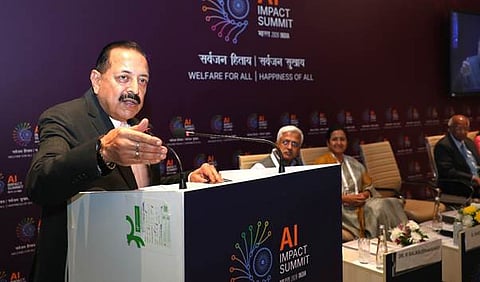

NEW DELHI: Dr Jitendra Singh, Union Minister of State (Independent Charge) for Science & Technology, on Friday said that Artificial Intelligence (AI) can never replace integrity, even as it transforms systems across sectors. Addressing the “AI Impact Summit 2026 India”, he said, "Artificial Intelligence (AI) can substitute everything on this planet, but it cannot substitute integrity".
He emphasised that while AI has the potential to transform systems, improve efficiency and widen access, it cannot replace human integrity. Calling for inclusive and ethical use of technology, he invoked the mantra “MANAV”, cited by Narendra Modi in his address on Thursday, to underline the importance of a human-centric approach in the deployment of AI.
He added in his speech that nearly 2,000 obsolete rules have been scrapped over the past decade as India moves towards technology-led governance, adding that capacity building remains crucial for creating a future-ready, AI-driven nation.
In his keynote address, Dr Singh said that in a time of rapid technological transition, institutions must continually upgrade themselves to remain relevant. "Artificial Intelligence, has become an inescapable reality across domains and must be meaningfully integrated into public systems", he said.
He described the most encouraging feature of India’s transformation as the presence of political leadership willing to embrace forward-looking and future-ready ideas. Recalling that discussions around AI-driven governance would have been unimaginable in official discourse a decade and a half ago, he credited Prime Minister Modi’s reform-oriented approach with fostering an environment where innovation and governance reforms progress together.
Dr Singh also highlighted the government’s decade-long effort to eliminate nearly 2,000 outdated regulations. "Many of these regulations, were designed for a different era and could not have anticipated today’s technological advancements. The simplification of procedures, including eliminating unnecessary attestations and redundant practices, reflects a shift towards trust-based governance", he asserted.
He stressed that in a rapidly evolving ecosystem, public servants must not only adopt new practices but also develop the capacity to continue learning. "The idea of blending best practices from both public and private sectors has strengthened governance reforms and helped build more agile systems", he claimed.
Referring to Digital Public Goods, Dr Singh remarked that although the terminology may be recent, its essence lies in advancing public good and citizen-centric governance. "From the very beginning, the government has pursued the vision of “maximum governance, minimum government,” focusing on transparency, accountability, and ease of living. Technology is an enabler, not the end", he said.
Drawing on practical experience, he cited the evolution of the CPGRAMS grievance redressal system. "While disposal rates had touched impressive levels through digital processing, citizen satisfaction did not always match the numbers. This led to the introduction of a human interface alongside AI-driven mechanisms. The experience demonstrated that the most effective model is a hybrid one, combining Artificial Intelligence with Human Intelligence", he added.
On India’s growing international recognition in AI, including appreciation from global institutions, Dr Singh said that while international benchmarks are important, solutions must be tailored to Indian conditions. He underlined that inclusive scaling and broader adoption are essential for the success of digital capacity-building initiatives.
He further remarked that genuine capacity building involves more than memorising acronyms; it requires internalising their meaning and translating them into action.
Citing the health sector as another example, Dr Singh noted that AI-assisted telemedicine services operate alongside physical doctors. While AI enhances efficiency and extends reach, the presence of a human doctor provides reassurance and builds trust among patients. Such hybrid models, he said, are particularly well suited to India’s diverse social and linguistic landscape, where technology must adapt to local realities.
The Minister also elaborated on the governance “MODEL” framework articulated by Prime Minister Modi, encompassing Moral and Ethical Systems; Accountable Governance; National Solvency; Accessible and Inclusive Systems; and Legitimacy and Validity.
Reiterating the significance of regulatory reform, he again referred to the scrapping of nearly 2,000 outdated rules over the past decade. Many of these, he observed, were framed for a different era and could not have foreseen current technological advancements. "The removal of unnecessary attestations and redundant procedures signals a transition towards trust-based governance", he said.
He added that the Capacity Building Commission(CBC) has been established to ensure that learning becomes a continuous institutional practice. In a fast-changing environment, he said, public servants must continually update their skills while cultivating the ability to keep learning. "The blending of best practices from the public and private sectors,has reinforced governance reforms and enabled the development of more agile administrative systems",he said.
