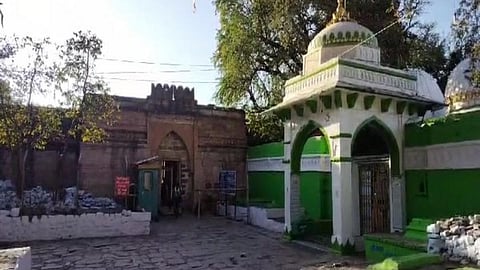

BHOPAL: Basant Panchami prayers by Hindus and Friday namaz by Muslims passed off peacefully on Friday at the disputed Bhojshala Temple–Kamal Maula Mosque complex in Dhar town of western Madhya Pradesh, following a Supreme Court order that allowed both communities to pray at separate locations within the ASI protected monument.
The rare and highly sensitive coincidence of Basant Panchami falling on a Friday was marked by massive security arrangements across the communally sensitive town.
Thousands of Hindu devotees took part in large processions and offered prayers from sunrise to sunset at the disputed complex, which Hindus claim is an 11th century temple dedicated to Goddess Vagdevi (Saraswati), built by Paramara dynasty ruler Raja Bhoja.
According to an official statement issued by the Dhar district administration, in line with the January 22 Supreme Court order, “On the occasion of Basant Panchami, the Hindu community's prayers went off peacefully at the designated location within the premises. Also, in compliance with the directives received from the Supreme Court, the Muslim community offered their prayers (Namaz) peacefully at their designated location between 1 pm and 3 pm.”
In the state capital Bhopal, Madhya Pradesh Chief Minister Dr Mohan Yadav praised the local administration for complying with the apex court’s directions.
“The authorities in Dhar ensured peaceful and uninterrupted Basant Panchami prayers and simultaneous namaz at separate spots in the same premises,” he said.
A senior state police officer camping in Dhar confirmed that 15 to 17 Muslim men were escorted in a protected anti riot vehicle to the ASI protected monument, where they performed Friday namaz exclusively and uninterruptedly between the stipulated 1 pm and 3 pm at the designated spot.
However, a group of 15 to 20 Muslim men, led by one Imran Khan, who claimed to be a resident of Gulmohar Colony in Dhar, alleged in a video that the authorities had arranged a “dummy namaz” by bringing in people from outside.
“On Thursday night, officers of the local administration and police came to us and escorted us away to a place close to the mosque complex with the promise of taking us securely to the mosque for offering namaz between 1 pm and 3 pm in accordance with the top court’s order."
"We were kept under police security, but the authorities and police didn’t keep their promise by taking us into the concerned premises for the Friday namaz. As the stipulated two hour period approached its end, the administration police representatives told us that we were free to return home and perform namaz. The administration is claiming that they ensured peaceful namaz within the premises, but that was a dummy namaz carried out by men brought from outside Dhar,” Khan alleged in the video.
When questioned by journalists about the allegations, Dhar District Collector Priyank Mishra said, “I don’t want to comment on such allegations. 15 to 17 Muslim men offered symbolic namaz at the separate and exclusive place designated for them with the consent of the community inside the complex between 1 pm and 3 pm, in compliance with the SC’s Thursday order.”
Two senior Hindu outfit leaders, Gopal Sharma and Ashok Jain, who have been crusading for the Bhojshala temple cause for decades, thanked the administration and the state government for ensuring akhand uninterrupted prayers on Basant Panchami from sunrise to sunset as per the Supreme Court order.
On Thursday, while hearing an application filed by the Hindu Front for Justice, seeking exclusive uninterrupted rights for Hindus to offer Basant Panchami prayers on January 23 at the disputed complex, the Supreme Court allowed Hindus to offer prayers from sunrise to sunset at a separate space within the premises.
The court also permitted Muslims to offer namaz at an exclusive and separate space in the same complex between 1 pm and 3 pm.
The apex court further directed that separate entry and exit points be put in place for both communities at the ASI protected monument. Following this, multiple entry and exit routes were created for thousands of Hindu devotees, along with a separate passage for a limited group of Muslims to offer Friday namaz.
It was after a gap of ten years that Basant Panchami and Friday namaz coincided. A similar coincidence had occurred earlier in 2013, when violent clashes broke out between saffron outfit activists and the police, and again in 2016.
In 2013 and 2016, the ASI had issued orders permitting Hindus to offer prayers on Basant Panchami from sunrise to sunset, except between 12 noon and 3.30 pm, while allowing Muslims to offer namaz at the disputed complex between 1 pm and 3 pm.
With the ASI not issuing any such order this time, the Supreme Court’s directive was implemented by the authorities on Friday.
While Hindus claim the complex to be the 11th century Bhojshala temple cum Sanskrit university dedicated to Goddess Saraswati and built by Raja Bhoja, Muslims maintain that the structure is the Kamal Maula Mosque.
