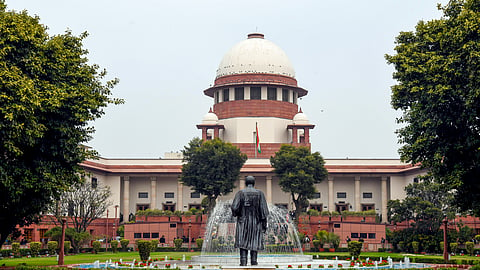

NEW DELHI: The Supreme Court's stay on the recent UGC equity regulations on preventing caste-based discrimination on campuses was largely welcomed by opposition parties on Thursday, with leaders from the BSP, Congress and TMC welcoming it, while the CPI(ML) Liberation said it is "deeply appalled" by the observations.
In a post on X, Bahujan Samaj Party (BSP) chief Mayawati said the apex court's order is appropriate in view of the current situation, as the regulations had led to an atmosphere of social tension.
Protests were held in different parts of the country against the regulations.
"The University Grants Commission has implemented new rules to prevent caste-based incidents in government and private universities across the country, which has led to an atmosphere of social tension. In view of the current situation, today's decision of the Honourable Supreme Court to stay the UGC's new rules is appropriate," Mayawati said in a post on X.
She asserted that this would not have happened had the UGC taken all stakeholders into confidence.
"However, such an atmosphere of social tension would not have arisen in the country, if the UGC had taken all stakeholders into confidence before implementing the new rules and had also provided proper representation to the upper-caste community in investigation committees, in accordance with the principles of natural justice," the former Uttar Pradesh chief minister said in her post in Hindi.
Congress leader Pramod Tiwari welcomed the top court's decision and accused the ruling Bharatiya Janata Party (BJP) of creating conflicts to divert attention from real issues.
"The BJP government creates conflicts in the name of religion, caste and category to divert people's attention from real issues. I welcome the Supreme Court's decision to stay the new UGC regulations," Tiwari told reporters here.
Another Congress leader, Ranjit Ranjan, suggested that the regulations should be sent to a parliamentary panel for scrutiny.
"The government should take it to the standing committee...It is the government's failure that it could not define it properly. The government should not bring a law that creates differences among students. The protests happened because the government could not take students into confidence," she told PTI Videos.
Trinamool Congress (TMC) leader Kalyan Banerjee also welcomed the apex court's decision.
"The Supreme Court has done the right thing, the UGC guidelines were unconstitutional," he told reporters.
The CPI(ML) Liberation, however, said the apex court's observations reflected a "myopic attitude" and also referred to its observations on another public interest litigation (PIL) matter on the rights of domestic workers.
"We are deeply appalled by the observations made by the Supreme Court on January 29 in the PIL against the UGC Equity Rules, 2026...," the Left party said in a statement.
"Caste and racial discrimination are not abstract concepts or historical relics. They are brutal, everyday realities in our educational institutions and across society. Can the rhetoric of a 'casteless society' deliver justice for the institutional murder of Rohith Vemula or Dr Payal Tadvi or the racist killing of Angel Chakma?" it asked.
The party pointed out that data compiled by the UGC itself shows that complaints of caste-based discrimination in universities and colleges increased by 118 per cent between 2019 and 2024.
"Historically, every legislation against oppression and injustice has led to reactionary and frenzied responses from dominant groups. In these instances, dominant groups reframed equality measures as personal victimisation to preserve social privilege and institutional impunity," it said.
In a significant development, the Supreme Court on Thursday stayed the recent UGC equity regulations on preventing caste-based discrimination on campuses, saying the framework is "prima-facie vague", can have "very sweeping consequences" and may end up dividing the society with a "dangerous impact."
The court also sought responses by March 19 from the Centre and the UGC on three pleas against the University Grants Commission (Promotion of Equity in Higher Education Institutions) Regulations, 2026, on the grounds that caste-based discrimination has strictly been defined as discrimination against members of the Scheduled Caste (SC), Scheduled Tribe (ST) and Other Backward Classes (OBC) communities.
