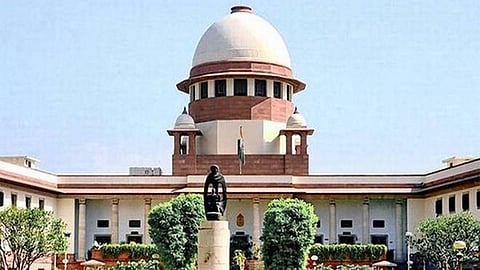

NEW DELHI: The Supreme Court on Thursday stayed the University Grants Commission (Promotion of Equity in Higher Education Institutions) Regulations, notified on January 23, 2026, till March 19, after hearing a batch of pleas challenging the Commission’s controversial order.
The new Promotion of Equity in Higher Education Regulations, 2026 has refined measures to tackle caste-based discrimination in campuses by restricting grievance mechanisms for SC, ST and OBC categories.
“The 2026 UGC regulations on what amounts to caste-based discrimination shall be kept in abeyance. The 2012 Regulations will continue. The provisions are prima facie vague and capable of misuse,” the top court said while staying the notification.
A two-judge Bench headed by Chief Justice Surya Kant and Justice Joymalya Bagchi passed the order, noting that the court was prepared to examine the constitutionality of the new regulations.
The apex court orally observed that if does not intervene in the matter, it "will lead to a dangerous impact" and "divide the society."
In strong remarks during the hearing, the Chief Justice questioned Solicitor General Tushar Mehta, asking whether the country was becoming regressive. “Whatever we have gained in terms of achieving a casteless society, are we now going backwards?” the court observed.
Referring to provisions in the new regulations that contemplate separate hostels for different castes, the court said, “For God’s sake, don’t do this. We all used to stay together. There are inter-caste marriages also.”
The apex court also issued notices to the Union government, the UGC and other respondents, directing them to file their detailed responses by March 19, 2026.
The Bench said it did not wish to pass a final order immediately and suggested the formation of a committee comprising eminent jurists who understand social values and societal challenges.
“How should society grow? How will people behave outside campus if we create this? These issues require careful thought,” the court noted.
The petitions before the court allege that the UGC has adopted a non-inclusive definition of caste-based discrimination and excluded certain categories from institutional protection.
Several pleas challenge the regulations for excluding ‘general category’ students from the grievance redressal mechanism.
One petition, filed by Vineet Jindal, sought an appropriate writ or direction restraining the Union of India and the UGC from enforcing Regulation 3(c) of the 2026 Regulations in its present exclusionary form, as it denies grievance redressal and institutional protection to persons belonging to non-SC/ST/OBC categories.
Jindal further sought directions to ensure that Equal Opportunity Centres, equity helplines, inquiry mechanisms and ombudsperson proceedings under the 2026 Regulations are made available in a non-discriminatory and caste-neutral manner, pending appropriate amendment or reconsideration of Regulation 3(c).
The UGC had notified the regulations on January 13, 2026, superseding the Promotion of Equity in Higher Education Institutions Regulations, 2012. While the stated objective of the new regulations is to foster equity, inclusion and a discrimination-free academic environment, the petitioners argue that the framework is constitutionally flawed.
Jindal contended that denial of access to grievance redressal mechanisms based on caste identity amounts to impermissible State discrimination and violates fundamental rights guaranteed under Articles 14, 15(1) and 21 of the Constitution of India.
A similar petition was filed on January 24 seeking a declaration that Regulation 3(c) of the 2026 Regulations is unconstitutional, discriminatory, arbitrary and violative of Articles 14, 15(1), 19(1)(a) and 21.
Another plea filed by Mrityunjay Tiwari, through advocate Neeraj Singh and AOR Satyam Pandey, sought directions to ensure that Equal Opportunity Centres, equity helplines, inquiry mechanisms and ombudsperson proceedings are made available in a non-discriminatory and caste-neutral manner, pending amendment or reconsideration of Regulation 3(c).
Tiwari also sought directions to read down and suitably amend Regulation 3(c) to define “caste-based discrimination” in a caste-neutral, inclusive and constitutionally compliant manner, extending protection to all persons subjected to caste-based discrimination, irrespective of caste identity.
The plea further sought a declaration that denial of grievance redressal mechanisms on the basis of caste identity violates Articles 14, 15(1) and 21 of the Constitution.
