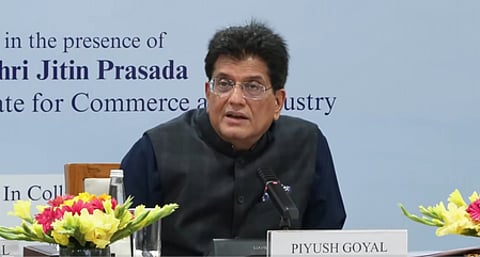

NEW DELHI: The government will use all policy tools and support measures to help domestic exporters deal with the ongoing West Asia crisis, Commerce and Industry Minister Piyush Goyal said on Friday.
He said that the government has set up an inter-ministerial group to look into the issues on a daily basis.
"And the government will use every policy tool and the export promotion mission to support our exporters...We will be formalising some ways to give comfort to our exporters," Goyal told reporters here on the sidelines of IIFT's vice chancellors' conclave.
He was responding to the demands of exporters seeking government intervention to help them tide over the problems following the disruptions in the movements of goods on account of the ongoing war between the US and Israel with Iran.
Exporters are facing issues with regard to the movement of consignments to West Asia as certain shipping lines are demanding high war-risk surcharges of up to USD 4,000 per 40 ft container, and some ships are stranded in international waters.
These developments have significantly pushed freight rates and insurance premiums.
West Asia is a key trading partner of India. In 2025, India imported USD 98.7 billion worth of goods from West Asia, making the region a crucial supplier for energy, fertilisers and industrial raw materials. Exports to the West Asian economies stood at USD 58.8 billion in 2024-25.
The commerce ministry, Goyal said, is in dialogue with the ministry of shipping and with shipping companies on the issues of exporters. "And I do hope we will find a resolution to this issue also," he said.
When asked about the issue of rising freight costs, he said the ministry is working with them to see how the burden on exporters can be mitigated.
"Every day the inter-ministerial group talks to the exporters...They take feedback, and we will not be found wanting in supporting our exporters in any way," he said.
He added that India would continue to meet all the commitments that the country's industries have made to foreign buyers in goods and services.
"But I can assure you, this government stands with our industry and will continue to ensure that all our international commitments are met. Because that is what defines India," he said, adding that even during Covid, India met all its international commitments, "which earned us the acronym of a trusted partner".
Exporters are seeking higher RoDTEP (Remission of Duties and Taxes on Exported Products (RoDTEP) rates, urging the Export Credit Guarantee Corporation of India (ECGC) not to raise insurance premiums, ad hoc working-capital limits and credit extensions similar to measures provided during the COVID-19 pandemic.
Exporters are facing shortage of containers, suspension or cancellation of vessel calls to the Middle East, and sharply higher logistics costs.
They have also sought urgent government support to mitigate the impact of shipping disruptions triggered by the Iran crisis and instability across key maritime routes.
International freight rates have risen by an estimated 15-20 per cent, while war-risk surcharges and insurance premiums for Gulf-bound shipments have increased significantly. Bunker fuel costs have also climbed, with marine fuel oil prices rising to around USD 580 per tonne from about USD 520, IREF has said.
They are urging the government to waive port-related charges, including storage and demurrage, in cases where cargo is rolled due to vessel cancellations or steep freight increases beyond exporters' control. Further, they have requested facilitation for cargo in transit to be returned, redirected or diverted, with support from customs authorities and the Reserve Bank of India for documentation and payment adjustments.
Rice exporters have sought an official advisory from the government recognising the disruption as a force majeure-type event, which they say would help prevent contractual penalties.
