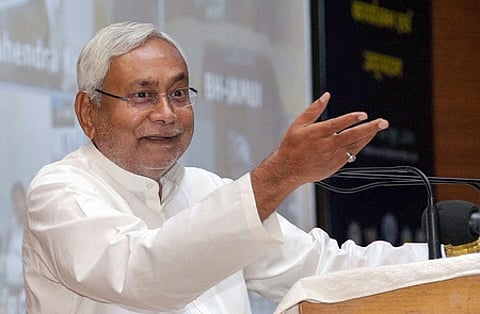

NEW DELHI: Amid fast-moving political developments in Bihar following Nitish Kumar's filing his nomination for the Rajya Sabha, attention has now turned to an imminent change of leadership in the state.
The Bharatiya Janata Party (BJP) is expected to announce its choice for the Chief Minister within the next week. If this happens, it would mark the first time that the National Democratic Alliance (NDA) government in Bihar would be led by the BJP, with the Janata Dal (United) moving to the second position within the alliance, along with other partners.
A buzz in political circles suggests that JD(U) may have agreed to the transition involving Nitish Kumar with certain conditions. One of these conditions could involve having a say—at least in a suggestive capacity—in the selection of the BJP’s chief ministerial face.
If this turns out to be the case, it would be the first such development within the NDA. Even after relinquishing the Chief Minister’s post to the BJP, Nitish Kumar, as the senior-most leader of the NDA in Bihar, could continue to exert influence over governance, albeit indirectly.
Some JD(U) leaders have indicated that Nitish Kumar will continue to provide guidance to the new head of the government, even after stepping down as Chief Minister, in the larger interest of the NDA government and the state.
Regardless of the exact arrangement, the leadership change is likely to prove a crucial moment for the BJP’s political future in Bihar. Historically, the BJP has never enjoyed independent political dominance in the state’s top governance post like the Chief Minister. However, what appears to be a carefully planned strategy has now opened the possibility for the party to appoint a Chief Minister from its own ranks.
There is a widespread perception in political circles that the organisational, ideological and electoral future of the BJP in Bihar will depend heavily on whom it selects for the role. Even if JD(U)’s role in the selection remains informal or advisory, the BJP will need to weigh several factors before finalising a leader to head the government.
Within the party, lobbying has reportedly intensified, with several leaders seeking support both in Bihar and in Delhi. At the same time, the central leadership—known for advocating governance through “non-controversial, impartial and hard-working leadership”—faces a significant test in navigating Bihar’s evolving political landscape.
Currently, the BJP in Bihar lacks a widely acknowledged charismatic leader who could easily emerge as the chief ministerial choice due to an unblemished public image and broad acceptability within the party organisation. While this remains a challenge, there are several leaders whose experience, loyalty to the party, ideological alignment with the Rashtriya Swayamsevak Sangh (RSS), and relatively non-controversial backgrounds could make them potential contenders.
“Our party must decide the face from original cadre and his or her association going back to RSS and other party’s founding principles, rather than going on his or her caste-based factor as the people in coming days, especially of NextGen, don’t want to vote on caste-based system but for development and law and order factors,” a senior BJP leader here remarked.
In Bihar’s political discourse, there is also growing concern that if the BJP selects its chief ministerial face under pressure from any particular lobby or influence group, it could damage the party’s long-term political prospects. Some party workers believe such a decision could even have repercussions in the crucial 2029 general election.
“Although we are not big leaders of party, but true workers since childhood to lifelong for BJP. Our view is the future of BJP can be safe and bright in Bihar when BJP makes a person from its parent organization and a person who moves forward with the inspiration of its ideology as the Chief Minister,” remarked a majority of party’s ground workers and leaders, urging Prime Minister Narendra Modi and Union Home Minister Amit Shah to take the Bihar case to finalisation of the CM face after wider consideration about the party’s future.
“Our party should select the face seeing at least 20 years ahead of politics in state which is now distancing itself from caste-driven politics gradually and the people want development; not controversy and corruption and lawlessness. Only a new face from sideline side, who has ability but not exposure could make a way for BJP head,” remarked many BJP workers.
Several names are currently being discussed as possible contenders, including Nityanand Rai, Samrat Chaudhary, Dileep Jaiswal, Gayatri Devi, Rama Nishad, Sanjeev Chaurasia and Vijay Sinha, among others. However, which of them—if any—will eventually emerge as the BJP’s final choice remains to be seen.
Many party observers stress that Bihar requires particularly careful selection. A poorly considered decision, they argue, could undermine the party’s ideological credibility and its repeated emphasis on good governance under Prime Minister Narendra Modi and Union Home Minister Amit Shah.
“If BJP fails to make a better Chief Minister then RJD which is sitting at home will definitely benefit from it. But overall, it is a lifetime opportunity for BJP that for its long future, BJP should elect only a person who has emerged from its organization and ideology as the Chief Minister of Bihar,” a senior BJP leader and former MP with organisational experience emphasised.
“If BJP fails to make a person coming from the legacy of its organization and ideology as Chief Minister, then it will mean that in the coming future, the politics of JDU and RJD will start pitting against each other. The Chief Minister of BJP will not only decide the future of Bihar but will also decide the future of BJP in Bihar and will also create a strong pillar of BJP's politics at the Centre,” opined several BJP cadres, requesting anonymity.
