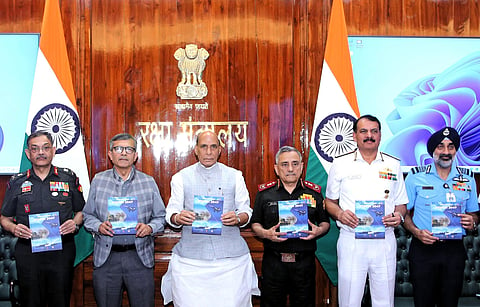

NEW DELHI: The Defence Ministry has unveiled a long-term blueprint to transform India’s armed forces into a joint, tech-driven and self-reliant military geared for future warfare as the country moves towards its Viksit Bharat target.
Prepared by the Headquarters Integrated Defence Staff (HQ IDS), the document titled ‘Defence Forces Vision 2047: A Roadmap for a Future-Ready Indian Military’ was released Tuesday by Defence Minister Rajnath Singh. It outlines the structural reforms, capability priorities and organisational changes required to modernise the armed forces.
In a statement, the government said the roadmap envisages the transformation of the military into an “integrated, multi-domain and agile force capable of deterring adversaries, responding across the full spectrum of conflict and protecting expanding strategic interests” amid rapidly evolving regional and global dynamics.
At the operational level, the transformation roadmap is closely linked to the plan to establish integrated theatre commands, which aim to bring assets of the Army, Navy and Air Force under unified commands organised by geography.
The push for theaterisation has been led by Gen Anil Chauhan, who earlier this year indicated that plans for theatre commands, which have faced repeated delays, could see fruition by May.
However, differences have emerged among the services over the structure. Army Chief General Upendra Dwivedi and Navy Chief Admiral Dinesh K. Tripathi have publicly backed the move, describing theatre commands as “inevitable” for achieving deeper jointness among the armed forces.
The Indian Air Force has expressed reservations. Air Chief Marshal A.P. Singh has argued that a centralised joint command in New Delhi would be more effective than dividing air assets among multiple theatres.
Another key focus of the vision roadmap is ‘Aatmanirbharta’ in defence, with emphasis on developing indigenous technologies and strengthening domestic defence manufacturing.
According to the Defence Ministry, the document also outlines a phased planning approach with prioritised capability targets across short-, medium- and long-term timelines.
India’s defence planning currently relies on several long-term instruments, including the Long-Term Integrated Perspective Plan (LTIPP), which outlines capability requirements over a 15-year horizon, and the Technology Perspective and Capability Roadmap (TPCR), which identifies future technologies and capability needs of the armed forces.
These feed into the Integrated Capability Development Plan (ICDP), a 10-year framework that is broken into five-year Defence Capital Acquisition Plans (DCAPs) and further into two-year roll-on Annual Acquisition Plans (AAPs) under the Defence Acquisition Procedure (DAP), translating long-term priorities into procurement programmes.
At the execution level, the Annual Acquisition Plan under the Defence Acquisition Procedure (DAP), which is due for an update this year, translates these priorities into yearly procurement programmes.
Under the proposed framework, these instruments are expected to be integrated into joint capability planning, rather than being driven primarily by individual services.
Moreover, the release of the two-decade long roadmap also comes amid a long-running debate over whether India should publish a National Security Strategy (NSS). An NSS outlines a country’s long-term security objectives, threat perceptions and policy direction across military, economic, cyber, diplomatic and internal security domains.
CDS Gen. Anil Chauhan has, on multiple occasions, including in his book released in May last year, dismissed calls for a written National Security Strategy (NSS), arguing that India already has the institutional structures in place to safeguard its security.
However, earlier in November 2024, Gen. Chauhan had reversed course and suggested that such a document was being prepared. Speaking at an event titled Future Wars and the Indian Armed Forces in New Delhi, he said a “written national security document” was indeed under preparation.
The contours of such a strategy share similarities with the Defence Forces Vision 2047 blueprint, at least as described in the government statement. The roadmap, which is supposed to be uploaded on the HQ IDS website, had not been made public till the filing of this report.
