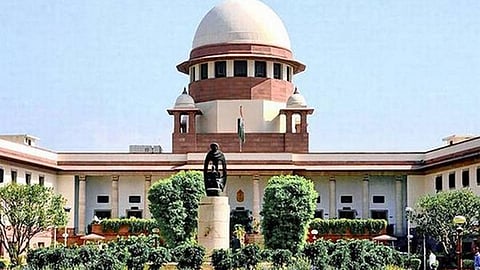

NEW DELHI: Taking into record the compliance report in the passive euthanasia matter involving Harish Rana, the Supreme Court on Wednesday heavily praised the decision of the family and termed it an act of generosity even in the face of personal loss.
"The saga of Harish had moved many, including the judges," the top court said and hailed his family’s decision to donate his organs after his death.
Harish’s family donated his organs after he passed away.
Rana passed away on March 24 after being shifted from his residence to palliative care at the All India Institute of Medical Sciences (AIIMS), pursuant to the Supreme Court’s March 11 judgment.
On Wednesday, a Bench of Justices JB Pardiwala and KV Viswanathan noted that Rana’s corneas and heart valve were donated by his family.
During the hearing, Advocate Rashmi Nanda informed the Court that the death certificate had been filed, and it is confirmed that Harish’s organs were donated.
Justice Pardiwala wanted to know from the lawyer as to whether organ donation had taken place, to which the counsel replied that his heart and corneas were donated, as only those organs were medically viable.
An appreciation certificate in that regard was also placed before the Court.
In its order, the Bench observed that Harish’s final moments reflected dignity, autonomy, and comfort.
"His passing demonstrated the importance of respecting individual choice in end-of-life care. Modern medicine has limits, and that prolonging life against a person’s wishes cannot always be equated with care," the Bench said.
It went on to express gratitude to the Director of AIIMS, doctors, and nursing staff for their care and support during Harish’s final moments.
On March 11, the Supreme Court, in a landmark verdict, allowed the withdrawal of medical treatment of 32-year-old Harish, who has been in a vegetative state for more than 12 years.
This was the first-ever passive euthanasia in the country, passed by the top court.
"When the primary and secondary boards certify for withdrawal, there is no need for the court's intervention. Since this was the first case, the reference to the court was felt. Withdrawal of treatment must be humane. It necessitates a structure," the Bench had noted.
The court passed the order of withdrawal of medical treatment after considering various factors, circumstances, and recognising the fact that there was no chance of revival for Harish as per the doctor's opinion and the medical board's report.
Harish's father, Ashok Rana, had moved the top court seeking passive euthanasia for his son by withdrawing his artificial life support.
Two medical boards -- constituted on the orders of the apex Court -- have each once submitted their report to it and stated that the man, Harish, has no chance for recovery at all.
Harish suffered serious head injuries after falling from the fourth floor of a building in 2013. He was on an artificial support system for more than 12 years.
Followingly his father, Ashok Rana, had moved the apex court seeking directions to grant passive euthanasia for his son, Harsh, by withdrawing his artificial life support.
It is to be noted that passive euthanasia is the intentional act of letting a patient -- who is in a vegetative state for a longer period of time -- die by withholding or withdrawing life support or treatment necessary for maintaining life.
