
If there is one striking difference between the 2019 and 2024 Lok Sabha elections, it’s the lack of a wave - be it a Modi wave, NDA wave, INDIA wave or even a Mandir wave.
With the hyper-nationalist fervour in 2019 after the Pulwama blasts and Balakot air strikes, several voters clearly stated that the BJP candidate didn't matter and that their vote for the party was essentially one for Modi. This time, in the absence of a national narrative, local candidates and local issues are playing a role in determining voter choices in Uttar Pradesh. The 'Modi factor' isn’t strong enough for them to vote for a disapproving candidate.
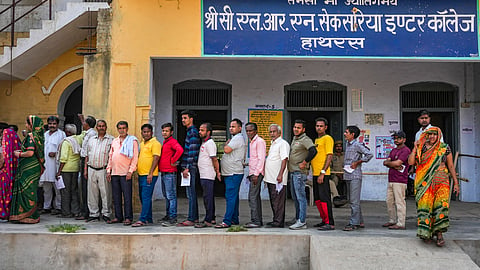
So far, the team and I have travelled to 14 Lok Sabha constituencies in Uttar Pradesh that have voted in the first four phases - from west UP's Ghaziabad, Meerut, Bijnor, Nagina, Saharanpur, Kairana and Muzaffarnagar towards Etawah, Kheri, Dhaurahra, Kannauj, Badayun, Mainpuri and Hathras.
We identified influential communities in each constituency and visited villages and townships where these communities have a strong presence to understand how voters are thinking, the issues determining their votes and if and why their voting preferences have changed since 2019. On average, we covered at least two Vidhan Sabha areas in each of the 14 Lok Sabha constituencies.
One of the most prominent issues across castes was the agrarian crisis. Even those of the Brahmin community who praised Modi as 'king' and were supporting BJP consistently spoke about their struggles as farmers. One of the specific issues all farmers faced was the menace of the stray cattle that destroyed crops in the fields.
With the Yogi government's increased restrictions on slaughterhouses and the fear of cow vigilantes, many farmers are left in a lurch. They are clueless about how to deal with their male cattle, essentially an economic burden on farmers who are anyway dealing with growing financial distress.
These policies have robbed farmers of an additional source of income, and they are now forced to abandon their male cattle and older cows and buffalos who can no longer produce milk. The state government has unsuccessfully attempted to build cow sheds to address the issue.
The stray cattle run over crops, graze on them and destroy them. The losses thus incurred are substantially higher than the quarterly cash transfer of Rs 500 a month from the central government as part of the much-hyped Kisan Samman Nidhi.
Add to this the shrinkflation in urea—the sacks have become smaller while the price has remained constant. Meanwhile, the state-mandated price for sugarcane has grown by only about Rs 45 a quintal in the last seven years, lower than under previous regimes.
This has resulted in the drifting away of several non-Yadav, non-Jat agrarian Other Backward Classes from the BJP in west UP. This includes castes like Lodhi Rajputs, Kurmis, Kushwahas and Sainis, who are mostly marginal farmers. The exact percentage of this shift is hard to determine, but a significant breaking away is evident.
When asked about a possible alliance with the BJP during the 2022 UP assembly elections, Rashtriya Lok Dal (RLD) chief Jayant Chaudhary had said, “I am not a chavanni (25-paise coin) that can be flipped.” Two years later, this March 2, the RLD that has a significant Jat following in West UP, joined the NDA. It was in the hope of consolidating Jat voters for the BJP-led alliance.
But in many seats like Kairana, Muzaffarnagar, Aligarh and Agra, Jat voters haven't shifted to the NDA to the extent hoped for. The ripples from the historic thirteen-month-long farmers' movement of 2020-21 continue to impact the Jat voters of the region and they remain suspicious of the new alliance. In many of these constituencies, the lower turnout is a result of core BJP communities voting in fewer numbers.
Another factor that could hurt the BJP in the first three phases is the massive Rajput panchayats held in Meerut, Kairana and Muzaffarnagar against the party. This was in response to a couple of speeches made allegedly against the community by BJP leaders.
On March 22, Parshottan Rupala, a BJP candidate from Rajkot, said, "Even kings and royals bowed down to the British… but not Rukhi samaj (a Dalit community)." He was seen to praise Dalits at the expense of Rajputs and Kshatriyas, whom he accused of entering into "roti-beti" relations with the British (breaking bread and entering into marital relations). Many also accused the BJP of 'keeping silent' when the caste name Gurjar was inscribed on the statue of Mihir Bhoj who they claim is a Rajput.
While there is a level of disillusionment with the ruling party, the opposition INDIA bloc has not been able to win over these communities. As a result, voter enthusiasm has been minimal and many have chosen not to vote.
What is also evident is a simmering anger against the ruling dispensation among large sections of the rural and semi-urban poor and even middle classes. Issues of inflation and unemployment are soaring and oft-repeated by voters.
In Meerut, many voters talked about how BJP’s key campaign points like the scrapping of Article 370 in Kashmir have no impact on their lives. One of them said, "We are not buying land there!"
The anger among the youth was further fuelled when the Uttar Pradesh Constable Recruitment and Promotion 2024 examination was cancelled. The exam was held on February 17 and 18 this year and over 48 lakh aspirants vied for 60,244 posts. It was later revealed that the examination papers had leaked. The state government announced that the exam would be held again after the Lok Sabha elections. Repeated incidents of paper leaks under the Yogi government have increased the despondency among young voters who eye government jobs. Young people from across rural western UP have always eyed a job in the army. The recently unveiled Agniveer scheme has proven to be yet another wet blanket.
Apart from the anger on unemployment and inflation that's evident among Dalits across UP, there is another concern. This March 25, BJP MP Anant Kumar Hegde from Karnataka called for 'rewriting' the Indian Constitution, which would not be possible without winning 400 of the 543 seats. At least three other BJP candidates have openly stated the same intention. The videos of their statements have gone viral. So the BJP's slogan of 'Abki baar, 400 paar' has caused a growing insecurity among Scheduled Caste voters about reservation.
This includes non-Jatav SC communities, large sections of which have in the past few years been voting for the BJP.
Another factor that could have worked in BJP's favour but is proving to be a dampener is that the BSP and SP couldn't ally. In 2019, because of the SP-BSP alliance, on many seats which didn't have a BSP candidate, there was a shift of a substantial number of Dalit votes to BJP. This time, in constituencies like Meerut, Saharanpur, Nagina, Kairana, Etawah, Lakhimpur Kheri and Mainpuri, there is a visible shift of such voters from the BSP to the INDIA bloc, essentially looking to vote for the strongest candidate against the BJP. It must be noted that a substantial share has also been retained by the BSP.
In some places, even Muslims are looking to consolidate in favour of not just the strongest candidate against the BJP but also voting beyond traditional patterns. For example, in the Nagina constituency, there is a strong consolidation of both Muslims and Dalits in favour of Chandrashekhar Azad from the Azad Samaj Party. This is because Muslims were looking for an alternative owing to the SP's silence on many issues related to the Muslim community.
As one moves further away from west UP, it seems Akhilesh Yadav's PDA slogan - with P for pichhde or backward classes, D for Dalits, and A for alpsankhyak or minorities - has rung a bell. Many voters are also calling it 'Pandit harao abhiyan' (Defeat the Brahmins campaign).
Women voters in rural areas are particularly upset with the lack of allocation of houses under the PM Awaas Yojana. Village after village, they were keen to show their abysmal living conditions. Many who got gas cylinders for the first time because of the government's much-touted Ujjwala Yojana are back to using clay stoves since they can't afford to refill their cylinders with the skyrocketing prices.
Yet, despite the growing discontent among various communities, it would be wrong to underestimate the BJP. Numerically significant castes like Brahmins and Baniyas have consolidated behind the BJP across UP. Also, unlike west UP, the Rajput anger doesn't seem to have much of an impact in central and eastern UP. The BJP still has a strong cadre base across castes.
As one voter in Kairana said, "The voters are silent and that could mean anything."
Nakul Singh Sawhney is an independent documentary filmmaker and founder of Chalchitra Abhiyaan.
(Views are personal)
