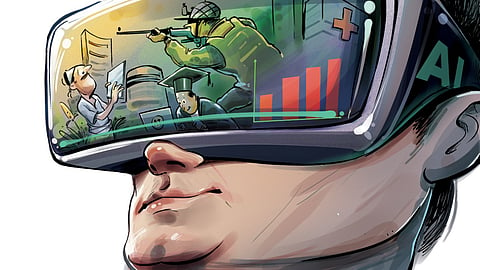

As leaders, military scholars, diplomats and industry representatives gather in New Delhi for the AI Summit, it should not be mistaken for a conclave of coders speaking a language only machines understand. For many of us, myself included, it can seem difficult to grasp what will be discussed and how it affects daily life. Yet AI is no longer confined to laboratories or technology parks. It’s becoming an invisible assistant in governance, security, disaster response, business and even the household. The real question is not whether India can build powerful algorithms but whether digital intelligence can serve every citizen.
At its simplest, AI is about experiential learning. Just as a seasoned commander reads terrain or a farmer reads the sky before rain, AI studies patterns in large volumes of data, recognises trends and anticipates what may come next. When woven into governance, it allows the State to act early.
India generates vast streams of information—on crops, rainfall, health, transport and markets. AI connects these fragments, helping detect distress, trigger timely medical response and improve emergency response time. The result is not abstract efficiency, but a smoother daily life.
This is where the ordinary citizen begins to see value. When shortages are anticipated, supply chains are adjusted before shelves empty. When disease trends are detected early, clinics prepare in time. When city services are monitored intelligently, breakdowns are prevented rather than repaired after causing inconvenience. Intelligence becomes a shared national asset.
In the security sphere, AI acts as a force multiplier. India’s security challenges span land, sea, air and cyberspace. Modern surveillance systems generate more information than human teams can process quickly. Machine-learning systems help sift through that volume, identify unusual patterns and highlight potential threats. They do not replace judgement; they assist it. Information mapping on geographic information system maps—layer by layer—helps in crisis prevention and management.
For the forces, this means sharper intelligence assessments and faster decisions. Equipment can be serviced before failure because predictive systems identify stress patterns. Fire control becomes more precise through simulation and learning. Logistics can be streamlined. Yet one principle must remain clear: machines support, but humans decide. Ethical oversight and human responsibility cannot be delegated.
Beyond security, AI may have its most visible impact in disaster management. India regularly faces cyclones, floods, earthquakes and heatwaves. Early warnings already exist, but AI refines them. By combining satellite imagery, weather data, river levels and historical records, predictions become more local and more reliable. Evacuations can be planned calmly rather than in panic. Relief resources can be positioned before landfall. Structural vulnerabilities in bridges or buildings can be identified before collapse. Quiet prevention saves more lives than dramatic rescue.
AI also has a role in protecting social stability. Misinformation can spread rapidly in a connected society. AI systems can detect unusual spikes in coordinated messaging, alert authorities and enable timely clarification. The objective is not censorship but preparedness. In a diverse democracy, preventing avoidable tension is itself a form of national strength.
The transformation extends into everyday life. A farmer can receive advice based on soil conditions and weather forecasts. A student in a remote village can access lessons in her own language. A local health worker can use AI-supported tools to detect disease early. Small businesses can forecast demand, manage inventory and grow digitally. For women managing households or small enterprises, intelligent systems can simplify budgeting, marketing and access to government schemes. Knowledge once limited by geography becomes widely available.
Education and skills development remain central to India’s future. As industries evolve, workers must adapt. AI can track employment trends and suggest training pathways. Learning platforms can adjust to pace and aptitude, ensuring that those displaced by technological change are not left behind.
Healthcare offers a similar promise. Diagnostic systems can assist doctors in early detection. Predictive tools can flag communities at risk of outbreaks. Telemedicine can extend expertise into underserved regions, narrowing the gap between urban and rural care.
Yet optimism must be balanced with caution. AI systems can be targeted by cyberattacks, data can be distorted, and flawed inputs can produce unfair outcomes demanding strong safeguards.
There is also a quieter concern that rarely enters public debate: the enormous amount of electricity required to run data centres and store the vast volumes of information on which AI systems depend. These server farms consume significant power and water for cooling, placing pressure on energy grids and the environment. If AI is to support sustainable development, its growth must be matched by cleaner energy sources and more efficient infrastructure.
India must therefore invest not only in capability but also in resilience. Data protection, cybersecurity safeguards, independent audits and ethical standards are essential. Public trust will determine success. Without confidence in fairness and safety, even beneficial systems will struggle for acceptance.
The broader question is whether AI will widen inequality or reduce it. If confined to elite sectors, it could deepen divides. If embedded in public services, translated into Indian languages and designed with simplicity, it can democratise opportunity. The technology itself is neutral; outcomes depend on governance and intent.
The AI Summit in New Delhi should therefore be seen as a national conversation about preparedness. It is about understanding how knowledge can be organised, analysed and applied to solve problems faster and more fairly. It’s about converting information into foresight and foresight into action.
Many among us remember the advent of mobile phones. They seemed expensive, unnecessary and complex. Today, they connect farmers to markets, families to loved ones and citizens to government services. AI may follow a similar path. At first, it appears distant and technical. Gradually, it becomes woven into daily routines.
For that reason, awareness matters. We may not need to write code, but we should remain curious, informed and open. Just as India embraced digital payments and mobile connectivity, we must be ready to understand and adapt to intelligent systems. AI is not a spectacle for specialists. It’s a tool whose value will be measured by how effectively it improves ordinary lives.
Lt Gen Syed Ata Hasnain (retd) | Former Commander, Srinagar-based 15 Corps; Chancellor, Central University of Kashmir
(Views are personal)
(atahasnain@gmail.com)
