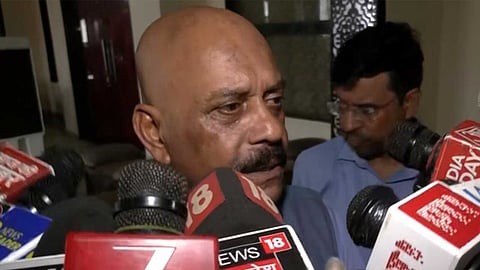

LUCKNOW: From flying fighter aircraft and testing combat systems to commanding the Indian Air Force’s Western Air Command during Operation Sindoor, Air Marshal (Retd) Jeetendra Mishra has taken on an entirely different responsibility: managing the affairs of the Ram Mandir in Ayodhya.
The Shri Ram Janmabhoomi Teerth Kshetra Trust on Wednesday appointed Mishra as its first full-time chief executive officer (CEO). The appointment comes at a crucial juncture for the temple trust, which is moving from the construction phase towards managing the day-to-day functioning of one of India’s biggest religious institutions. It also comes amid scrutiny over the handling of temple donations.
Who is Jeetendra Mishra?
Mishra is a highly experienced former Indian Air Force officer who served for more than 38 years. He was commissioned into the IAF’s fighter stream on December 6, 1986, and retired on April 30, 2026, after serving as Air Officer Commanding-in-Chief of the Western Air Command.
The Ministry of Defence’s official profile describes him as a fighter combat leader and experimental test pilot with more than 3,000 hours of flying experience.
His professional training included the National Defence Academy in Pune, the Air Force Test Pilots School in Bengaluru, the Air Command and Staff College in the United States and the Royal College of Defence Studies in the United Kingdom.
A career built around fighter operations and testing
Mishra’s career was not limited to conventional command assignments. He commanded a fighter squadron, served as the chief test pilot at the Aircraft and Systems Testing Establishment (ASTE), and was Air Officer Commanding of two frontline air bases.
He also held several important appointments at Air Headquarters, including Director of the Operational Planning and Assessment Group, Principal Director (ASR) and Assistant Chief of Air Staff (Projects).
Before taking charge of the Western Air Command, he served as Deputy Chief of Integrated Defence Staff (Operations). The position gave him experience in joint planning and coordination involving India’s three armed forces.
His Kargil connection
One of the lesser-known chapters of Mishra’s career goes back to the 1999 Kargil War.
During the conflict, Mishra was associated with efforts to operationalise laser-guided bombs on Mirage-2000 aircraft. The technology subsequently played an important role in India’s air operations against Pakistani positions during the war.
This experience placed him at the intersection of combat operations, technology and operational planning—areas that became recurring themes throughout his military career.
Western Air Command and Operation Sindoor
Mishra assumed command of the Western Air Command on January 1, 2025, succeeding Air Marshal Pankaj Mohan Sinha.
Just months later, the command found itself at the centre of India’s military response during Operation Sindoor, launched in May 2025 following the Pahalgam terror attack.
As the head of the Western Air Command, Mishra was among the senior commanders responsible for the operational planning and execution of India’s air response. His role during the operation subsequently earned him the Sarvottam Yudh Seva Medal, one of India’s highest wartime distinguished-service honours.
He was among a small group of senior military officers recognised for their contribution to Operation Sindoor.
Mishra had already received the Ati Vishisht Seva Medal and Vishisht Seva Medal during his career.
Why was he chosen as Ram Mandir CEO?
Mishra’s selection is significant because the Trust is entering a different phase of its existence.
The construction of the temple has been accompanied by a massive expansion of Ayodhya’s religious tourism ecosystem. The Trust now has to deal with large-scale devotee management, administration, security coordination, finances, staff, facilities and coordination with government agencies.
A CEO provides a dedicated executive layer for these functions.
Mishra’s nearly four decades of experience in large-scale organisational management, operational planning, logistics, coordination and crisis management could therefore be particularly relevant to the Trust’s new requirements.
His appointment also marks a transition from a largely religious-trust-led administrative structure towards a more professionally managed institutional model.
Selection process
Mishra was not simply picked from a small internal pool.
According to reports, the Trust received 5,585 applications for the CEO position. A selection committee screened the candidates, eventually reducing the field to a shortlist before personal interviews were conducted in Ayodhya.
Mishra emerged from that process as the preferred candidate and was subsequently approved by the Trust.
Appointment amid scrutiny of the Trust
The timing of the appointment is also important.
The Trust has faced scrutiny following allegations of irregularities involving temple donations, with eight people arrested in the related case. The controversy has increased attention on financial controls and administrative oversight within the institution.
Against this backdrop, the appointment of a former senior military commander with a reputation for institutional discipline and operational management could be seen as an attempt to strengthen the Trust’s executive functioning.
A new chapter for Ayodhya’s temple administration
Mishra’s appointment represents an unusual career transition: from India’s military establishment to the administration of its most politically and religiously significant temple project.
The Trust has simultaneously appointed new trustees and reorganised key responsibilities, indicating a broader administrative restructuring.
For Mishra, the challenge will now be fundamentally different from commanding a military formation. Instead of aircraft, bases and combat operations, his brief will involve managing a vast religious institution, coordinating multiple stakeholders and ensuring that the temple can function efficiently as millions of devotees pass through Ayodhya.
The choice of a former Western Air Command chief suggests that the Trust is looking for professional executive management, operational discipline and tighter institutional coordination as the Ram Mandir moves into its next phase.
From Kargil to Operation Sindoor and now Ayodhya, Mishra’s career has moved from the battlefield to one of India’s most closely watched religious institutions.
