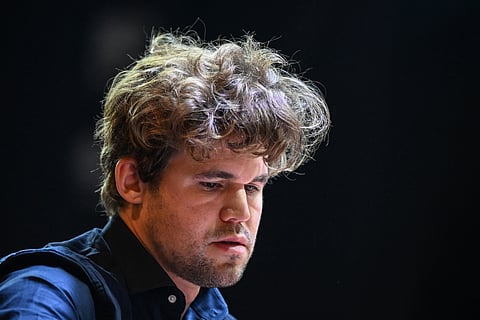

SINGAPORE: A couple of days ahead of the World Championship, Magnus Carlsen and Fabiano Caruana had checked into Singapore. In an alternate world, the former, the World No 1 across all three regular formats (Classical, Rapid and Blitz), would have arrived in the city-state to play the final.
Now? Not so much. He had arrived with Caruana, the World No 2 in Classical, to play a couple of games of freestyle chess, a variant of the game. In this game, the starting order of the pieces on the back rank are randomised.
So, as D Gukesh and Ding Liren checked into a plush hotel for the World Championship, Carlsen and Caruana, with a bevy of photographers, sailed off on a yacht to play a couple of freestyle games.
Carlsen won the series — of course he won the series — before posting something provocative on X. "Freestyle > Classical". He, of course, knew what he was doing. In less than 24 hours, the World Championship's first game was about to get underway.
On November 25, less than two hours after the final began, Emil Sutovsky, the CEO of the world body (FIDE), couldn't resist. "Classical > any other", he wrote on X.
Welcome to the battle to preserve the board game's purest version and its immediate siblings in the face of increasing alternatives.
****
It's the one question all of the game's stakeholders — fans, players and administrators - have had to answer in Singapore over the last two weeks. Before getting into the game's future, it's important to acknowledge the one main problem with the Classical time format, according to one of the greatest players to have played the game.
It's been analysed to such an extent that surprises are rare. Players know the openings like the back of their hand. Hence, there's an element of predictability.
It's what Carlsen mentioned during an interview to Straits Times before the Championship began. "I really hope that this can be a big part of the future of chess," he had told The New Indian Express during his series against Caruana. "Nowadays, everything is moving a bit quicker. In normal chess, quicker chess is becoming more and more important.
"What we are seeing as well is that the original format has been diluted because it’s too analysed. So we really wanted to create something new. And I think this can be very exciting."
Sometimes, Classical can be a bit boring because players are so familiar with all the main lines and the novelties too. This can lead to many draws and not a lot of excitement. In such a scenario, players have to make a miscalculation or overreach for the pieces to come to life. The Norwegian's point, hence, is simple: randomise the starting point of the main pieces and bring back extempore to the game.
****
Every time something new, shiny and, importantly fast, emerges, factions form. A few want to preserve traditions. Others bat -- pardon the pun -- for the fun, fast version. It's especially true for sport. Cricket is still grappling with this problem. Hockey may face this issue down the line. Rugby, tennis, football... you name it and there's an alternate format ready to move in with a wrecking ball.
In chess, though, the problem somehow seems to be more unique when compared to other sports. The ones who want to preserve the purest form of the game are the teenagers and the wunderkinds.
At first glance, both Viswanathan Anand (FIDE deputy) and Emil Sutovsky (FIDE CEO) may not have any other choice other than to sing peans for the oldest format. But their reasoning comes with a lot of truth. "I'm happy to sense and feel that with the exception of Magnus and maybe some of the older players... in fact, the younger generation loves Classical chess," he told The New Indian Express.
"Pragg (R Praggnanandhaa), (D) Gukesh, Nodirbek (Abdusattarov), Arjun (Erigaisi)... all these youngsters, they really enjoy playing and they are very motivated. They are dreaming of this stuff. What I really like is they are willing to take considerable risk to play interesting chess and fight for points. Classical chess has never been in safer hands."
When Gukesh was asked about his thoughts on Classical chess within the context of Carlsen abdicating his title, the 18-year-old couldn't have been more equivocal. "(I was) looking forward to being here since the time I started playing," he had said before the opening game. "I'm very excited to be here. It's a World Championship, it's a very special event."
That has translated to the masses as well. At first glance, the city-state may not be a natural place to host the game's blue-riband match. But the Singapore Chess Federation put their cards in motion after Gukesh had won the Candidates. An Indian facing off against an opponent from China in a country like Singapore... it just made sense.
And people have embraced it. $64 may be steep to watch two GMs make moves on a board with a cube separating the audience from the players but the fans have lapped it up. They still value this product.
****
"Regular chess," Sutovsky tells The New Indian Express, "is, by a huge gap, more popular and more suitable for an ordinary player. You don't have even 0.1% of players playing other variants of chess."
When the CEO says regular chess, he's talking about the most common time controls -- Classical, Rapid and Blitz. The variants include the likes of Fischer-Random (known as chess960).
"I understand top Grandmasters playing it, because they have been studying chess and working on it for 15, 20, 30 years. Some of them feel like they have exhausted the charm of it. But that's not the case with the chess community in general," he said.
"The magic of chess is that it is easy to learn, difficult to master. So other variants have the flavour, but I don't see it becoming very appealing to a wider audience.
"For them, it is important that they can refer to patterns that they learn, classical games that famous players played, pet systems that they like to open with, all of it would be gone in Fischer Random, for example."
****
While Carlsen continues to play all time controls — he's the prohibitive favourite in the World Rapid and Blitz later this month — he has more or less turned his back on the World Championship. However, there is a feeling, nothing more than a speculation, actually, that he may be tempted to come back if somebody from the younger generation wins the title.
Gukesh can test that theory out.
