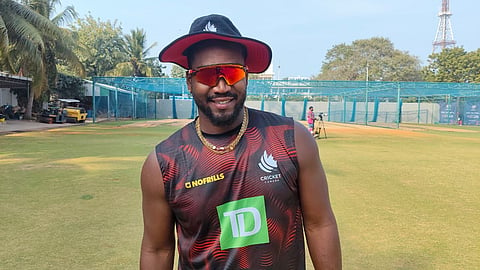

CHENNAI: GUYANA-born Canada pacer Dilon Heyliger's tale is one that can be quite inspiring. While he may not have the magnetic effect of the big names in the sport, he is already a hero to the young children in his village in the Essequibo region. From his humble beginnings in Suddie, where he could not afford equipment, he has given back to the place he grew up by offering cricket kits to talented children in the region. West of Essequibo river where he grew up was a subject of political tension due to neighbouring country Venezuela's attempts to interfere.
Born to a restaurateur and an electrician, Heyliger clang on to cricket from Day One. "There was a cricket ground which was obliquely across from my house. So we just grew up just across the cricket ground. You're always there in the mornings and evenings. That's where I played all my cricket there," he told this daily on Monday. Heyliger felt that sport, especially cricket, provided a "small escape" from daily rigours of life.
"Cricket is a gateway to get out of the region and maybe move to Georgetown or maybe to Trinidad. You always find kids that are talented, but they don't get the opportunity to go to the bigger stage," he said. That is one of the reasons that Heyliger is doing his bit to help the sport grow in the region. After the 2024 T20 World Cup, the pacer went back to his village to provide cricket kits to children in need of them.

"I am in a position to give it back to the village where I grew up and you want to make things a bit easier for them. As you know, gears and equipment are not cheap. It is hard to get and seeing the smiles on their faces is good. They are the future & backbone of cricket in Essequibo," he explained.
Heyliger said that he promised himself that he would continue this practice post this edition of the T20 World Cup. "For this World Cup, I am going to do something special for the kids. I want it to be a surprise, as I always do. And I always want to put a smile on the young kids' faces."
Heyliger initially had to make do with the training equipment like pads and gloves. "I remember I used to get my gear from my far-off cousins in England. They used to play cricket there and my mom reached out to them. They used to send stuff and we used to prepare with the denim. I remember stitching up the gloves with the denim jeans. I can remember using the bamboo to make the pads. It was difficult back then just to get equipment," he recalled.
Travelling from his village to the capital city Georgetown — East of the Essequibo river, was also another difficulty. "I could not afford travelling to the city. Everything that I did back then was on my own. To travel across the river to George town, you had to fetch in a big cricket bag and when the transportation (people) sees you, sometimes they don't take you. You have to end up renting a whole car and back then, it was difficult for me, just to even catch a boat with a big cricket bag. They never used to want to take me unless I paid for the whole seat," he explained.
Travelling to Canada to play club cricket was how the 36-year-old bowler found a new lease of life. After stints in the Caribbean Islands and England, he got his first opportunity in 2014 to play for Islanders in Canada. He explained why he could not continue in Guyana "After I did well for Islanders in 2014, I got an opportunity to play for Vikings in 2015. I did not want to go back to Guyana. There was a lot of politics and stuff in cricket. That is when I decided to settle in Canada," he said.
Only two years into life in Canada, he broke through the senior men's team. He was part of the team that helped Canada qualify to the 2024 World Cup. The memorable moment he had in that tournament is his two-wicket haul against Pakistan. Now in India for the 2026 edition, he hoped to leave a lasting mark here, and continues to give back to the place where he grew. "Sport and cricket has had a great impact on me getting out of poverty. I wouldn't say poverty is just living, you know, below the line. to afford certain things. So, now I'm in a position where I could help these kids so, they could be focused and, you know, take a little bit more time now for them to grow," he added.