
BENGALURU: Burdened by the five guarantees, the government was constrained to fully implement development projects this year too, as Chief Minister Siddaramaiah walked the tightrope to fulfill the 2025-26 budgetary announcements.
His budget with an outlay of Rs 4.09 lakh crore has a revenue deficit of Rs 19,262 crore. The state earmarked Rs 51,034 crore for the guarantees, while the shortfall in revenue receipts from GST rate rationalisation constrained the state’s spending. There will be a shortfall of Rs 20,000 crore in revenue receipts by the end of the financial year.
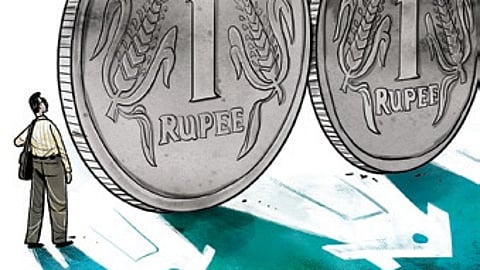
On the brighter side, Karnataka’s IT Policy 2025-30 envisaged to boost the annual software exports from Rs 4.09 lakh crore to Rs 11.5 lakh crore with an incentive of Rs 967 crore to reinforce the state’s position as a leading innovation-driven and industrially progressive tech economy. The falling rupee against the dollar is expected to help its software exports to the US in the coming years.
The state boasted of the country’s highest per capita income at Rs 2,04,605 for 2024-25, registering a staggering 93.6% growth from Rs 1,05,697 in 2014-15. Good agriculture output because of good monsoon will only add to it.
Experts said if the government had pruned the spending on the five guarantees, it could have saved by Rs 10,000 crore. But some Congress legislators complained about lack of funding for development projects, saying they alone cannot win elections and the development too is necessary to impress the electorate. Cashing in on it, BJP harped on the government delaying two instalments of Gruha Laksmhi dole, alleging that the government was facing a fund crunch and asking it where the Rs 5,000 crore had disappeared.

The Lokniti-CSDS (Centre for the Study of Developing Societies) report came as a downer for the government as it stated that positioning ‘Gruha Lakshmi’ as financial security for women cast it as patronage instead of as basic income for unpaid household labour. This misrepresented the scheme in the eyes of some recipients, making them feel ‘undeserving’, the report stated.
The Chief Minister’s Infrastructure Development Programme, announced in the budget with an outlay of Rs 8,000 crore, did not take off.
The Mid-Year Report forecast a revenue growth of 7.7%, while stating that the outlook for the fiscal year remained positive because of good monsoon, strong services and industrial performance, state recording the second highest GST collections in the country and capital expenditure increasing by 32.3%. Karnataka emerged as the top FDI destination in Q1 of FY26, with inflows of $5.6 billion because of its policies, the report noted.
The fiscal deficit remained at 2.95% of GSDP within the Karnataka Fiscal Responsibility Act limit of 3% and total outstanding liabilities at 24.91% of GSDP (within 25% ceiling). Motor vehicle tax collections reached Rs 5,812 crore, registering a growth of 4.9%.
To boost its revenue collection, the state enacted the Karnataka Mineral Rights and Mineral Bearing Lands Tax (MRT) Bill, 2024, to levy a tax on mineral-bearing lands in addition to the royalty. This was expected to yield Rs 3,000 crore, but the bill is still pending with the President.
The new VB-G RAM G Act, which has replaced MGNREGA, will put a bigger burden of Rs 5,000 crore annually on the state as the new rural guarantee scheme has increased the share of states from 10% to 40%. The state had budgeted Rs 51,877 crore as tax devolution and Rs 16,000 crore as grant-in-aid from the Centre. Up to September 2025, the State had received Rs 23,040 crore and Rs 5,139 crore respectively. The grant-in-aid has decreased by 38.2% in 2025-26, compared to Rs 8,309 crore it received 2024-25.
State’s budgeted gross borrowings are Rs 1,16,000 crore, while the repayment is Rs 26,474 crore for 2025-26. Up to September 2025, the state has availed Rs 3,459 crore, incurring an expenditure of Rs 2,688 crore towards loan repayment.
The stamp duty and registration fee reached Rs 11,805 crore in the first half of 2025-26, recording a marginal decline of 1% as compared to last year, because of the slowdown in real estate activity.
There were allegations of the government diverting SC/SP-TSP grants to fund the guarantees. There is now further speculation that the government would divert the allocation meant for pension, sources said. Though at times the issue of delayed salaries for its employees was raised, the government dismissed it, claiming the state’s financial health was good. As fuel prices went up, prices of essential commodities spiked too, further burdening customers who were already suffering from the milk price hike.
The State’s Consumer Price Index (CPI) was at 206.2 (base of 100 in 2012) which meant that the price of basket of consumer goods and services doubled in 13 years. Inflation stood at 2.64% as against the national average of 0.71%.