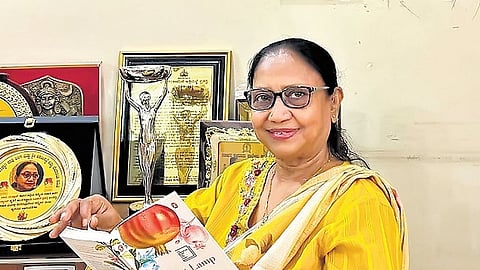

NEW DELHI: The Supreme Court has agreed to hear on Friday (September 19) a petition against the Karnataka High Court's dismissal of pleas challenging the State government's decision to invite International Booker Prize-winning author, Banu Mushtaq, as chief guest to inaugurate Dasara festival in Mysuru.
The matter was mentioned by the lawyer of the petitioner, H S Gaurav, before the Chief Justice of India (CJI), BR Gavai, for urgent hearing as the event is scheduled to take place on September 22. The apex court bench agreed to hear the appeal on Friday, September 19.
The lawyer told the top court that a non-Hindu has been allowed to perform Agreshwari puja at Mysuru temple on September 22 in Karnataka. Gaurav, in his appeal filed in the top court, said that the Karnataka High Court had erroneously held that no legal or constitutional right of the petitioner was violated.
The petition claimed that Mushtaq's participation would hurt the sentiments of people, as she has made "anti-Hindu" statements in the past.
The petitioner approached the top court after the Karnataka High Court dismissed his plea, noting that “interfaith participation in religious festivals is not against the constitution”.
The petitioner said, "The inauguration would involve lighting of lamp before sanctum sanctorum of Goddess Chamundeswari. The HC erred by not appreciating that this cannot be performed by a non-Hindu."
Earlier on September 15, a two-judge Bench of Chief Justice Vibhu Bakhru and Justice CM Joshi of the High Court rejected a batch of petitions -- including that of Gaurav's -- claiming that Mushtaq's participation would hurt the sentiments of people as she has made "anti-Hindu" statements in the past.
Rejecting the pleas, the High Court had said Mushtaq is an accomplished person and none of the guarantees recognised under Articles 25 and 26 of the Constitution are offended in the case.
"Undisputedly, the festivities are organised by the State every year. And an accomplished person is called for the inaugural ceremony. The persons in the past have included scientists, educationists, authors, and freedom fighters. Undisputedly, respondent No.4 (Banu Mushtaq) is an accomplished author and 2025 Booker Prize winner. She is also a lawyer and a social activist. She has also served in various public offices, including being a Member of the Hassan City Municipal Council, Chairperson of the Visitor's Board of Chamarajendra Hospital, Member of the State Library Authority and Chairperson of the Hassan District Samata Vedike and Women's Development Forum," said the High Court.
While rejecting the pleas, the bench also clarified that the participation of a person practising a particular faith or religion, in celebrations of festivals of other religion, does not offend the rights available under the Constitution of India.
Gaurav in his petition said that the High Court had erred by not appreciating the fact that the inauguration commences with the performance of rituals and religious hymns before the deity, in the presence of millions of devotees. "If such inauguration is conducted by a person belonging to a different faith, it violates the religious beliefs of Hindu worshippers and risks defiling the sanctity of the festival by contravening established rules relating to the worship of the deity on this auspicious day. The HC erred by not appreciating the fact that the performance of Pooja by a Hindu dignitary is an essential religious practice protected under Article 25. Hence, state interference by altering this practice amounts to violation of fundamental rights of Hindus," said the plea.
Gaurav added that the High Court erred by not appreciating the fact that while the State may support cultural celebrations, it cannot alter or dilute the inherently religious character of a Hindu festival rooted in temple and Agamic traditions.
