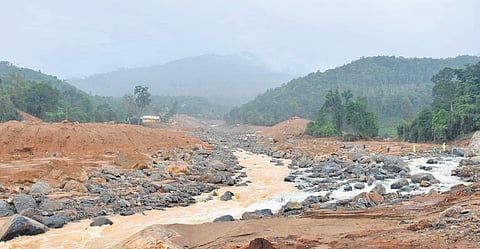

THIRUVANANTHAPURAM: The twin landslides in Wayanad have brought the issue of climate change to the forefront even as a debate rages on whether the disaster was caused by the phenomenon or was man-made, a result of ignoring warnings.
A section of scientists argues that had the Madhav Gadgil expert committee’s recommendations for the Western Ghats been implemented, the disaster could have been averted. However, a larger section studying climate change opines that global warming, warming of the Arabian Sea and change in monsoon pattern, coupled with climate change, all contributed to the massive landslides.
“The people of Wayanad have a distant relation to the causes of climate change and resultant global warming,” Roxy Mathew Coll, climate scientist at Indian Institute of Tropical Meteorology, told TNIE.
“As a high hill area, the mountains block the monsoon wind. Now, there is more moisture in the wind. This warm, moist air rises in hilly regions and transforms into multi-cellar clouds, leading to heavy rain. The warm air is supplied by the Arabian Sea due its warming,” he said.
Scientists said it is time Kerala focuses on climate change. “Kerala can claim compensation from the United Nations Climate Fund for the distresses it faces due to climate change,” said S Faizy, an ecologist specialising in International Environmental Policy.
“If it rains in a particular area, only 15% of rainwater percolates into the soil. The Wayanad landslides are a direct impact of climate change and global warming. If we claim that the disaster was caused due to forest degeneration and human intervention, we are downsizing the gravity of a serious global issue. And it is going to affect us for years,” he said.
“Kerala could make use of it as it is aimed for developing countries. The 28th meeting held in December 2023 in Dubai too had created an operational mechanism for funds. The board meeting was also held this July. It is to be noted that the Intergovernmental Panel on Climate Change (IPCC) in its 2021 report had predicted change in flood cycles, from every 100 years to every 4-5 years,” Faizy said.
The scientists also warn about more occurrences of extreme rainfall in Kerala. “According to studies, this will intensify by 2100,” Coll said.
“In Kerala, the seasonal rain is decreasing while short and heavy rain is increasing. To defend itself, the state has to acquire self-reliance. We are not equipped with enough monitoring stations under IMD. If we are able to continuously monitor, we can locate landslide-prone areas and identify hotspots,” Coll said.
He said Keralites should also change their habit of owning land and more homes.
Meanwhile, Dr V S Vijayan, a member of the Madhav Gadgil committee, said though climate change played a role in the Wayanad tragedy, human intervention shared a bigger blame for it. “Had the Gadgil panel recommendations been implemented, this could have been avoided. We had identified the affected areas as Ecologically Sensitive Areas – Zone I,” he said.
