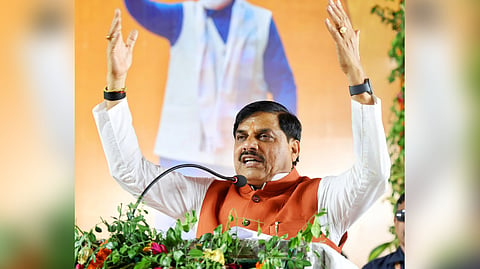

BHOPAL: A day before a special state cabinet meeting is expected to clear the draft Uniform Civil Code (UCC) Bill, Madhya Pradesh Chief Minister Mohan Yadav on Friday said only those who marry once would have the legal right to reside in the state.
Addressing events in Tikamgarh and Katni districts, Yadav strongly pitched for the implementation of the UCC in Madhya Pradesh.
"The law should be equal for everyone and there should not be any discrimination. Why should the law be different for a Hindu and for a Muslim? Shouldn't there be a single law for everyone?" he asked.
"If Ram marries just once in his lifetime, then why Rahim should be allowed to get married three or four times? Muslim women are also our sisters. Now, only those who marry once will have the legal right to live in Madhya Pradesh," the chief minister added.
The Ram-Rahim comparison to advocate for the UCC was made by Yadav for a second time in three days. He had made a similar remark during an event in Indore on Wednesday.
Yadav's remarks at two separate events on Friday came a day before a special state cabinet meeting in Bhopal's Jagdishpur village (formerly known as Islam Nagar), where the draft UCC Bill is likely to be cleared for introduction during the five-day monsoon session of the state Assembly beginning July 20.
The UCC draft was prepared by a six-member committee appointed by the state government on April 27 and headed by retired Supreme Court judge Justice Ranjana Prakash Desai.
The panel submitted its report to the chief minister on the evening of July 13 and has recommended that Scheduled Tribes be excluded from the proposed Uniform Civil Code. Tribal groups and sub-groups account for at least 21% of Madhya Pradesh's population.
The committee submitted a three-volume report.
The first volume contains its recommendations, based on an analysis of international, national and state laws, along with prevailing practices. The recommendations are divided into 10 chapters.
The second volume contains the draft Bill prepared by the committee in accordance with existing laws and rules in Madhya Pradesh. The proposed legislation comprises four parts, 404 sections and seven schedules.
The third volume includes the public consultation report, detailing consultations conducted by the committee at the district and state levels as well as through its dedicated website.
The committee received more than 9.58 lakh responses from the public and included an analysis of the feedback based on questionnaires, gender and community.
While Goa has historically followed a common civil code, three BJP-ruled states — Uttarakhand, Gujarat and Assam — have already enacted UCC laws. Two other BJP-ruled states, Maharashtra and West Bengal, have constituted committees headed by Justice Desai to prepare UCC drafts.
The steps taken by several BJP-ruled states to either enact UCC laws or constitute committees to prepare legislation are being viewed as part of a broader push towards a nationwide uniform civil law for all religious communities, a long-standing promise in the BJP's political agenda.
