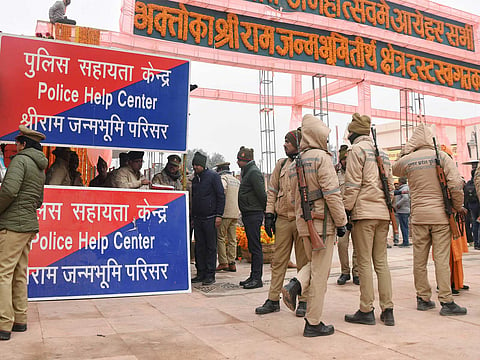

Was a parallel fund collection racket operating in the name of the Ram Temple, with fake donation receipt books used to dupe unsuspecting devotees? This is now the central question confronting investigators after the Special Investigation Team (SIT) recovered a forged donation receipt book during its probe into the alleged Ram Mandir donation theft case.
The recovery has opened a new front in the investigation, with police now examining whether the accused not only siphoned off offerings from inside the temple premises but also collected money from devotees by issuing counterfeit receipts resembling those of the Shri Ram Janmabhoomi Teerth Kshetra Trust. If established, the alleged racket would significantly widen the scope of the case from theft of donations to an organised fraud exploiting the faith of Ram bhakts.
The breakthrough came during the police custody remand of the three accused—Lavkush Mishra, Anukalp Mishra and Karunesh Pandey. Acting on disclosures made during interrogation, the SIT took the trio to Lavkush Mishra's residence in Ayodhya, where investigators recovered a fake donation receipt book. Police also questioned members of his family to ascertain whether they had any knowledge of the alleged operation or the storage of the forged documents.
Investigators believe the recovered receipt book closely resembles an older format used by the Trust during its nationwide fundraising campaign for the construction of the Ram Temple. The SIT is now matching serial numbers, printing patterns and handwriting with genuine Trust records to determine whether the forged receipts were actually used to collect money from devotees.
Police are also trying to identify people who may have received such receipts and whether the money collected ever reached the Trust's official accounts. Digital devices seized from the accused are being examined to trace any electronic records, photographs or messages related to the alleged fake receipt network.
The recovery has transformed what initially appeared to be a case of theft from temple donation boxes into a much larger investigation. Officials are now pursuing two parallel lines of inquiry—whether cash offerings deposited inside the temple were stolen and whether devotees outside the temple were cheated through forged donation receipts.
The three accused were brought from Ayodhya district jail after a local court granted police custody remand. During questioning, investigators confronted them with financial records, witness statements and other evidence collected over the past several weeks.
Earlier, the SIT had flagged serious lapses in the management of temple donations, including inadequate CCTV surveillance, weak monitoring of donation boxes and procedural deficiencies during the counting of offerings. Investigators believe these shortcomings may have facilitated repeated misappropriation of donations.
The investigation has also expanded to include scrutiny of the assets of the accused, while civic authorities have initiated proceedings over alleged building bylaw violations linked to properties owned by Lavkush Mishra. Several former Trust employees and office-bearers have also been questioned as investigators seek to determine whether the alleged fraud involved a wider network.
With the recovery of the fake receipt book, investigators are now attempting to establish whether an organised parallel donation collection system was functioning in the name of the Ram Temple. If the evidence confirms that devotees were issued counterfeit receipts, the case could emerge as one of the most significant financial fraud investigations linked to the Ram Mandir since its consecration.
