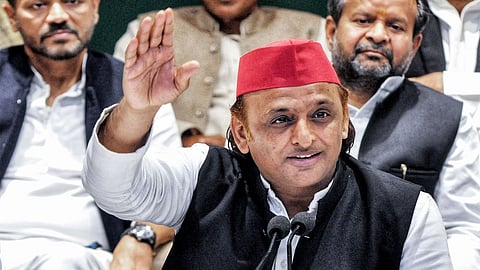

LUCKNOW: The Samajwadi Party’s performance in the Uttar Pradesh Legislative Council elections has renewed attention on its efforts to strengthen its grassroots organisation ahead of the 2027 Assembly polls. By winning the Lucknow Graduates’ constituency and the Agra Teachers’ seat, among other constituencies, the party has demonstrated its ability to mobilise voters in electorates where local networks, candidate visibility and sustained engagement can play a significant role.
However, the results also raise a larger question for party president Akhilesh Yadav: can the organisational efforts that helped the SP secure victories in specific constituencies be replicated across Uttar Pradesh’s 403 Assembly segments, or does the party continue to depend on individual candidates and localised support bases?
The BJP won six of the 11 Legislative Council seats contested in the October 2026 elections, while the SP secured five. The SP’s gains included wresting the Lucknow Graduates’ seat from the BJP and winning the Agra Teachers’ constituency through Akash Agarwal, who had won the seat as an Independent in 2020 before joining the SP. The results underline both the party’s ability to attract established local candidates and the continuing importance of constituency-level political networks.
The SP’s current strategy can be traced to the 2024 Lok Sabha election, when it won 37 of Uttar Pradesh’s 80 parliamentary seats, emerging as the state’s largest party in the election. The Congress won six seats, while the BJP was reduced to 33, down from 62 in 2019. The outcome strengthened Akhilesh Yadav’s PDA—Pichhda, Dalit, Alpsankhyak—political framework, which sought to broaden the party’s appeal beyond its traditional Muslim-Yadav support base.
The challenge came in the subsequent Assembly bypolls, when the SP struggled to reproduce its parliamentary performance. In February 2025, the party began outlining a revised organisational strategy for the 2027 Assembly election, focusing on booth-level mobilisation, early candidate selection, social-media outreach and the induction of former bureaucrats from backward, Dalit and minority communities.
An SP insider, on the party’s organisational review and the weakness said, “Having acknowledged our weakness, we are, now, focusing on strengthening our presence in every booth.”
Since the 2024 election, the SP’s organisational push has involved three broad areas: strengthening booth-level structures, identifying candidates well ahead of the election and expanding its social coalition.
The early-candidate strategy is intended to give nominees time to build relationships with voters, establish local teams and identify constituency-specific issues before the campaign formally begins. It also shifts some organisational responsibility towards candidates and district units rather than leaving mobilisation largely to the central leadership during the election season.
The party has also sought to bring former civil servants and representatives from communities covered by its PDA framework into its political and advisory networks. The objective is to improve its reach among non-Yadav Other Backward Classes and Dalit communities, while retaining its established support among Muslims and Yadavs.
In September 2026, the SP also conducted internal surveys across all 403 Assembly constituencies and asking booth-level agents to identify additional voters. The party also launched a “Youth Jodo, Booth Mazboot Karo” campaign through its student wing, SP Chhatra Sabha, to reach university and college students and collect feedback for a youth-focused manifesto.
The MLC elections offer a useful, though limited, test of the SP’s organisational approach.
In Lucknow, Kanti Singh defeated incumbent BJP MLC Avnish Kumar Singh by 17,127 votes, securing 56,905 votes against his 39,778. Kanti Singh had previously won the constituency in 2014 before losing in 2020 as an Independent. Her return to the seat under the SP banner suggests that candidate familiarity, established networks and party organisation can reinforce one another.
The Agra Teachers’ constituency presents a different example. Akash Agarwal, who won the seat as an Independent in 2020, contested as the SP’s official candidate and retained it for the party. His candidature illustrates how the SP can strengthen its position by bringing established local figures into its organisational framework.
These victories are relevant to the party’s wider strategy because they show that local political capital can be incorporated into the party structure. But they do not establish that the same formula will work uniformly in Assembly constituencies, where the electorate is much larger and more diverse and where candidates must also contend with competing caste coalitions, national and state-level narratives, welfare issues and the strength of rival party machinery.
The results therefore leave a crucial distinction: winning through a well-established local candidate is not necessarily the same as building a durable district organisation capable of delivering results across multiple constituencies.
The SP’s own organisational review has identified booth-level weakness as a concern. The next question is how uneven that weakness remains across districts.
First, the party must demonstrate that its booth committees function consistently beyond constituencies with established leaders or a strong cadre base. A committee that exists on paper may not necessarily have reliable voter lists, active workers or the capacity to mobilise supporters on polling day.
Second, the expansion of the PDA coalition requires local leadership that can accommodate communities with different political expectations. A statewide social-justice narrative may create common ground, but district-level organisations must translate it into representation, local engagement and candidate choices that are acceptable to different groups.
Third, early candidate selection can give nominees time to develop their constituencies, but it also requires effective coordination between candidates, district presidents and the state leadership. Where local factions compete for influence, the announcement of a candidate well in advance does not automatically ensure that the entire organisation works behind that nominee.
Finally, the SP must sustain its outreach between elections. The MLC results concern graduates and teachers registered in specific constituencies, not the entire electorate. These voters have distinct professional interests and mobilisation networks. Their behaviour cannot be treated as a direct measure of support among rural households, women voters, young first-time voters or different caste groups in Assembly elections.
The MLC victories provide evidence of the SP’s capacity to mobilise in particular settings. They do not, on their own, establish the reach or reliability of its district-level organisation across the state.
Political analyst Dr Shashikant Pandey, Head of the Department of Political Science at Dr Bhimrao Ambedkar University, Lucknow, highlighted the importance of the SP’s expanding social coalition while contrasting it with the BJP’s organisational strength.
“Akhilesh has been expanding his support base for years, while Yogi and the BJP continue to rely on an organisational machine that remains unmatched,” Pandey said.
However the MLC results add another dimension to this challenge. The SP’s success in Lucknow Graduates and Agra Teachers demonstrates the importance of candidate networks and local mobilisation. Yet the BJP’s six-seat tally also shows that the ruling party continues to retain a substantial presence in these specialised electorates.
The SP’s organisational changes since 2024 suggest a move towards earlier candidate preparation, more extensive booth-level mobilisation, wider social representation and greater use of constituency feedback.
What remains unclear Pandey said is the degree to which these initiaives have translated into a consistently active district-level organisation. Publicly reported plans and electoral victories offer only part of the picture; a full assessment would require district-wise evidence on booth committee functionality, worker participation, voter-contact records and coordination between candidates and local office-bearers.
For the SP, the central challenge is no longer simply to establish a broad political narrative. It is to make that narrative operational at the local level, including in constituencies where the party lacks a prominent candidate or an established support network.
The MLC elections offer a starting point for that assessment, not a definitive verdict. Whether the SP can turn constituency-specific successes into sustained organisational strength across Uttar Pradesh will depend on what happens between elections: the quality of its district leadership, the continuity of its booth committees, its ability to manage local rivalries and the extent to which its PDA framework translates into durable relationships with voters.
