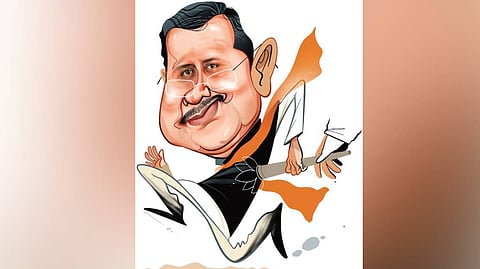

In an era of politics increasingly defined by decibel levels, Nitin Nabin’s rise has been marked by an altogether different quality-- restraint. At 45, the five-term MLA from Bihar’s Bankipur constituency has been formally elected national president of the Bharatiya Janata Party (BJP), capping a political journey rooted less in spectacle and more in sustained organisational labour. His elevation signals not just personal ascent, but the party’s renewed faith in methodical leadership drawn from the grassroots.
Nabin’s political apprenticeship began in the corridors of the Akhil Bharatiya Vidyarthi Parishad (ABVP), the student wing of the Rashtriya Swayamsevak Sangh (RSS). From there, he moved through the BJP Yuva Morcha, learning the rhythms of cadre-based politics long before occupying positions of authority. Those formative years, colleagues say, shaped a politician who listens more than he speaks, plans more than he postures.
His entry into electoral politics, however, came under poignant circumstances. In 2006, following the death of his father, Navin Kishore Prasad Sinha, a veteran BJP leader and four-time MLA from Patna West, Nitin Nabin contested the by-election from the same constituency. He won, stepping into the Bihar Assembly not merely as a political heir but as a full-time legislator. After delimitation, he shifted to Bankipur, a traditional BJP stronghold, which he has represented continuously since 2010, securing four consecutive terms.
Though his political lineage is unmistakable, Nabin has rarely leaned on it. Instead, he built credibility through legislative consistency and party work, eventually serving as a minister in the Nitish Kumar cabinet, where he handled multiple portfolios with low-profile efficiency.
That understated style extends into his personal routine. A deeply private man, Nabin begins his day with an hour-long puja, after which politics takes over without pause. He describes himself as a full-time politician, someone for whom public life is not episodic but immersive. He is known to read widely, consuming newspapers and journals with near-ritual discipline. It is a habit inherited from his father, who believed that political change flowed not from degrees but from reading, reflection and intellectual curiosity.
Within party circles, Nabin is regarded as incisive without being abrasive. He uses wit as a political instrument rather than a weapon, challenging adversaries without sliding into the personal. Measured in speech, he is also known as a patient and attentive listener, a leadership trait the BJP increasingly values.
While Bihar remains his political base, it was his performance outside the state that decisively altered his national profile. In 2023, the BJP entrusted Nabin with leading its campaign in the Chhattisgarh Assembly elections. At the time, the Congress government under Bhupesh Baghel appeared firmly entrenched, with most opinion and exit polls predicting a Congress return. What followed surprised many. Under Nabin’s stewardship, the BJP carried out extensive organisational restructuring, focused on booth-level management and micro-coordination, and quietly recalibrated its campaign machinery. The result was a clear BJP majority. Political observers attributed the turnaround less to rhetoric and more to groundwork—precisely the kind of politics Nabin specialises in. That success now looms large as the party gears up for a historic bid for a fourth consecutive Lok Sabha victory.
His appointment as national working president last month, followed by his election as national president, has inevitably fuelled speculation back home. With Bihar Chief Minister Nitish Kumar’s health often the subject of rumour, sections of the BJP see Nabin as a potential future chief ministerial face. Others suggest his trajectory may soon take him to the Rajya Sabha, with vacancies from Bihar expected in April. Such a move would trigger a by-election in Bankipur, further reshaping the state’s political chessboard. For now, however, Nabin remains a member of the Bihar Assembly and is expected to participate in its proceedings from February 2.
Beyond the arithmetic of power, it is Nabin’s persona that has earned trust across factions. Colleagues and detractors alike describe him as humble, accessible and unpretentious. He keeps his personal profile deliberately low, preferring to foreground organisational strength over individual acclaim. In a political culture often enamoured with firebrands, his quiet dependability has emerged as a strategic asset.
That dependability also aligns with the BJP’s organisational culture, which has traditionally placed emphasis on discipline. Nabin’s progression from student activist to legislator, minister, strategist and now national president has unfolded over nearly two decades within that framework. His elevation also adds to regional representation at the national level, bringing a leader from eastern India into the party’s top leadership.
Nitin Nabin’s political journey brings together several strands, an inherited legacy shaped by his own effort, personal belief systems balanced with administrative pragmatism, and strong regional roots aligned with national responsibilities. As he steps into the BJP’s most significant organisational position, his role is expected to centre on coordination and structure-building, with a focus on decision-making, organisational systems and internal consultation.
