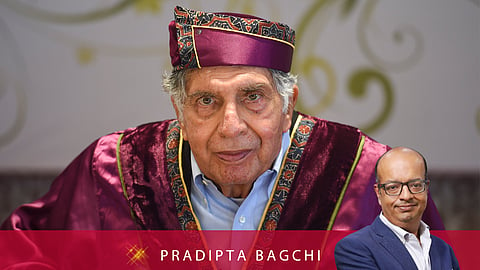

The story of local stray dogs being cared for in Bombay House, the HQ of the Tata Group in Mumbai, is well known. What is perhaps less known is the personal relationships Ratan Naval Tata had nurtured with them. When Mr Tata moved from Bombay House to the Tata Trust offices 500 metres down the road, above the Starbucks at Horniman Circle, Fort in 2012 after relinquishing charge as the Group chairman, one black stray not only tracked him to his new office but also insisted on visiting him there on the fourth floor every day when Mr Tata was in office. Nobody knew how the dog knew about Mr Tata being in the vicinity but nevertheless he was always there to greet him.
Cut to 2017. In one high-powered meeting with top officials and advisors of the group (where the writer was present), a silent observer in the room was stretched out, legs in the air on his doggy bed next to the boardroom table. At some point, the black dog woke up and stretched. Mr Tata immediately leapt to his feet, petted the dog and opened the boardroom door so that the canine could make his way back out to the street (The meeting was temporarily adjourned to make sure that the dog’s needs were looked after). The future of the Tata group would wait for five minutes.
This unwavering sense of humility and kindness towards people and animals has often been highlighted during Mr Tata's life, but certain episodes during his career as the chairman of Tata group also brought his steely convictions and firm belief systems to the forefront. Once he made up his mind after due consideration, it was nigh impossible to change it.
Circa 2008, Singur, West Bengal. Under pressure from Mamata Banerjee, he took an overnight decision to move the Nano factory at significant risk to Sanand. Gujarat. "You can put a gun to my head. Then you can either shoot the gun or pull it away because I will not move my head," said Mr Tata then. He personally oversaw a monumental effort from the Tata Motors team, which in the best tradition of thrillers, saw them dismantling entire automotive production lines and equipment and moving out of the factory in the dead of night. That was the start of his long relationship with the Prime Minister, when Narendra Modi was the Gujarat CM and offered to house the Nano factory in his state. While the Nano did not set the market alight commercially, the design innovations and manufacturing benchmarks it showcased inspired not only Tata Motors but also the entire Indian auto industry. And turned Sanand into a significant auto hub it is today.

When Mr Tata dreamt, he dreamt big and then pursued them with passion, purpose and most importantly patience. He was a pioneer in globalising the Indian business.
His overseas asset acquisition spree in US, UK and Europe in the 2000s left his Indian peers incredulous. Within a decade, Tata bought Tetley Tea in 2002; then Corus, the erstwhile British Steel in 2006-07; and finally Jaguar Land Rover from Ford in 2008-09. In between, he established visible hotspots for Indian business globally with acquisition of landmark hotels in London, New York, Boston and San Francisco that put Taj Hotels on the global map.
Many of these decisions required long-term investments to pay off. But as he once told a journalist when asked whether his decisions to buy these expensive foreign assets was wise, “I don't always take the right decision. I make the decision and then make it right."
When he took over chairmanship of the group from another business legend, JRD Tata in 1991, the Tata Group was at best, a loose federation of companies working under with the same brand but with very different cultures and leaders. Equity dilutions to raise capital had led to lack of control and created company fiefdoms within the group. The first task was to bring it all back together and he approached the issue with deliberation and steadfast belief in his ideas. A new brand identity was created and to use the Tata brand, group companies had to sign up to framework of values which determined the company's behaviour with stakeholders and left no space for any questionable actions. Fiefdoms were slowly dismantled and newer, modern management structures were introduced.
Unheard for the Tatas in 1990s, he also took tough business decisions – selling personal care business Lakme to Hindustan Unilever, for instance. Later, Tata Sons steadily increased its span of control by hiking its equity stake in key companies especially after the uber successful listing of TCS on the bourses in 2004.
More than any other Indian industrialist of his generation, to Mr Tata goes the distinction of taking Indian business to a higher sense of belief, competence and innovation across industries. He may have been a fifth-generation Tata family member to head the group, but he also infused new professional attitude and greater ambition into the Tata group.
His drive to make cars in India propelled Tata Motors into passenger cars. While the Indica and Indigo may seem unrefined today, their launch in early 2000s set new benchmarks for small cars for other players to follow.
His dream to bring aviation back into the Tata fold began with a JV with Singapore Airlines in the 1990s. When unscrupulous and persistent lobbying from Jet Airways stymied that dream for almost two decades, Mr Tata, despite advice to the contrary, refused to submit to this game and bided his time. "By standing out so publicly and consistently against graft, Mr Tata was ahead of his time," remarked The Economist in 2012.
His commercial aviation dream was finally realised when Vistara finally took off in 2012 just as he retired. Although it was long after he retired, Tatas bringing Air India back into the group was an especially proud moment for him as it was his mentor JRD Tata who had the vision to bootstrap Air India before it was nationalised in the 1950s.
His love for all things aviation was capped by his flight on an F16 fighter jet some years back. His belief in the potential of the Indian aerospace industry led him to found and nurture Tata Advanced Materials Systems for many years until the sector was opened to the private sector players recently.
He was an architect from Cornell University, USA but his real passion lay in design and in an abiding curiosity about how something worked. Among his friends and peers, he was known for his expertise and love of design from cars to technology and even Tata campuses. For example, he never lost his interest in designing cars and before every new model launch, the design and engineering teams from JLR and Tata Motors would take time to brief their former chairman on the intricacies of the new designs and the new model's functionalities and take his feedback. He remained as ever curious and engaged.
Some of his business bets didn't work out. His belief in CDMA technology for mobile phone networks was not successful due to regulatory confusion and technology constraints. But unlike many other telcos, Mr Tata insisted Tata Tele honour all its financial commitments to the government despite the venture losing money and failing to take off.
Never ostentatious in his habits or lifestyle, Mr Tata lived in a small bungalow by the sea, shunned extra security and remained a private individual, especially once he stepped down as the Tata chairman in 2012. Though not an extrovert, he had an infinite capacity to build strong friendships and mutual connections with his peers across the world – from architects like Todd Williams to musical maestros like Zubin Mehta and tech pioneers like Irwin Jacobs founder of Qualcomm.
Always media shy and away from the public glare, Mr Tata was at his best in more private settings with employees, customers and partners. After company events, he would often stay back to meet employees (and in later years take many selfies with them), have a meal and engage. His natural curiosity led him to immerse himself in new demos and presentations and ask questions that the presenter had not considered yet. For group employees, he was the epitome of the Tata values, living them every day with his actions and words and someone who inspired them.
His ability to engage and relate to people across all age groups was special. From young professionals who wanted to work with him to start-up founders who wanted his blessings as an investor in their companies, even after he retired, Mr Tata was able to build connections with Millennials and Gen Z simply by understanding and addressing what was important to them. His decision to participate in social media, through old-school hand-signed messages, only added to his popularity and respect in his retired years.
His support for innovative social enterprises, for elder care by young adults for example kept him engaged and motivated. Despite the problems caused by Covid, he ensured that the Mumbai has a new world-class hospital for small animals like dogs and cats. And most importantly his messages of support and encouragement have ensured that the Tata heritage of giving back many times over to communities in India (and now increasingly the world) is truly embedded in the DNA of Tata companies.
As The Economist said in a leader in 2012, when he stepped down: "Mr Tata’s career carried two powerful lessons for an introverted and corruption-obsessed India. First, that India has far more to again than lose from the outside world. And second, that a company can be a force for progress."
That sentiment rings even truer now that he is no longer with us, but happily reunited again with his favourite companions – his German Shepards Tito and Tango. Go Well, Mr Tata.
(Pradipta Bagchi is a communications consultant and worked as Chief Communications Officer with Tata companies between 2004 and 2019. He can be found on X @bagchips.)