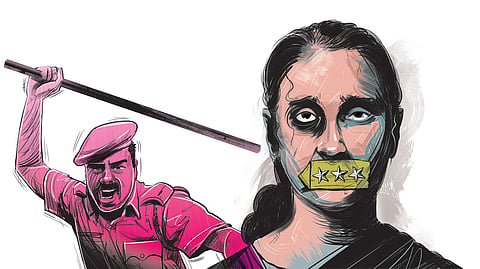

The recent case of police brutality in Odisha, where the fiancée of an Army officer was allegedly assaulted while in custody, has ignited national outrage. But this horrific episode is more than just a singular instance of gender-based violence; it points to systemic flaws in India's law enforcement. Over 2,000 custodial deaths were reported between 2017 and 2021, yet the number of convictions remains staggeringly low.
While the Odisha government’s immediate response — suspending officers and promising investigations — may seem swift, these actions appear more aimed at pacifying public anger than delivering real accountability. Without substantial reforms, such measures merely skim the surface, leaving the entrenched culture of police impunity intact.
On the night of September 14-15, a couple approached the Bharatpur Police Station in Odisha to report a road rage incident. Instead of receiving protection, the woman alleges she was brutalized — beaten, molested, and sexually assaulted by officers, including the station inspector. Her fiancé, an Army officer, was also allegedly assaulted and unlawfully detained. This appalling event reveals a disturbing truth: the very institutions designed to protect citizens often become perpetrators of violence.
Beyond the headlines, this case raises critical questions about the state of policing in India. Why do incidents of custodial violence continue to occur with alarming frequency? Why is it so difficult to bring perpetrators to justice? And how can we restore public trust in a system that is meant to protect us?
A 2021-2022 report from the National Human Rights Commission documented over 2000 custodial deaths during that period alone, highlighting the widespread abuse of power. Despite efforts like the Supreme Court's 2023 directive mandating CCTV surveillance in police stations, incidents like this one expose glaring gaps in accountability and enforcement.
The pattern of police misconduct then is not unique to Odisha. National Crime Records Bureau (NCRB) data from 2021 reveals that over 49,000 complaints were filed against police officers, yet fewer than 28% resulted in any disciplinary action.
Between 2019 and 2022 less than 1% of officers implicated in custiodial deaths were convicted. The Centre for Law and Policy Research (CLPR) in 2023 highlighted that most of these deaths involved marginalized groups.
In the Odisha case, while five officers have been suspended, such reactive measures barely scratch the surface. What’s really needed is to dismantle the entrenched culture of impunity within law enforcement that shields officers from facing meaningful consequences.
Despite legal reforms, such as the 2013 Criminal Law (Amendment) Act aimed at reducing sexual violence, police stations — meant to be places of protection — are often sites of fear for women. In 2022, the NCRB reported over 31,000 cases of rape in India, with a disturbing number involving law enforcement officers as perpetrators. A 2023 report by the Ministry of Women and Child Development revealed that over 70% of women were afraid to report crimes to the police, fearing further mistreatment. This culture of fear silences many victims.
The Odisha case highlights the urgent need for systemic reform. India’s response to police misconduct can no longer rely on short-term suspensions or public statements. What is needed is a structural overhaul of the country’s law enforcement system. Investigations into police misconduct should be conducted by independent bodies or judicial commissions, not internal police units that often protect their own.
Additionally, India’s police forces must undergo continuous gender-sensitivity and human rights training. A 2023 pilot program in Maharashtra, which introduced such training for newly inducted officers, led to a 12% reduction in complaints of police misconduct. This type of training should be scaled up nationwide.
The police departments must also improve transparency by publicly disclosing the outcomes of investigations into misconduct. The custodial deaths and sexual violence perpetrated by law enforcement must lead to swift legal action, with no room for impunity.
The Odisha case has cast a harsh spotlight on India's police forces, exposing the deeply ingrained issues that plague them. The nationwide outrage presents a rare opportunity for meaningful reform, but the question remains: will India seize this moment for change, or will this case simply become another tragic entry in the long list of police brutality incidents? Without systemic reform, the cycle of abuse, impunity, and public mistrust will only continue.
Justice for the Odisha victim — and for all victims of police violence —remains precarious. India’s path forward hinges on its willingness to embrace reform. The nation is watching, and what happens next could either pave the way for change or allow the status quo to persist.
(The author is Director, AF Development Care, New Delhi)
