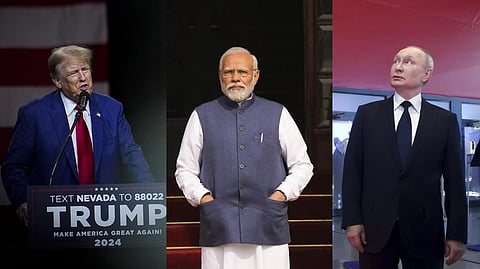

The recent tariff blows administered by President Trump upon India, accompanied by his dismissive "dead economy" remark, has led to us unfurling foreign policy moves involving Russia and China. These offer a textbook case of strategic signaling, demonstrating a preparedness to exercise all available levers of statecraft.
Prime Minister Modi's telephone conversation with President Putin, coupled with NSA Ajit Doval's visit to Moscow, served to not only reassure Russia but also sent a calculated message to Washington. This was further bolstered by our Prime Minister's visit to China for the SCO Summit and the subsequent visit of Chinese Foreign Minister Wang Yi to New Delhi, where he held extensive talks with NSA Ajit Doval and other Indian leaders.
Notably, Doval himself visited China in June 2025 for the SCO Security Council Secretaries' meeting and held direct discussions with Wang Yi in Beijing. President Putin has now called PM Modi to brief the latter about his discussions with President Trump. And PM Modi has in turn thanked President Putin for doing so. The dance is well and truly on.
Moments such as these have the tendency to revive Cold War reflexes and it must come as little surprise to hear many voices urging India to reassert its strategic autonomy. However, the fact that India along with Brazil has fared the worst among major economies in trade negotiations with the United States raises questions of whether this is far deeper than just short-term friction.
To understand, we must unpack the developments before rushing into any conclusions.
First, there needs to be the realisation that the nostalgia for a 146-million-strong Russia—rooted in its historic use of the UNSC veto—to shield a 1.4-billion-strong India is no longer enough to meet rising aspirations in our nation. Around 7 to 8 million young Indians enter the labour market each year. For an India, where more than 65 percent of the population is under the age of 35, relations with Russia offer limited prospects to expand economic opportunities or strengthen the country’s manufacturing base.
What we must instead understand is that certain structural realities will continue to shape the US–India relations regardless of leadership changes. Both Trump and Modi are well above their nations' median age 40 and 29 respectively, yet their personal styles have disproportionately influenced bilateral narratives. It would, though, be short-sighted to reduce the overall trajectory of the relationship to this specific political moment.
India is more than Modi and the US is more than Trump
Long-term trends such as shifting demographics, immigration patterns from India to the US, rapid technological change—an area where the Indian diaspora in the US has a significant role to play—and China's steady rise will keep drawing the two countries into deeper engagement.
Broadly, the United States can't be reduced to President Trump, just as India is more than Prime Minister Modi. As former US National Security Adviser and Republican John Bolton recently hinted, with a passing of a few more quarters, the world can get on with the normal realities. That said certain elements of Trump-era politics are likely to leave a lasting imprint on US domestic and foreign policy.
With this being the case, while India can and should diversify its partnerships, particularly with Southeast Asia and Northeast Asia along with Latin America and Africa, its engagement with the United States must continue to be given a unique place. With nearly a quarter of the global GDP and as the world's leading technological innovator, the US offers India the opportunity to leapfrog technologically, bolstered by the influence and resources of a vast and well-integrated Indian diaspora.
Therefore, it is essential to view this relationship within the broader strategic canvas, one in which US–India engagement remains among the most consequential. This relationship could also benefit India–Europe ties, given the transatlantic interdependencies.
Now, coming specifically to the present.
It seems President Trump had been irked by India. There might have been a discernible US role in dousing the latest India–Pakistan conflagration. It was so even in past episodes like the 1999 Kargil war and 2001-02 Operation Parakaram. The only difference is that President Trump jumped in to claim credit this time around.
President Trump's limited sensitivity to the nuanced history and to India's established red lines, which the career diplomats of the US State Department would have been expected to convey to him, hasn't helped matters. With India rebuffing the US President's claims, a significantly weaker Pakistan, with far fewer levers of influence, managed to secure comparatively better economic outcomes from Washington.
This included President Trump’s high-profile lunch meeting with Pakistani Army Chief Asim Munir. But the natural trajectory of US–India relations that had been on the upswing ever since President Bill Clinton's landmark visit to India in March 2000, will likely reassert itself over time.
Need for a foreign policy reboot
What this episode underscores is the urgency we must show in absorbing and acting upon the lessons from this diplomatic setback. There must be a sharper reading of the tea leaves in Washington and a more agile foreign policy.
Along with this must come a rethink of personality-driven approach adopted by the Modi government. Nowhere is this more evident than in the foreign policy establishment.
Under Foreign Minister S Jaishankar, a seasoned career diplomat, the Ministry of External Affairs has increasingly resembled an event-management outfit rather than a strategic command center.
Much of Jaishankar’s public visibility comes through carefully curated interviews with sympathetic think-tank interlocutors or appearances at international forums that resemble PR showcases rather than substantive policy engagements. This performative style, which privileges clever soundbites and applause-winning lines, risks turning diplomacy into a spectacle where optics overshadow outcomes.
More importantly, it also overlooks a central strength of India’s foreign policy tradition: its domestic inclusivity and bipartisan consensus. For decades, India’s external posture derived stability from a broad political agreement that foreign policy must remain above partisan divides. This consensus, whether on non-alignment, nuclear policy, or neighborhood engagement or even the US, allowed India to navigate shifting global dynamics with continuity and credibility.
By contrast, the current approach sidelines wider political dialogue.
Without investing in institutional resilience, regional expertise, and cross-party ownership, India risks hollowing out the very foundations that once made its foreign policy distinctive and served it well. In a century defined by multipolar uncertainty, shifting alliances, and technological disruption, India must embrace a foreign policy that is inclusive, bipartisan, and future-ready; but definitely not one reduced to the cadence of a public-relations campaign. Only then can we as a nation soar onwards.
(Views are personal. The author has over 25 years of experience as a practitioner, researcher, and analyst in international affairs.)
