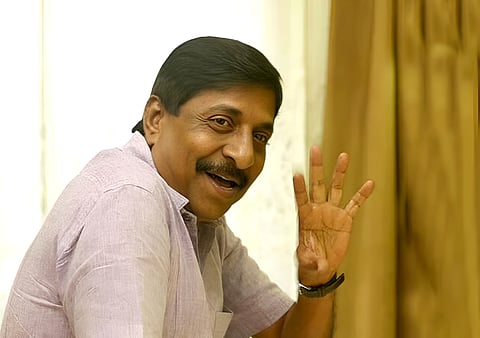

THIRUVANANTHAPURAM: How political was he? Or apolitical for that matter. Veteran writer- actor- director Sreenivasan's political screenplays traverse mostly through wafer-thin margins of both the political and apolitical, even at times, merging the two. A master storyteller, he succeeded in capturing the subtle hues of the Malayali psyche via his scripts that almost always reflected Kerala society in its entirety, through a career that spanned almost five decades of stellar creative output.
As an untiring champion of social satire, political criticism and creator of unadulterated humour, Sreenivasan mirrored the Malayali community of the 70s and 80s, with all its vulnerabilities, pettiness, honesty or the lack of it through his blockbuster scripts.
Be it his first Mazha Peyyunnu Maddalam Kottunnu, the widely popular trilogy of Nadodikkattu, Pattana Pravesham, Akkkare Akkare Akkare spread over three years, his screenplays encapsulated storylines that never failed to question the societal convictions of the day.
Sandesam, one of his most popular screenplays ever, could well be the rebelliousness of a societal spectator, fed up with the existing system. Contrary to popular perception it was not mere Left bashing or revving up anti-Communist sentiments that Sreenivasan often indulged in. The astute political commentator that he was, Sreenivasan preferred to take a bird's eye view at the sore lack of inner political conviction that often runs as a leitmotif through Kerala society, cutting across all classes.

Laced with vibrant political undertones, Sreenivasan's scripts often shed light on a wide variety of topics. Who can ever forget the clipped arbitrary hint of threat hidden within Polandinekurich Oraksharam Mindaruth, an evident reference to the setback faced by Communists in Poland.
The ease with which he incorporated a slice of international politics into the socio-cultural-political machinations of a Kerala neighbourhood, stands testimony to his brilliance as a scriptwriter.
Exposing the Malayali’s innate farcical hypocrisy and inbuilt contempt for anything and everything around him, Sreenivasan zeroed in on the deep-rooted prejudices and complexes of the Malayali psyche. In a way, Sreenivasan—whose dialogues have become ingrained in the minds of Malayalis across the globe—created a kaleidoscope of frames that captured the idiosyncrasies of Kerala society of the time. Be it Gulf migration in the 80s and 90s, spiralling unemployment, the typical work-shy youth of the era, their intricate social complexities, or lack of political conviction—the list seems endless.
In many ways, Sreenivasan’s scripts aptly captured the political, religious, spiritual, and philosophical undercurrents of Kerala society. The manner in which his scripts depicted tears, laughter, sorrow, self-pity, and inner complexities held Malayalis captive. He chose to tread a path that differed distinctly from many established screenwriters, be it the legendary MT Vasudevan Nair, the widely popular T. Damodaran, or the mystic Padmarajan. His cinematic scripts chose to turn the searchlights on the shattered hopes and dreamy future aspirations of the burgeoning Malayali middle class.
The average Malayali was ever his faithful audience—the very people he took up his pen for. For instance, even while portraying the woes of unemployment, he did not shy away from shedding light on how militant trade unionism killed many business dreams of Gulf returnees, as enshrined in the film Varavelppu, which would later be termed apolitical. The latter half of his writing career saw a more content version of the scriptwriter in him, as seen in films like Chinthavishtaaya Shyamala and Njan Prakashan. Even while appearing somewhat pessimistic in approach, his firm belief in the innate goodness of people never seemed to waver.
How, then, would an average Malayali cine-buff remember him in totality? Sreenivasan could well remain the master of subtle humour for Malayali movie lovers for years to come.
LIFE AND TIMES OF A LEGEND
1956: Born on April 6 at Pattiam near Thalassery, Kannur
1976: Film debut Manimuzhakkam, directed by P A Backer
1977: Enrolled in Film and Television Institute of Tamil Nadu, Chennai
1979: First lead role in move Sanghaganam by P A Backer
1984: Debut as writer in Odaruthammava Aalariyam by Priyadarshan. Also married Vimala.
1989: Debut as director with Vadakkunokkiyanthram, which he also wrote himself
1998 - Won national film award for best film on other social issues for Chinthavishtayaya Shyamala
Career highlights
1976 Manimuzhakkam
1977 Sneha Yamuna
1980 Mela
1984 Odaruthammava Aalariyam(also writer), Panchavadi Paalam, Akkare 1985 Mutharamkunnu PO (also writer), Punnaram Cholli Cholli (also writer), Aram + Aram Kinnaram (also writer)
1986 T P Balagopalan MA (also writer), Sanmanassullavarkku Samadhanam (also writer), Oru Katha Oru Nunnakatha (also writer), Dheem Tharikida Thom
1987 Nadodikattu (also writer)
1988 Pattanapravesham (also writer)
1991 Sandesam (also writer)
1993 Midhunam (also writer)
1994 Thenmavin Kombath
1996 Kalapani
2003 Kilichundan Mampazham (also writer)
2007 Arabikkatha
2011 Traffic
2018 Njan Prakasan (also writer)