
Two years have passed since the Hamas assault on Israel that began this latest cycle of devastation, and Gaza lies in ruins. What began as an act of terror has become the systematic annihilation of a people—a genocide, as even the United Nations has underlined.
More than sixty-five thousand Palestinians are dead, tens of thousands wounded, and almost the entire population driven from their homes. Hospitals and schools have disappeared under bombardment. Gaza's universities, once alive with young voices, now stand silent—a monument to an erased future. Children are being made to die of hunger while food and medicine wait at sealed borders. The punishment no longer targets those who carried out the attack; it engulfs an entire population.
Survival itself has turned into resistance. The world watches and turns away. "Ceasefire" has grown into a broken word, and "peace" has become a theatre directed by those who veto it. This is not war in any recognisable sense. It is the deliberate destruction of a people, carried out in daylight and broadcast to a world that refuses to see.
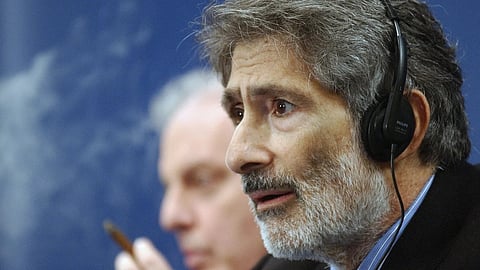
In this devastation, the absence of Edward W Said, the great Palestinian-American intellectual, feels less like nostalgia and more like a moral void. His death anniversary passed quietly on September 25, yet his voice belongs to this hour.
Said would have condemned the killing of civilians by Hamas without hesitation, but he would not have allowed that condemnation to erase the history that made such violence imaginable—the occupation, the siege, the relentless colonisation, and the daily humiliations that strip life of dignity.
He would have spoken against terror and revenge with equal precision, exposing the rhetoric of "security" when it becomes a cover for domination. His anger would have been disciplined, his grief unsentimental, his demand unyielding: moral life begins when we refuse to look away.
Said's clarity is needed now—the courage to name things truthfully, to see in Gaza not a passing conflict but the culmination of a century-long struggle over land, history, and representation. He would have reminded us that the question of Palestine is not a regional concern but the measure of the world's conscience, and that in Gaza's devastation we witness what he most feared: reason stripped of its moral life.
For Said, the vocation of the intellectual was a form of moral labour. "There is nothing more reprehensible," he wrote, "than those habits of mind in the intellectual that induce avoidance, that turning away from a difficult and principled position which you know to be right but choose not to take."
The task was to speak truth to power, to resist the comforts of consensus, to preserve an independence of thought that no ideology could command. Nothing corrupts that calling more than trimmed words and patriotic caution. Solidarity must be earned through criticism, especially of the power closest to us. Gaza has revealed how few have remained faithful to that measure.
Across universities, media, and public life, neutrality has become the language of evasion. Sorrow replaces analysis, and complexity becomes a shield for paralysis. Gaza is treated not as a people under siege but as a diplomatic inconvenience.
Said warned against this liberal habit, the instinct to seek balance in the face of devastation. For him, to be worldly was not to be neutral but to recognise that knowledge lives inside power, and that conscience must answer for that entanglement.
The evasions he chronicled have hardened into institutions, even among thinkers who once placed reason at the centre of moral life. Among them, Jürgen Habermas, one of the foremost philosophers of our time, long regarded as a guardian of communicative ethics and democratic reason, stands as a painful example. In 2023, he and a group of German intellectuals issued a statement condemning the killings by Hamas while describing Israel's assault on Gaza as "justified in principle".
Coming from a thinker who had helped shape Europe's moral vocabulary after fascism, the statement was shocking and wounding. It called for proportionality and warned that the use of the word genocide was "historically inappropriate and politically dangerous". Its tone was careful, procedural, exact—and hollow.
Against the ruins of Gaza, such phrasing no longer sounds like philosophy; it sounds like bureaucracy rehearsing its own virtue. What can "justified in principle" mean when entire cities have been erased? What does "proportion" mean when food, water, and medicine have become weapons of siege? These are not questions for academic debate but for moral reckoning. Said foresaw this: when critique loses its ethical nerve and takes refuge in consensus, it ceases to be criticism and becomes etiquette for power.
He had seen such paralysis before. In his London Review of Books essay My Encounter with Sartre, Said recalled a 1979 seminar in Paris organised by Les Temps modernes, Sartre's influential journal of political engagement. For "security reasons", it was moved to Michel Foucault's apartment.
Sartre, Simone de Beauvoir, and Foucault were present—Europe's leading voices of freedom gathered to discuss Palestine. When the subject arose, silence took over. De Beauvoir left early. Foucault excused himself, saying he had nothing to add, and went to the Bibliothèque Nationale. Sartre, who had once written with searing honesty about colonialism and the Algerian war, said nothing.
Said remembered the moment not to diminish their intellectual stature but to expose a deeper failure—the inability of Europe's conscience to confront its complicity in new forms of empire. Foucault's attention to "microphysics of power" rarely extended to the vast machinery of occupation; Sartre, despite his past courage, could not speak against a state he had come to identify with Jewish survival. In that quiet Paris apartment, the language of liberation fell silent before the politics of fear, and the moral courage of a generation gave way to hesitation.
It was against such evasions that Said shaped his politics. Where others mistook silence for prudence, he sought an ethics of clarity and risk. He rejected partition not as diplomacy but as a continuation of colonial logic, the renewal of domination through the language of peace. In its place, he imagined a single democratic state under one constitution, secular and inclusive, where Jews and Palestinians could share equal citizenship and responsibility.
Peace, in this imagination, was not a truce between separations but an acknowledgment of "overlapping territories and intertwined histories", a moral realism grounded in coexistence rather than division. Critics called it utopian. Said countered that the so-called two-state solution was the true illusion, a map designed to preserve inequality under the name of peace.
History has proved him right. The geography of apartheid has replaced the promise of sovereignty; the justice he imagined remains the only principle that still carries moral weight.
His moral clarity extended into vigilance. Said watched how diplomacy transformed liberation into administration and resistance into bureaucracy. The Oslo Accords, hailed as the dawn of peace, appeared to him as an act of surrender. In The Desertion of Arafat, he accused the Palestinian leadership of exchanging justice for privilege, turning the struggle for self-determination into the management of occupation.
What was presented as reconciliation became a machinery of control, in which the occupier dictated the terms and the occupied enforced them. He called it a "colonialism of procedures", a system where freedom was reduced to paperwork and dignity to dependence. His resignation from the Palestine National Council was an act of integrity, his refusal to believe that justice could be negotiated within structures built to maintain inequality.
That illusion has returned in new forms. The Trump–Netanyahu twenty-point plan repeats Oslo's moral fraud, offering aid without freedom and reconstruction without sovereignty. Announced in the shadow of a US veto on a United Nations ceasefire resolution, it turned Gaza's ruins into a stage for imperial charity.
Cameras framed the speeches while the siege continued. The language was careful; the cruelty, administrative: a "deradicalised" Gaza under foreign supervision, security without statehood, control disguised as order. Trump's ridiculous demand for the Nobel Prize and his grotesque dream of rebuilding Gaza as a tourist paradise replay the logic that Said had long exposed—the conversion of destruction into development, conquest into investment.
Against these ugly spectacles of power and human hubris, Said practised a truthfulness grounded in care and risk. He insisted that the intellectual's task was not to serve authority but to unsettle it, to give voice to those silenced by the rhetoric of domination. Thought itself, for him, was a moral act, a form of answerability to suffering.
"The intellectual," he wrote, "is neither a pacifier nor a consensus-builder, but someone whose whole being is staked on a critical sense." He lived by that conviction. His Columbia University office was once set ablaze; he was branded a "professor of terror".
When he hurled a symbolic stone across the Lebanese–Israeli border in 2000, American newspapers vilified him. Yet he wrote on, undeterred, turning outrage into lucidity. His authority came not from privilege but from risk, from the discipline to think freely even when the cost was isolation.
Exile shaped that discipline. Said often turned to Jewish thinkers who had defined the moral conscience of modernity—Erich Auerbach, Theodor Adorno, Walter Benjamin. In their meditations on memory and displacement, he found a mirror for his own condition. With irony and gratitude, he once called himself "the last Jewish intellectual".
The phrase was an act of solidarity, not identification. As a Palestinian Christian, he recognised how his own homelessness resonated with older histories of exile, yet his moral compass remained anchored in the suffering of his own people. From that in-between space—between belonging and estrangement—he spoke against every form of domination.
Said often reminded his readers that Palestinians are "the victims of the victims". He never diminished Jewish suffering; he insisted that it must be remembered in its full horror. Yet remembrance cannot become a justification for new injustice. The tragedy of the twentieth century, he wrote, is that the moral authority born from one people’s persecution has been invoked to rationalise the displacement of another. The historical dispossession of the Jews cannot serve as an alibi for the dispossession and annihilation of the Palestinians.
Of all peoples, the Jews, with their long memory of exile and persecution, should have been most attuned to the pain of another uprooted people. It is not Jewishness but the Zionist war machine, sustained by American power and Western complicity, that has turned the ideals of refuge and redemption into the instruments of siege. Said’s warning remains urgent: when history’s victims become agents of domination, the moral order of the world collapses once more.
In Gaza, the earth itself has become a grave. What happens there is not war but genocide, the deliberate destruction of a people through starvation, bombardment, and erasure. The powerful call it defence; its victims endure it as extinction. As Walter Benjamin wrote, to remember the past is to seize hold of a memory at a moment of danger. One such memory is that of Edward Said and his lifelong engagement with the question of Palestine. Said teaches us that moral understanding begins with memory, with the courage to recover histories buried beneath official narratives and to describe them in their full human density.
His writing on Palestine insists that memory is not nostalgia but resistance, a way of reclaiming dignity from the language of domination. Against the evasions of liberal reason and the failures of intellectual courage, from Habermas' procedural caution to Sartre's and Foucault's silences when Palestine entered Europe's moral imagination, Gaza stands as the site where the collapse of reason becomes visible.
Against such moral ambiguities and silences, gestures of resistance continue to emerge. A group of school students in Kasaragod performed a mime in solidarity with Gaza before being silenced by a few. A flotilla of activists from across the world, including Greta Thunberg, sailed toward Gaza in an act of solidarity but was stopped by Israeli forces before reaching its shore. Acts such as these, though fragile, affirm the persistence of moral life and the possibility of affiliation.
They resist the comfort of forgetting and renew the fragile bond that ties thought to responsibility. Said believed that humanism can be redeemed only in the name of humanism, despite its long history of complicity and blood. That faith, tested by empire and exile, still endures. From the ruins of Gaza, a new critical humanism must begin again, not as a discourse of mastery but as a practice of care and empathy. From these fragments a different kind of reason may yet take root, tempered by grief, sustained by compassion, and alive to the suffering of the wretched of the earth.
(Prasad Pannian teaches in the Department of English and Comparative Literature at the Central University of Kerala, Kasaragod. He is the author of Edward Said and the Question of Subjectivity (New York: Palgrave Macmillan) and was awarded the Edward Said Fellowship at the Heyman Center for the Humanities, Columbia University, in 2019. He can be reached at prasadpannian@cukerala.ac.in.)
