
Some people in Mamata Banerjee’s inner circle must have their knives out for her. On the day of the Durga Puja carnival in Kolkata that coincided with the climate calamity in north Bengal, instead of handing her a note at the start of the event advising her to publicly commiserate with those bereaved and left homeless in the floods and landslides, the Brutus handed her a violin.
As a result, what the world saw was not just Mamata clapping and dancing with a bevy of starlets on a grand stage on the city’s arterial Red Road as the idols of goddesses rolled by on flatbeds, it even saw her pretend-playing the violin thrust into her hands.
All this, while north Bengal drowned.
How her adversaries must have smirked when cameras clicked and recorded for history the moment when a violin-playing Mamata donned the mantle of King Nero who had historically or mythically played the fiddle or lute or cithara as Rome burned.
Mamata needs to spring-clean her coterie. Someone in it who is more mindful of history than her has damaged her image more badly than the BJP could ever dream of doing.
Battlefield North Bengal
Assembly elections in West Bengal are six months away and the Durga Carnival and north Bengal floods are sure to be major factors in the poll battle of 2026. North Bengal has consistently been Mamata’s Achilles’ heel. In poll after poll, north Bengal has denied her a total sweep of the state. Of eight Lok Sabha seats in the region, the BJP won six in 2024, while in 2021, most of the BJP’s 77 seats in Assembly came from the six districts of north Bengal—Cooch Behar, Alipurduar, Jalpaiguri, Darjeeling, North Dinajpur and Malda.
For the Trinamool Congress (TMC), any opportunity to win brownie points in north Bengal is a godsend. And at Nagrakata, it had a chance. Two visiting BJP lawmakers—an MP and an MLA—were brutally assaulted there. A blame game followed, with the TMC claiming that Nagrakata was a BJP stronghold but disgruntled BJP supporters had attacked the BJP leaders because they had allegedly come to the spot with only some photographers for photo-ops. And no relief material. This analysis gained ground as similar, if less violent, protests met some other local BJP MLAs at a couple of other places when they went to distribute relief.
The TMC could have capitalised on this and launched a political campaign against the BJP on its non-performance and loss of ground in north Bengal. But they kind of blew it. A full 48 hours after the attack on the BJP leaders, despite the miscreants being clearly visible in video footage of attack, there have only been two arrests. Six others named in the FIR are yet to be arrested. The BJP claims the attackers are TMC goons and so allowed to go scot-free. Adding a communal twist, the BJP posted photos of the “miscreants” on X, named them and pointed out they are all of the minority community.
Mamata pursued her own brand of identity politics. She visited the injured BJP MP Khagen Murmu in hospital but not the BJP MLA Shankar Ghosh admitted in the same institution. Why this discrimination between two BJP leaders who were injured in the same attack? Mamata’s explanation was that Murmu was a diabetes patient and his condition more complex. She also said he was not badly hurt and had a minor injury behind his ear.
The BJP claims Murmu has a fractured facial bone. It also claims Mamata visited the MP because he belongs to the Adivasi community and she may have angered her Adivasi vote bank if she had ignored him. Ghosh is not an Adivasi.
PM vs CM
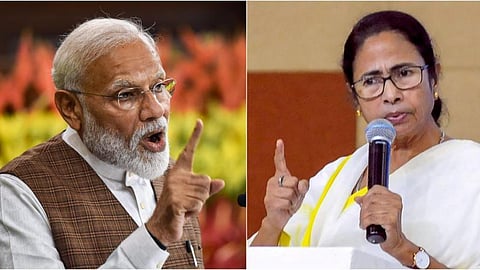
Prime Minister Narendra Modi joined issue with a long tweet. Mamata’s response was longer. Both were equally scathing. But Modi was less Prime Minister and more party leader in the tweet. Some key lines: “the manner in which our Party colleagues…were attacked in West Bengal…is outright appalling …(and)…highlights the insensitivity of the TMC as well as the absolutely pathetic law and order situation in the state.”
Mamata paid back in kind. Modi was trying to “politicise a natural disaster without waiting for a proper investigation,” she wrote; her punchline, “such sweeping unsubstantiated generalisations are not only immature but also… unbecoming of the highest office in the land.” Modi’s belated visit to Manipur also drew a rebuke as did his “opportunistic political theatre” in Bengal.
Modi and Mamata have publicly crossed swords on X in the past. But the exchange was always between a PM and a CM. In this latest round, two of the highest office-bearers of the country have exchanged verbal slingshots as party functionaries or karyakartas.
Politics over ecology
Amid the political battle between the BJP and the TMC, key questions about the devastation of north Bengal have been pushed to the back burner. One of the most startling videos to have emerged in the aftermath of the disaster is of hundreds of logs floating down a swollen river. The scene, say those familiar with the film, is reminiscent of Pushpa, which tells the story of a sandalwood smuggler who may be based on Veerappan.
This video clip has raised concerns about large-scale deforestation across north Bengal to apparently make way for tourist resorts and malls on the fringes of the forests. Officials have reportedly claimed the logs had floated down from the forests of Bhutan. But it would be erroneous to say the explanation has found many takers.
Almost exactly two years ago, a GLOF or Glacial Lake Outburst Flood had turned the Teesta river into a turbulent torrent that killed 100-plus people in north Bengal. Memories of the GLOF have returned to haunt those who are watching the environmental depredation of north Bengal. In the past, north Bengal, they say, would see devastating floods every 10 or 15 years. But the current disaster has come within two years of the GLOF and fears are growing that the frequency of these climate calamities will increase without policy changes.
But who will make those life-and-death decisions about saving the ecology and the environment? Politicians have a completely different priority list. If not a Durga Puja Carnival, there will always be some other urgent issue that will give them much higher returns on investment of their attention than climate calamities and the price people pay.
