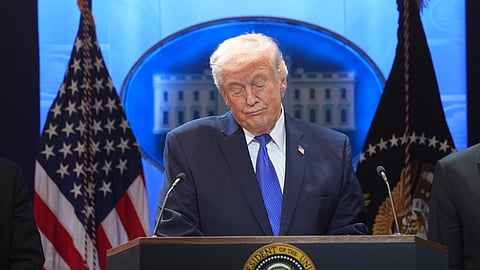

President Donald Trump on Friday announced a new extra 10 per cent global tariff on US trade partners after vowing to use other methods to reinstate his signature economic policy which was struck down by the country's Supreme Court earlier in the day.
"The Supreme Court's decision today made a president's ability to both regulate trade and impose tariffs more powerful and more crystal clear, rather than less," he said.
"Other alternatives will now be used to replace the ones that the court incorrectly rejected," Trump told a press conference, adding that these options could also bring in more revenue.
He also suggested that most trade deals negotiated under the threat of his tariffs remained in effect, mentioning India specifically.
"The India deal is on," Trump said in response to a question.
"All the deals -- we're just going to do it a different way," he said.
Trump, who had nominated two of the justices who repudiated him, responded furiously, accusing the court of being influenced by "foreign interests."
"It's my opinion that the court has been swayed by foreign interests," Trump told journalists.
Calling the Supreme Court decision "deeply disappointing," Trump said he was "absolutely ashamed" of "certain members" of the conservative-dominated court who ruled against him.
"I'm ashamed of certain members of the court, absolutely ashamed, for not having the courage to do what's right for our country," Trump said.
Further attacking the judges who voted to knock down his tariffs --Chief Justice John Roberts and Justices Amy Coney Barrett and Neil Gorsuch-- Trump said "they’re just being fools and lapdogs for the RINOs and radical left Democrats."
Without naming them, Trump referred to the jurists by their action as "very unpatriotic and disloyal to our Constitution."
He said the ruling opened the door to allow him to go in "probably a direction that I should have gone in the first time."
Trump also suggested the ruling may not "substantially constrain" tariffs going forward and mentioned using the Trade Expansion Act and other past laws, including the Tariff Act of 1930 going forward. He said those alternatives would simple mean a "little bit longer" process.
Trump also scoffed at his ability to order full economic embargoes against countries, but not raise tariffs.
"How ridiculous is that?" he asked.
Commenting on the issue of refunding the around $133 billion taken in from his tariffs, Trump said the legal battle pertaining to the matter would take years.
Trump said the issue was "not discussed" in the ruling and added, "We'll end up being in court for the next five years."
In his first reaction to the ruling, Trump called it "a disgrace" when he was notified of the news during his morning meeting with several governors.
The US Supreme Court on Friday, in a six-three ruling authored by conservative Chief Justice John Roberts, upheld a lower court's decision that Trump's use of a 1977 law to impose tariffs exceeded his authority.
The justices ruled that the law at issue -- the International Emergency Economic Powers Act, or IEEPA -- did not grant the power to the US President to impose tariffs on trading partners. The court emphasized that the law on imposing tariffs is only meant for use in national emergencies.
(With inputs from AP, AFP)
