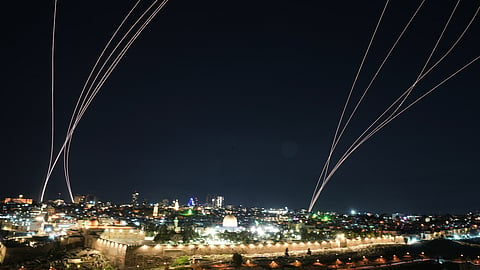

PARIS: The war in the Middle East has so far been defined by two images: Iranian drones and missiles plunging to the ground and exploding, and interceptors streaking into the skies to stop them.
In the first two days of the conflict, Iran launched nearly 400 missiles and around 1,000 drones towards the United Arab Emirates, Kuwait, Bahrain, Qatar and Jordan, said Mintel World, which specialises in open-source intelligence. That figure does not include Iran's main target, Israel.
"It's really who has a deeper magazine," said Scott Benedict, a former marine and expert at the US-based Middle East Institute.
"It's like two archers launching arrows at each other and somebody is going to run out of arrows before the other person runs out of arrows."
Top US military officer General Dan Caine told a press briefing that its integrated air and missile defence network was working "exactly as it's intended", intercepting "hundreds" of ballistic missiles.
But how long those systems can keep operating is an open question, with interceptors expensive and in limited supply.
'Shooting the archer'
At the end of last June's 12-day war, experts estimated that Iran had between a few hundred and nearly 2,000 missiles capable of striking Israel.
This was separate from its stockpile of shorter-range missiles still capable of reaching Gulf countries. Iran has also used drones which, while less capable, are much cheaper to manufacture.
An Israeli security source on Saturday said Iran's ballistic missile production had been "increasing rapidly."
To fire its missiles, Iran has to use launch vehicles, most of which were destroyed in June, while those that survived are now being targeted by the United States and Israel.
US Defense Secretary Pete Hegseth said the war was a case of "shooting the archer instead of the arrows."
Iran's latest missile barrages appear to be smaller than those launched in June and in October 2024, when Iran first retaliated against Israeli agression.
"The low density of the Iranian salvos raises questions about Tehran's offensive capabilities," said Etienne Marcuz, a researcher at the France-based Foundation for Strategic Research.
"Are they preserving their stockpile to prolong the conflict and wear down their adversaries, or do they no longer have the capacity to launch coordinated strikes?"
Despite the smaller salvos, he said a "non-negligible number of missiles are still getting through, which might show that the defences are no longer as watertight and the Israelis know, they too will have to hold out over time" by economising their interceptors.
'Low but constant pressure'
Hegseth said the United States and its allies have enough interceptors to sustain operations for some time.
Benedict agreed that "we certainly have the magazines to get to a point faster where we're in a better position than the Iranians." Nevertheless, the attacker has a key advantage.
For each ballistic missile, "at least two" interceptors need to be fired to guard against failure, said Marcuz.
Interceptor missiles are also very expensive and only produced in small numbers, despite planned production increases. For example, only 96 THAAD missiles are produced each year and 600 of the PAC-3 MSE munitions used in the Patriot system.
During the 12-day war, some 150 THAADs were fired, The Wall Street Journal reported.
"The stock is not going to last very long," said Marcuz, making it crucial for the United States and Israel to destroy Iran's launchers as soon as possible. However, completely destroying Tehran's ballistic missile threat was unrealistic, he said.
Like the Houthis in Yemen, Iran was likely to retain a "residual capability that will maintain a low but constant pressure for years if there is no political settlement."
