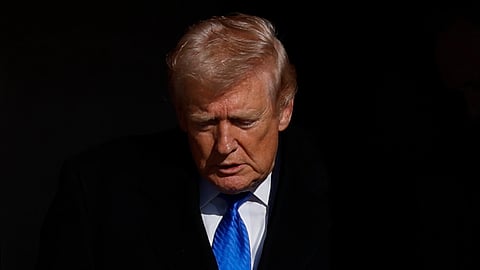

US President Donald Trump has executed another spectacular about-turn, from threatening to escalate the Iran war to announcing "very good" talks to end it, which were denied by the Islamic republic.
AFP looks at the facts, the speculation and what might happen now:
Are there talks happening?
Yes, according to Trump, no according to Tehran, but it might depend on how "talks" are defined.
Trump claimed Monday that the US had been engaging with an unnamed Iranian leader who he described as "the man who I believe is the most respected and the leader" and was "very reasonable."
He clarified that he was not the country's injured supreme leader Mojtaba Khamenei, however.
The Axios newsite, citing an unnamed Israeli official, identified the mystery interlocutor as Mohammad Bagher Ghalibaf, Iran's powerful speaker of parliament who is one of the most prominent non-clerical figures in Tehran.
But Ghalibaf stated that "no negotiations" were underway in a post on X, adding that the announcement was "fake news" intended "to manipulate the financial and oil markets and escape the quagmire in which the US and Israel are trapped."
The New York Times, citing unnamed officials, also said there had held "direct communication" between Iranian Foreign Minister Abbas Araghchi and Trump's special envoy Steve Witkoff "in recent days" -- although neither side has confirmed this.
But that doesn't mean other "talks" aren't happening.
Why?
Iran's foreign ministry spokesman Esmaeil Baqaei confirmed that messages had been received over the weekend from "some friendly countries indicating a US request for negotiations aimed at ending the war".
Trump's administration has held two rounds of talks with Iran since the US leader returned to the White House in 2025, with both ending in surprise US-Israeli attacks on the country -- in June last year and most recently on February 28.
All of these negotiations were indirect -- with Gulf state Oman playing the role of mediator, shuttling messages between the two sides which have had no formal diplomatic relations since 1980.
Oman has been left burned by its experiences, but other countries with friendly relations with Tehran and Washington appear to have stepped in to pass messages between the two sides, principally Egypt, Pakistan and possibly Turkey.
Egypt's Foreign Minister Badr Abdelatty called his Iranian counterpart Araghchi and Trump's envoy Witkoff on Sunday and Monday.
Pakistan's Prime Minister Shehbaz Sharif on Monday said he spoke with Iran's President Masoud Pezeshkian, while army chief Asim Munir liased with Trump on Sunday, according to a report in The Financial Times.
Pakistan already acts as a diplomatic go-between for Iran in Washington, with Sharif writing on X that his country was committed to playing "a constructive role in advancing peace in the region".
Qatar, a frequent backchannel for US and Israeli diplomacy in the region, has ruled out playing a role.
What will negotiations cover?
Principally, Iran's nuclear programme again, the subject of talks and friction since 2003.
"We want no enrichment, but we also want the enriched uranium," Trump said Monday, referring to Iran's known 440-kilogram stockpile of uranium which is enriched to 60 percent -- close to the 90 percent needed to make a bomb.
In the last round of talks before the US-Israeli attack on February 28, Tehran offered to retrieve the stockpile from under its bombed nuclear facilities and blend it down to lower levels, according to Iranian foreign minister Araghchi.
Tehran, which has always denied wanting to build a nuclear weapon, had also offered to allow the UN's IAEA nuclear agency inspectors to return, reports say.
Trump said Monday that there were already "major points of agreement" with Iranian negotiators.
But having been attacked twice, Iran is now likely to seek guarantees of non-aggression in the future, financial compensation for the bombing, and a lifting of sanctions.
Iran's hold over the Strait of Hormuz, a vital oil and gas shipping route which has been effectively closed, gives it leverage it did not hold in previous rounds of talks.
"I'm very sceptical (about the talks) because trust has been completely destroyed and the positions of the warring parties are further apart than ever," David Khalfa, a Middle East specialist at the Jean-Jaures Foundation, a Paris-based think-tank, told AFP.
"The margin for maneuvre on both sides is very limited," he added.
There is also another possible reading of the whole sequence: Trump is buying time again before sending in US ground troops to try to open up the Strait of Hormuz or seize Iranian oil assets.
