
WASHINGTON: President Donald Trump has had a lot to say about his thinking on the way ahead in the Iran war since Republicans were trounced in last week's midterm elections.
In exchanges with reporters, broadcast interviews and social media posts since Election Day, he's somehow managed to back away from carrying out additional strikes while also backing away from the prospect of additional talks with the Islamic Republic's negotiators on ending the 8-month-old conflict.
The president acknowledged on the day after the midterms that the war and the global economic tumult it's caused were partly to blame for Republicans' electoral losses, while maintaining it was the right thing to do.
Then, at the start of this week, he huddled with Qatar's prime minister at the White House and afterward told reporters that he believed it was highly unlikely he'd need to order new major strikes on Iran, declaring that the war "militarily is effectively over."
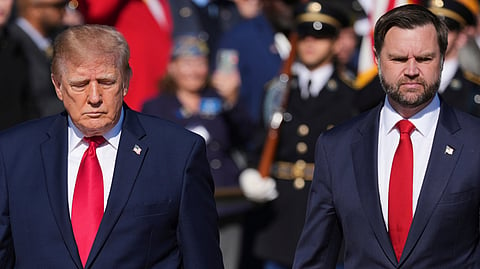
But by Thursday, he was again raising questions about whether he needed to rush to find an endgame. He declared that the U.S. no longer needs a deal with Tehran and brusquely directed Vice President JD Vance — who served as his chief negotiator in earlier peace talks with Iran — to shift his attention to the administration's domestic anti-fraud campaign.
All the while, Trump warned Iran that the U.S. military is "locked and loaded" and keeping an eye on Pickaxe Mountain, a facility linked to Iran's nuclear program, for signs of activity.
"If something does not work out, I would not hesitate" to act, Trump told conservative broadcaster Hugh Hewitt on Thursday.
Iran war will shadow Trump during his trip to Asia
Trump's tonal shifts have only added to the uncertainty about what comes next in a war in which America's allies were not consulted before it was started but nonetheless struggle to deal with its economic ramifications.
"President Trump is now acting like an arsonist who has set ablaze our foreign policy," Democratic Sen. Cory Booker of New Jersey said in an interview Friday on the sidelines of the Democrats' postelection gathering in Denver. "And now he just wants to walk away."
The president's ambiguous positioning on the war is expected to loom large during a visit next week to the Philippines and the Asia-Pacific Economic Cooperation meetings in the Chinese tech hub of Shenzhen.
While in Shenzhen, Trump will hold an unprecedented three-way summit with China's Xi Jinping and Russia's Vladimir Putin. Trump is expected to discuss Iran and the three powers' nuclear stockpiles with Xi and Putin.
The White House declined to comment directly to queries on Trump's postelection rhetoric on Iran. But Secretary of State Marco Rubio underscored that Trump's approach is leading to the Iranian economy collapsing.
"The economic pain that we are inflicting on that regime is so great that there's no need for military action because we've weakened them so much," Rubio said in a Friday evening speech to the Federalist Society.
Rubio insists US hasn't given up on mediation efforts
Iran remains unwilling to engage in negotiations over its nuclear program until the U.S. agrees to several core conditions that Iran has been demanding be part of any ceasefire agreement.
Differences with Iran over its nuclear activities remain the thorniest issue and one that Trump insists must be resolved as part of any deal meant to end the war.
Tehran's rhetoric has hardly cooled. Iran's deputy U.N. ambassador Gholamhossein Darzi told the United Nations Security Council on Friday that Iran "has never closed the door to diplomacy." But he warned that should the U.S. or Israel return to bombing, his country would offer "an immediate and decisive response."
Rubio earlier this week stressed that the U.S. is not opposed to mediators continuing their efforts.
"If there's a deal to be done, the president will be the first one to be in favor of it," Rubio said. "But it's not going to be a stupid deal. It's not going to be a bad deal."
Michael Singh, managing director at the Washington Institute for Near East Policy, said he expects the status quo to persist for some time, with the U.S. and Iran locked in a stalemate over the Strait of Hormuz and the U.S. continuing its monthslong naval blockade that's curbing the flow of Iranian crude to the global market.
Singh said the American strategy of squeezing Iran economically is a far more attractive option for Trump than military escalation or making concessions to Tehran.
He also suggested Trump could always reverse his position on Vance engaging with Iranians if the president finds the Iranians are ready to seriously negotiate.
"It's probably the most sensible path as well to sort of be patient, keep the pressure on, allow the mediators to keep doing their work," said Singh, who worked on Middle East issues in former President George W. Bush's White House. "And when the time is right, but not before then, is when you want to engage senior officials like the vice president and so forth."
