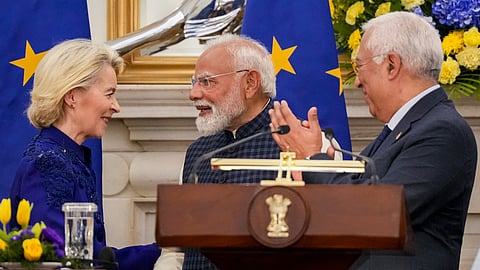

NEW DELHI: India and the European Union have concluded negotiations on a landmark Free Trade Agreement (FTA) that delivers sweeping tariff reductions across sectors, significantly enhancing market access for Indian exporters while safeguarding sensitive domestic industries.
Dubbed the 'mother of all deals' by the government, the agreement provides preferential access to the EU across 97% of tariff lines, covering 99.5% of India’s export value.
While the deal has been announced, processes like legal scrubbing, signing and most importantly ratification by EU member states may take another year.
Here is a sector-wise break-up of the key duty cuts and market access commitments secured under the FTA:
Textiles & Apparel
All tariff lines will move to zero duty, eliminating EU tariffs of up to 12%. This opens the EU’s textile and apparel import market worth about USD 263.5 billion to Indian yarn, garments, and home textiles, offering a major boost to employment-heavy MSME clusters.
Leather & Footwear
EU duties of up to 17% will be eliminated at the entry into force of the FTA. The move is expected to strengthen India’s $2.4 billion leather and footwear exports and improve its share in the EU’s $100 billion import market.
Marine products
Tariffs of up to 26% will be reduced to zero, covering 100% of trade value. The duty cuts are expected to significantly enhance exports of shrimp, frozen fish, and value-added seafood, benefiting coastal economies.
Gems & jewellery
Import duties of up to 4% will be eliminated across all tariff lines. Preferential access is expected to improve competitiveness of India’s USD 2.7 billion jewellery exports in the EU’s USD 79.2 billion import market.
Chemicals
The FTA provides zero duty access on 97.5% of India’s chemical export basket by value, removing tariffs of up to 12.8%. This benefits inorganic, organic, and agrochemical exports and supports MSME-led clusters.
Plastics & rubber
Preferential access to the EU market will reduce existing duties, supporting growth in India’s plastics and rubber exports, currently valued at USD 2.4 billion to the EU, against a global import market exceeding USD 317 billion.
Engineering goods
Tariffs of up to 22% on engineering exports will be reduced or eliminated, enhancing India’s competitiveness in the EU, where engineering goods imports are valued at nearly USD 2 trillion.
Medical devices & instruments
Tariffs of up to 6.7% will be eliminated across 99.1% of tariff lines, aiding exports of medical instruments, lenses, spectacles, and testing equipment.
Agricultural & processed food products
Preferential access has been secured for tea, coffee, spices, grapes, gherkins, cucumbers, dried onion, and selected fruits and vegetables. Sensitive sectors such as dairy, cereals, poultry, soymeal, and certain fruits and vegetables have been excluded to protect domestic interests.
Mines, minerals & metals
Zero duty across 100% of tariff lines will enable India to scale exports of value-added minerals and strengthen integration with EU manufacturing value chains.
Furniture, Home Décor & Wooden Crafts
Tariffs of up to 10.5% will be reduced, improving access for Indian furniture, bamboo products, and handicrafts in design-led European markets.
Overall, 70.4% of tariff lines covering 90.7% of India’s exports will see immediate duty elimination, while another 20.3% will move to zero duty over three to five years. Limited tariff reductions and tariff rate quotas (TRQs) apply to select sensitive products.
The government said the agreement balances ambitious export gains with adequate safeguards, positioning India’s labour-intensive and MSME-driven sectors for deeper integration into European value chains while creating jobs and long-term growth opportunities.
Meanwhile, India has offered significant market access to EU goods while carefully sequencing tariff reductions to protect sensitive domestic sectors. Overall, India will liberalise 92.1% of its tariff lines, covering about 97.5% of EU exports by value, marking one of the most ambitious goods-market offers made by New Delhi in any trade pact.
Nearly half of these tariff lines—around 49.6%—will see immediate elimination of customs duties once the agreement enters into force. This category largely covers EU industrial and high-technology products such as machinery, mechanical and electrical equipment, select chemicals, pharmaceuticals, medical devices and engineering goods. These imports are expected to lower input costs for Indian manufacturers, improve access to advanced technologies and support India’s integration into global value chains.
A further 39.5% of tariff lines will be subject to phased duty elimination over five, seven and ten years. This staggered approach applies to more sensitive industrial products, including automobiles and auto components, capital goods, advanced manufacturing equipment, metals and certain consumer durables. The longer timelines are aimed at giving Indian industry sufficient time to adjust and enhance competitiveness while still committing to eventual tariff liberalisation.
For a smaller set of products—around 3% of tariff lines—India has agreed to partial tariff reductions rather than full duty elimination. These largely relate to agricultural and horticultural items such as apples, pears, peaches and kiwi fruit. In some cases, access for EU goods will be governed through tariff rate quotas, allowing lower duties only up to a specified import volume to prevent market disruption.
At the same time, India has drawn clear red lines around highly sensitive sectors. Products such as dairy, cereals, poultry, soymeal and certain fruits and vegetables have been excluded from tariff concessions, ensuring domestic producers remain protected.
