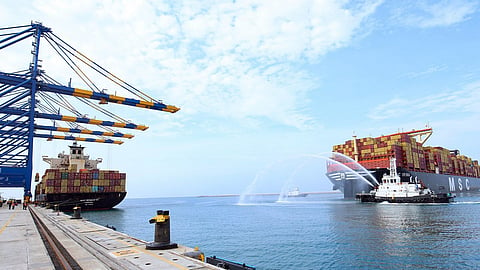

MUMBAI: International rating agency Moody’s has warned that the continuing blockade of the Strait of Hormuz -- the key shipping passage that carries a fifth of crude oil and LNG to the world -- poses substantial risks to the global economy as it dislocated energy markets, and more so for India which will bear the maximum brunt of the blockade leading to significantly higher risks of a weaker rupee, higher inflation and widening current account deficit.
Stating that India stands out among large Asian economies that rely on Middle East crude, Moody’s senior analysts Madhavi Bokil and Elena Nadtotchi said, "costly energy imports would weaken the rupee, raise inflation, worsen the current account balance, and complicate monetary policy as well as fiscal management if they lead to expanded subsidies to help offset the economic shock."
On why the Hormuz closure matters, the report further said, "a prolonged disruption in navigation through the Strait of Hormuz, would likely trigger sustained supply shortages; prices averaging higher than $100/barrel for Brent (has already crossed $93 a barrel Friday), higher inflation; tighter financial conditions; and slower global growth."
However, they quickly added that they expect the conflict to be relatively short-lived and that safe navigation through the Strait will pick up again. Swift resolution of supply restrictions and current inventories would raise average Brent prices for 2026 only moderately, to $70-$80 in 2026 from $69 in 2025.
However, an adverse scenario analysis shows a sustained increase in crude prices to $100 or higher will exacerbate energy security concerns and economic strains.
“Significantly higher oil prices for a sustained period would strain energy importing regions, especially Europe and Asia. High energy prices would raise consumer prices and production costs globally, eroding household purchasing power and weighing on investment.
“Inflation risks could compel major central banks to even raise rates. The resulting tightening in financial conditions and increased uncertainty will crimp global growth,” they warned.
Stating that India standout among Asian countries, they warned that the other key Asian economies of Japan and Korea are both highly import-dependent and vulnerable to high energy prices increasing production costs. However, each country has more than six months of reserves to overcome supply shortages.
Other reports, quoting oil industry analyst firm Kepler, said India, which meets as much as 85% of its oil need and 90% of LNG needs through imports, has oil reserves of only 100 million barrels which can last only five to six weeks.
Among the major Asian economies, China is the most insulated, they said citing its large reserves, regulated prices, and managed exchange rate which will likely temper the impact on consumer prices, but industrial margins would still face stress if global growth suffers.
“The magnitude and duration of the supply shocks will determine the impact on the global economy. While strong inventories provide a buffer for now, a prolonged conflict remains a significant risk. A moderate increase in the Brent prices would have limited and short-lived effects on global growth and markets,” they said.
Shipping in the Strait, where a significant share of the world's oil flows, would likely gradually resume if hostilities stopped. But if blocked for an extended period, global oil and natural gas markets will likely start factoring in enduring shortages, leading to price shocks with significant ramifications for the region and the global economy. And the worst hit economies will be in Asia as it is the top destination for oil moving through the Strait.
While China gets 38% of its energy shipped via the Strait, for India it is 15% (however many reports peg the Gulf/Strait dependency of India at a much higher level of 46% of oil and 40% of LNG sourced only from Qatar). For Korea it is 12% and Japan it is 11% and the rest of Asia’s dependency is 14%. European dependency is 4% and for the rest of the world it is a marginal 4%, they said quoting data from the US Energy Information Administration for Q1 2025.
For the energy exporters from the Gulf, the dependency on the Strait is much higher with Saudi Arabia leading with 37%, Iraq at 23%, the UAE at 13%, Iran at 11%, Kuwait at 10%, Qatar at 4% and others depending on this chokepoint for 2% of shipping movements.
Stating that the global energy market is highly susceptible to a cut in Middle East supplies of oil and LNG, which ships as cargo rather than through pipelines, they said “the Strait handles about one-third of global maritime trade in crude, about 15 million barrels daily. With only 3-4 million barrels are available daily on alternative routes, a prolonged blockade would prevent about 11-12 million barrels of oil exports. Prolonged disruptions would likely cause shutdowns of production facilities in the region, leading to severe shortages that drive up oil prices, as well as prices for refined fuel products.”
The closure of the Strait disrupts all exports from Qatar, which supplies about 20% of global LNG trade, largely to Asia as well as Europe. Such a shutdown would initially delay deliveries but can also cause shortages and reignite bidding wars that marked the 2022 energy crisis.
