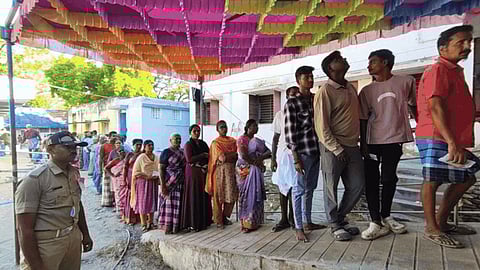
Elections for all 234 Assembly seats in Tamil Nadu and 152 of West Bengal’s 294 seats begun on Thursday in what is a summer of elections, with polling having concluded in Kerala, Assam and Puducherry on April 9.
In Tamil Nadu, more than 5.73 crore voters are set to decide the fate of 4,023 candidates in a three-way contest primarily between the DMK-led alliance and the AIADMK-led NDA, as Chief Minister MK Stalin seeks to retain power while AIADMK leader Edappadi K Palaniswami aims to return to office after five years. However, the Dravidian heavyweights face a tough fight, with the electoral debut of actor Vijay’s TVK adding a new dimension to the contest.
In West Bengal, over 3.60 crore voters, including nearly 1.75 crore women, are eligible to vote in the first of two phases covering 152 of the state’s 294 seats, which will shape the contest between the three-term CM Mamata Banerjee-led TMC and the BJP, which is seeking to form the government for the first time in the state.
The second phase, covering 142 seats and focusing on Kolkata and surrounding districts, is scheduled for April 29. Polling in both states will begin at 7 am and will conclude at 6 pm.
Counting of votes in Tamil Nadu and West Bengal will take place on May 4, along with Kerala, Assam and the union territory of Puducherry.
Accessibility gaps persist at polling stations across Tamil Nadu, raising concerns over whether persons with disabilities (PwDs) can vote independently despite official assurances of compliance.
A ground audit of 47 booths across 12 districts found widespread shortcomings, including steep or makeshift ramps, absent handrails, narrow corridors and inaccessible toilets. The findings contrast with claims made by election authorities before the Madras High Court that all polling stations had permanent ramps and “Assured Minimum Facilities”.
Field visits, however, revealed inconsistent implementation, with some locations relying on temporary structures or unfinished buildings, while others lacked basic access entirely.
In several instances, PwDs were reportedly assisted physically due to poor infrastructure, undermining the principle of independent voting. While a few centres showed better preparedness, especially in parts of Coimbatore and rural pockets, the overall picture points to uneven readiness ahead of polling, with officials promising last-minute fixes.
DMK MP Kanimozhi cast her vote at CSI St. Ebba’s School in Chennai as polling continued across Tamil Nadu.
#WATCH | Tamil Nadu Elections 2026 | DMK Deputy General Secretary and MP Kanimozhi casts her vote at a polling station in Chennai. pic.twitter.com/w7hC44ZvSz
— ANI (@ANI) April 23, 2026
Vengaivayal residents boycotted the elections, raising black flags at the village entrance in protest. From the #DMK alliance to the newly formed #TVK, they alleged that no party approached them for votes or even campaigned in the village. Residents said their demand remains… pic.twitter.com/PwauRNDzbo
— Pearson abraham/பியர்சன் (@pearsonlenekar) April 23, 2026
Residents of Vengaivayal boycotted the polls, hoisting black flags at the village entrance in protest.
Villagers alleged that no political party, from the Dravida Munnetra Kazhagam alliance to the newly formed Tamilaga Vettri Kazhagam, approached them for votes or conducted any campaign.
They reiterated that their stand remains unchanged, demanding justice for the Vengaivayal incident.
Tamil Nadu’s assembly election campaign has evolved into a rare three-cornered contest, breaking from the state’s traditional DMK-AIADMK duopoly with the entry of actor Vijay’s Tamilaga Vettri Kazhagam (TVK), which has added a new layer of unpredictability to the race.
Vijay’s TVK has emerged as the key wildcard, drawing strong interest among younger and urban voters, even as its campaign has faced disruptions and criticism following the fatal Karur stampede last year. Despite setbacks, the party has maintained visibility through sustained outreach.
Analysts say TVK’s impact on vote splits could be decisive in a tightly contested election, with its appeal potentially reshaping outcomes in multiple constituencies.
Tamil Nadu Deputy Chief Minister Udhayanidhi Stalin on Thursday expressed confidence that DMK will emerge victorious in the Assembly elections.
Speaking to reporters after exercising his franchise here, the DMK youth wing secretary urged people to come and vote. To a question on how confident he was about his party winning the elections, he said, "I am very confident."
Tensions escalated in Murshidabad as a scuffle broke out between TMC workers and Aam Janata Unnayan Party (AUJP) founder Humayun Kabir.
The incident occurred while Kabir was visiting a locality where a crude bomb hurling was reported a day earlier.
#WATCH | West Bengal Elections 2026 | A scuffle breaks out between TMC workers and Aam Janata Unnayan Party (AUJP) founder Humayun Kabir in Murshidabad.
— ANI (@ANI) April 23, 2026
Humayun Kabir is visiting the area where a crude bomb hurling incident was reported yesterday. pic.twitter.com/jv5RfbyWzz
Former CM and DMK candidate from Bodinayakkanur Assembly constituency O Panneerselvam casts his vote at a polling station in Periyakulam
#WATCH | Tamil Nadu Elections 2026 | Theni | Former CM and DMK candidate from Bodinayakkanur Assembly constituency O Panneerselvam casts his vote at a polling station in Periyakulam pic.twitter.com/oFkNzz6ru8
— ANI (@ANI) April 23, 2026
According to Election Commission (EC) figures, polling till 9 am recorded a turnout of 17.51 per cent.
About 1.1 crore voters exercised their franchise till 9 am, the EC said.
Chennai recorded 16.51 per cent polling, Madurai - 17.08 per cent, Coimbatore - 18.45 per cent and Tiruchirappalli - 17.99 per cent.
At Kolathur Assembly constituency, where Chief Minister M K Stalin is contesting, saw 17.51 polling till 9 am and at Chepauk - 15.70 per cent.
Deputy Chief Minister Udhayanidhi Stalin is contesting from Chepauk Assembly constituency.
Similarly, Edappadi constituency recorded 19.04 per cent, where AIADMK general secretary Edappadi K Palaniswami is contesting.
In Trichy East, where Tamilaga Vettri Kazhagam chief Vijay is contesting, saw 17.72 per cent polling.
BJP leader K. Annamalai expressed confidence that voters will make the right choice as polling concludes. He urged citizens to reflect on the past five years and vote for Tamil Nadu’s future.
The most contentious issue in the West Bengal Assembly election has been the Special Intensive Revision (SIR) of voter rolls, with the debate now centred on whether the revision could influence the prospects of the three-term government led by Mamata Banerjee.
The Trinamool Congress has questioned the process, while the BJP has maintained that the revision is aimed at cleaning up the electoral rolls.
Notably, West Bengal has 294 Assembly seats, with a majority mark of 148. In 2021, the Trinamool Congress won 215 seats, compared with 77 for the BJP, while the Left and others secured one seat each.
The Election Commission has used the term “logical discrepancy” during the revision process, a classification not previously used in recent SIR exercises in other states, including Bihar, Gujarat and Uttar Pradesh.
The SIR exercise has led to the removal of around 90 lakh names from the electoral rolls, accounting for roughly 11.6% of the electorate. The figure is close to the Trinamool Congress’s winning margin in the 2021 polls, when it secured around 48% of the vote compared with 38% for the BJP.
According to updated roll data, of the 90 lakh names, around 65 lakh were attributed to death, migration, duplication or non-availability. Around 27 lakh cases were placed under adjudication, while approximately 33 lakh names were subsequently reinstated after verification.
The impact has varied across districts, with higher deletions reported in several areas, including West Burdwan, South Dinajpur and parts of North Kolkata. The Trinamool has argued that the scale of deletions in some constituencies overlaps with its previous winning margins, raising concerns over voter exclusion.
EVM glitches disrupted voting at a few places in West Bengal on Thursday as polling was underway in the first phase of the assembly elections, officials said.
Overnight violence was also reported from some places amid the unprecedented security arrangements made.
In Murshidabad district, polling was halted at booth number 156 in Parsalika Madanmohan Primary School in the Beldanga assembly segment after an Electronic Voting Machine (EVM) developed a snag, they said.
At booth number 212 in the Samsherganj assembly constituency, voting did not begin on time because of similar issues. Polling was also delayed at booth number 130 in Kandi, officials added.
In Purba Medinipur, an EVM malfunction was reported in Birulia of the Nandigram assembly constituency.
In Cooch Behar, voting at booth number 229 in Town High School was suspended for nearly an hour before resuming. Polling was also delayed at booth number 231 in Malda district's Habibpur constituency.
In Siliguri in Darjeeling district, polling could not start on time at booth number 26/31 in Margaret School because of a faulty EVM.
West Bengal recorded a turnout of 18.76 per cent in the first two hours of voting in the first phase of the assembly polls on Thursday, according to the Election Commission.
The Bankura assembly constituency registered the highest turnout at 22.05 per cent in the first two hours, followed by Samserganj in Murshidabad at 21.85 per cent and Chandrakona in Paschim Medinipur at 21.83 per cent, according to the EC.
Coochbehar Dakshin recorded the lowest turnout at 15.57 per cent, followed by Chanchal in Malda at 15.64 per cent and Harischandrapur at 15.98 per cent.
Marking a brisk polling, 17.69% votes have been polled for the Assembly elections, within the first two hours, in Tamil Nadu. The polling started at 7 a.m. In all, 5.73 crore voters will be voting today to elect 234 MLAs. In all, 4,023 candidates are in the fray.
Chief Minister MK Stalin and three other CM aspirants - AIADMK general secretary Edappadi K Palaniswami, NTK leader Seeman and TVK president Vijay have cast their votes by 9 a.m in their respective constituencies.
Chief Minister and DMK president MK Stalin, his wife Durga Stalin, Deputy CM Udhayanidhi Stalin and other family members cast their votes in a polling booth in Alwarpet. AIADMK leader Edappadi K Palaniswami and his family members cast their votes at a booth in Siluvampalayam in Edappadi constituency. NTK leader Seeman and TVK president Vijay cast their votes in their respective booths in Neelankarai.
Voting was delayed at a booth in Raghunathganj Girls' School after an Electronic Voting Machine malfunction, triggering frustration among voters.
Many expressed anger over the long wait and the absence of a prompt replacement machine.
VIDEO | West Bengal Polls: Voting delayed at Murshidabad's Raghunathganj Girl's School booth due to EVM malfunction; voters express anger over long wait and lack of replacement machine.#AssemblyPollsWithPTI #WestBengalPollsWithPTI
— Press Trust of India (@PTI_News) April 23, 2026
(Full video available on PTI Videos -… pic.twitter.com/pzmKxiyHSX
Vijay, chief of Tamilaga Vettri Kazhagam, has written to the Chief Election Commissioner urging an extension of polling hours until 8 pm.
In his letter, he cited travel disruptions and long queues that have delayed voters, stressing that extended hours are necessary to ensure everyone gets a fair chance to cast their vote.
Vijay, TVK chief and candidate from Tiruchirappalli East and Perambur constituencies, writes a letter to the Chief Election Commissioner to extend polling hours by two hours till 8:00 pm.
— ANI (@ANI) April 23, 2026
"Extend polling hours by two hours: In view of the large surge of delayed voters due to… pic.twitter.com/PFREoC4L3i
Union minister Piyush Goyal appealed to voters in Tamil Nadu to turn out in large numbers and cast their ballots, stressing the importance of every vote in shaping the state’s future.
"Vote for development, progress & prosperity! Tamil Nadu today has an opportunity to change its fate. I appeal to all eligible voters to go out in large numbers and cast their votes.
Every single vote holds the power to shape a brighter, more developed future for Tamil Nadu. Make it count."
வளர்ச்சி, முன்னேற்றம் மற்றும் செழிப்பிற்காக வாக்களியுங்கள்!
— Piyush Goyal (@PiyushGoyal) April 23, 2026
இன்று தமிழ்நாட்டுக்கு தனது விதியை மாற்றிக்கொள்ள ஒரு வாய்ப்பு கிடைத்துள்ளது. தகுதி பெற்ற வாக்காளர்கள் அனைவரும் பெருமளவில் திரண்டு வந்து, தங்கள் வாக்குகளைப் பதிவு செய்யுமாறு நான் கேட்டுக்கொள்கிறேன்.
ஒவ்வொரு வாக்கிற்கும்… pic.twitter.com/dPp4FXM9bd
BJP state president and candidate from Sattur seat Nainar Nagenthran casts his vote at Sri Jayendra Saraswathi Silver Jubilee School, Tirunelveli.
VIDEO | Tamil Nadu Polls: BJP state president and candidate from Sattur seat Nainar Nagenthran (@NainarBJP), casts his vote at Sri Jayendra Saraswathi Silver Jubilee School, Tirunelveli.#AssemblyPollsWithPTI #TamilNaduPollsWithPTI
— Press Trust of India (@PTI_News) April 23, 2026
(Full video available on PTI Videos -… pic.twitter.com/1WbtPUEk9x
VIDEO | Tamil Nadu election: Actor Dhanush casts his vote at Kamarajar Road Corporation School, Chennai. #AssemblyPollsWithPTI #TamilNaduPollsWithPTI
— Press Trust of India (@PTI_News) April 23, 2026
(Full video available on PTI Videos - https://t.co/n147TvrpG7) pic.twitter.com/pBDjmFhoex
Riju Dutta said polling has remained largely peaceful, with no major incidents reported. He noted that a few minor issues did arise but were promptly addressed, and voting is proceeding smoothly so far.
VIDEO | West Bengal Polls: “No major incident has happened apart from a few minor incidents which have already been tackled; till now peaceful voting is underway,” says TMC leader Riju Dutta.#AssemblyPollsWithPTI #WestBengalPollsWithPTI
— Press Trust of India (@PTI_News) April 23, 2026
(Full video available on PTI Videos -… pic.twitter.com/P8Qhb00opO
After casting vote for Tamil Nadu Assembly elections, Tamil Nadu Chief Minister MK Stalin said, 'Tamil Nadu will win'.
VIDEO | Tamil Nadu election: After casting vote at SIET College, Chennai, CM MK Stalin (@mkstalin) says, "Tamil Nadu will win."#AssemblyPollsWithPTI #TamilNaduPollsWithPTI
— Press Trust of India (@PTI_News) April 23, 2026
(Full video available on PTI Videos - https://t.co/n147TvrpG7) pic.twitter.com/ME8plbiDXw
VIDEO | Tamil Nadu Polls: State minister and DMK’s Tiruverumbur seat candidate Anbil Mahesh (@Anbil_Mahesh) casts his vote at TSM School in Trichy.#AssemblyPollsWithPTI #TamilNaduPollsWithPTI
— Press Trust of India (@PTI_News) April 23, 2026
(Full video available on PTI Videos - https://t.co/n147TvrpG7) pic.twitter.com/V3MAAu1iEG
West Bengal’s electoral behaviour is shaped by a mix of religious concentration, caste categories and regional identity blocs, with constituency outcomes often reflecting sharply localised demographic balances.
Hindus account for around 70–72% of the population, while Muslims form approximately 27%, based on Census 2011 data.
Scheduled Castes constitute about 23%, while Scheduled Tribes account for around 5–6%, with significant concentration in North Bengal and western districts.
Muslim voters form a decisive segment in several districts, particularly Murshidabad, Malda, Nadia and parts of North Bengal, where they can constitute a majority in select constituencies, making them a key factor in electoral strategies in these regions.
SC voters are widely distributed across rural Bengal and often act as a swing bloc in closely contested seats, while ST communities influence outcomes in select hill and forest belts, especially in North Bengal and Jangalmahal.
Caste structures in West Bengal are less formally articulated in political mobilisation compared to some other states, but regional identity and socio-religious clustering strongly influence voting behaviour at the constituency level.
Age composition broadly reflects national patterns, with a significant youth electorate (18–35) playing a key role in shaping campaign narratives around jobs, welfare and governance.
Unlike more structured caste-based systems elsewhere, West Bengal’s electoral arithmetic is driven by an overlapping mix of religion, caste category and regional identity, with parties tailoring outreach accordingly.
Karti Chidambaram expressed strong confidence in the alliance led by DMK, calling it a well-organised coalition that has remained intact since 2004 and is poised to secure enough seats to form the government comfortably.
He also cautioned against overinterpreting voter turnout figures, noting that voting percentages can be misleading due to the deletion of names following the SIR process.
VIDEO | Tamil Nadu Election 2026: Congress MP from Sivaganga Karti Chidambaram (@KartiPC), says, "Our alliance is a very large, well-organised alliance. An alliance which has been there since 2004. We are very confident that this alliance under the leadership of CM MK Stalin will… pic.twitter.com/1eh4AUb11Q
— Press Trust of India (@PTI_News) April 23, 2026
Tamil Nadu CM and DMK candidate from Kolathur, MK Stalin arrives at a polling station in Chennai to cast his vote. His family, including his son and Deputy CM Udhayanidhi Stalin, is also with him.
VIDEO | Tamil Nadu election: CM MK Stalin and Deputy CM Udhayanidhi Stalin, along with their families, cast vote at SIET college. #AssemblyPollsWithPTI #TamilNaduPollsWithPTI
— Press Trust of India (@PTI_News) April 23, 2026
(Full video available on PTI Videos - https://t.co/n147TvrpG7) pic.twitter.com/6znrRVNKOh
Congress president Mallikarjun Kharge appealed to voters in Tamil Nadu to participate actively in the Assembly elections, framing the contest as a fight to safeguard key democratic principles.
“The fight today is to secure your rights. The fight is to protect federalism, rationality, equality, justice and freedom,” he said in a post on X.
“It is also to ensure inclusive welfare and retain the ideals of social justice espoused by your icons. It is time for you to exercise your Democratic right and take a stand against those who want to snatch your federal rights,” he added.
Kharge further urged the first-time voters to come out in large numbers and exercise their franchise.
Dear brothers and sisters of Tamil Nadu,
— Mallikarjun Kharge (@kharge) April 23, 2026
The fight today is to secure your rights. The fight is to protect federalism, rationality, equality, justice and freedom.
It is also to ensure inclusive welfare and retain the ideals of social justice espoused by your icons.
It is…
VIDEO | Tamil Nadu Election 2026: Actor Rajinikanth (@rajinikanth) casts vote at Stella Mariss, Chennai.#AssemblyPollsWithPTI#TamilNaduPollsWithPTI
— Press Trust of India (@PTI_News) April 23, 2026
(Full video available on PTI Video - https://t.co/n147TvrpG7) pic.twitter.com/uzqqkeoajm
Tamilaga Vettri Kazhagam (TVK) chief Vijay, contesting from Tiruchirappalli East and Perambur constituencies, arrived at a polling station in Neelankarai to cast his vote during the Tamil Nadu Assembly elections.
A crowd gathered outside the polling station as actor arrived to cast vote.
VIDEO | Tamil Nadu Polls: TVK chief and candidate from Tiruchirappalli East and Perambur constituencies Vijay (@TVKVijayHQ) casts his vote at Vaels International School in Chennai.#AssemblyPollsWithPTI #TamilNaduPollsWithPTI
— Press Trust of India (@PTI_News) April 23, 2026
(Full video available on PTI Videos -… pic.twitter.com/1Ia1j89BkA
VIDEO | West Bengal polls: Voters stand in long queues at polling booths in Birbhum to cast their votes amid tight security.#AssemblyPollsWithPTI #WestBengalPollsWithPTI
— Press Trust of India (@PTI_News) April 23, 2026
(Full video available on PTI Videos - https://t.co/n147TvrpG7) pic.twitter.com/DflwZV5YBd
AIADMK leader D Jayakumar cast his vote at a polling station in Mylapore.
Contesting from Royapuram, he called the election crucial, alleging it would end "one family dynasty" and "ganja culture". He also slammed the state’s law and order situation, calling it the worst in Tamil Nadu.
Tamil Nadu’s electorate shows a pronounced demographic tilt, with youth, first-time voters and women forming key segments of the voter base, according to Election Commission electoral roll data.
Women voters form a decisive share of the electorate, with electoral roll data showing they number over 2.93 crore, compared to around 2.80 crore male voters, making them a crucial constituency. Parties have increasingly targeted this segment with welfare schemes, cash transfers and household-linked benefits, with such messaging playing a central role in campaigns.
Data from the final electoral roll published on February 23 shows a significant youth presence. There are 12,51,742 first-time voters (aged 18–19) and 1,05,31,653 electors in the 20–29 age group. Broader ECI roll-based analysis suggests that voters in the 18–29 age group account for an estimated one-fifth of the electorate, while the wider 18–35 cohort is assessed to form over a third of registered voters.
Age composition remains a key electoral factor, with electoral roll data pointing to a sizeable youth electorate, particularly in the 18–35 bracket, making young voters an important swing segment in urban and semi-urban constituencies. First-time voters in the 18–19 age group form a new entrant cohort that is especially significant in urban and semi-urban areas. This makes young voters a structurally important bloc across fast-growing urban centres such as Chennai, Coimbatore and Madurai, as well as industrial and semi-urban belts.
Together, youth and women voters are seen as central to electoral outcomes in Tamil Nadu, with issues such as employment, welfare delivery, public services and governance shaping preferences across both urban and rural constituencies.
Actor and Rajya Sabha MP Kamal Haasan and his daughter Shruti Haasan arrive to cast vote at Chennai High School, Eldams Road, Teynampet.
Voting was briefly delayed at Booth 295 in Thoothukudi’s Duvipuram after a malfunction was reported in the control unit of the electronic voting machine, PTI reported.
Officials are working to fix the issue, and polling is expected to resume once the technical glitch is addressed.
Tamil Nadu’s electoral landscape is shaped by a combination of Dravidian political identity, caste-based social blocs and a relatively young electorate, with parties calibrating candidate selection and alliances around region-specific social balances.
Hindus form around 87.6% of the population, followed by Christians at about 6.1% and Muslims at around 5.9%, according to Census 2011 data.
Caste composition is not officially enumerated beyond Scheduled Castes and Scheduled Tribes, but electoral analysis consistently places Backward Classes (BCs and MBCs combined) at around 65–70% of the population, forming the backbone of both DMK and AIADMK support bases.
Among identifiable social blocs, Vanniyars (around 12–15%) dominate parts of northern Tamil Nadu, while Thevars, Gounders, Nadars and other intermediate communities each range broadly between 3–10% depending on region, making constituency-level caste balancing critical. These sub-groups operate within the larger BC/MBC framework and are reflected in candidate selection strategies.
Scheduled Castes account for roughly 20%, giving them decisive influence in several southern and central constituencies, while Scheduled Tribes are estimated at about 1%, concentrated in limited pockets.
Religious minorities, though smaller in proportion, remain electorally relevant in select constituencies, particularly in southern districts and urban centres.
Tamilisai Soundararajan, BJP candidate from Mylapore, cast her vote and called on citizens to celebrate their democratic right.
Reflecting on her journey, from a medical student to Governor and now a candidate, she said her commitment to voting has never changed.
Emphasizing the “beauty of democracy,” she urged for a safe Tamil Nadu, meaningful change, and stronger representation of women’s voices in Parliament and the Assembly.
VIDEO | Tamil Nadu Election 2026: BJP candidate from Mylapore candidate Tamilisai Soundarajan casts her vote, says, "Everyone should celebrate the democratic right. I am really very happy that the same booth game me opportunity to vote as an ordinary member, to vote as a medical… pic.twitter.com/NSOtcqHTwG
— Press Trust of India (@PTI_News) April 23, 2026
AIADMK General Secretary Edappadi K Palaniswami cast his vote along with family members in his hometown, the Edappadi Assembly segment in Salem district.
He also appealed to voters to step out in large numbers and exercise their democratic rights, stressing the importance of active participation in the electoral process.
#ElectionsWithTNIE | #AIADMK candidate from the #Edappadi Assembly constituency, @EPSTamilNadu, arrived to cast his vote.#TamilNaduAssemblyElections2026 #TNAssemblyElections #AssemblyElections
— TNIE Tamil Nadu (@xpresstn) April 23, 2026
📽️ANI pic.twitter.com/GM1cedZ6js
State BJP vice president Khushbu Sundar casts her vote at a polling booth in Mylapore. The constituency sees a contest between BJP's Tamilisai Soundararajan here and DMK's D Velu.
VIDEO | Tamil Nadu Election 2026: BJP leader Khushbu Sundar (@khushsundar) arrives at Sri Chaitanya Techno School polling station in Chennai to cast vote, says, "People have right to question any government. I think it is a fundamental duty. One day is a holiday, let us relax… pic.twitter.com/vVw4CKArCM
— Press Trust of India (@PTI_News) April 23, 2026
#WATCH | Tamil Nadu Elections 2026 | NTK Chief Senthamilan Seeman casts his vote at a polling station in Neelankarai. pic.twitter.com/zqcJB2XKBO
— ANI (@ANI) April 23, 2026
BJP leader and Leader of Opposition Suvendu Adhikari, contesting from Nandigram and Bhabanipur, said he offered prayers and interacted with polling agents, urging that voting be conducted peacefully.
Commenting on voter rolls, he alleged that without “dead, fake or infiltrator voters,” there would be no chance for Mamata Banerjee to win.
#WATCH | West Bengal Elections 2026 | Suvendu Adhikari, State LoP & BJP Candidate from Nandigram & Bhabanipur says, "...We are Hindus, we are Sanatanis. I offered prayers, offered a 'naman'.... I spoke to polling agents of my constituency...Polling should be held peacefully."… pic.twitter.com/KhghWrutFR
— ANI (@ANI) April 23, 2026
#WATCH | Tamil Nadu Elections 2026 | Senior Congress leader P Chidambaram casts his vote and shows his inked finger, at a polling station in Karaikudi, Sivaganga. pic.twitter.com/5rRqLmFtCk
— ANI (@ANI) April 23, 2026
Voting for the Tamil Nadu Assembly elections began early in the morning under tight security arrangements across the state.
Long queues were seen outside several polling booths even before voting officially commenced, with voters arriving early to cast their ballots. Authorities have deployed extensive security measures to ensure a smooth and peaceful polling process.

Prime Minister Narendra Modi On Thursday urged the voters in Tamil Nadu to participate enthusiastically in the Assembly elections, calling it a “sacred democratic duty.” He encouraged youth and women to turn out in large numbers and help achieve a record voter turnout in a post on X.
As Tamil Nadu votes in the Assembly elections, I call upon all voters to take part enthusiastically in this sacred duty of democracy. I urge the youth and the women of Tamil Nadu in particular to come out and vote in record numbers.
— Narendra Modi (@narendramodi) April 23, 2026
Polling begins for 152 seats in first phase of assembly elections in Bengal, amid tight security.
Polling started at 7 am with voters queueing up outside booths in districts ranging from Darjeeling and Jalpaiguri in the north to Murshidabad, Nadia, Birbhum and Hooghly in the south.
Voting begins across Tamil Nadu for Assembly election amid tight security
West Bengal goes to the first phase of polling on Thursday in a tightly contested Assembly election that has sharpened into a polarised battle over identity, citizenship and political dominance, even as traditional debates on jobs and corruption recede.
Voting will be held across 152 of the state’s 294 seats, spanning all 54 constituencies in north Bengal and parts of Murshidabad, Nadia, Birbhum and Hooghly. Over 3.60 crore voters, including nearly 1.75 crore women, are eligible to cast their ballots.
The first phase is widely seen as crucial for both the ruling Trinamool Congress (TMC) and the Bharatiya Janata Party (BJP), which is banking on north Bengal to retain its political relevance in the state. For the TMC, led by Chief Minister Mamata Banerjee, the challenge is to prevent a BJP surge in its traditional weak zones.
Campaign rhetoric has centred on allegations and counter-allegations over governance, infiltration and voter roll revisions, with the Special Intensive Revision (SIR) exercise and deletion of names emerging as a flashpoint across several districts.
The Election Commission has deployed 2,450 companies of central forces, with over 8,000 polling stations classified as sensitive, underscoring the intensity of the contest.
The phase also includes a series of high-profile and closely watched battles across north Bengal’s tea gardens, hill constituencies and border districts, each shaped by distinct local concerns ranging from wages and jobs to identity politics.
Counting of votes for all phases will take place on May 4.
Seats in Phase: 1: 152 of 294
Total voters: Over 3.60 crore electors
Women voters: Nearly 1.75 crore
Polling coverage: North Bengal (all 54 seats) + parts of Murshidabad, Nadia, Birbhum, Hooghly
Central forces deployed: 2,450 companies
Sensitive booths: Over 8,000 polling stations
Election focus: High-security deployment due to polarised contest
Tamil Nadu heads into a decisive Assembly election on Thursday after months of high-decibel campaigning, setting up a multi-cornered contest that will test the durability of the state’s Dravidian political order. Over 5.73 crore voters will decide the fate of 4,023 candidates across 234 constituencies, with polling scheduled from 7 am to 6 pm. The results will be declared on May 4.
The ruling DMK-led Secular Progressive Alliance, led by Chief Minister M K Stalin, is seeking a renewed mandate on the back of its “Dravidian Model” governance pitch, with allies including the Congress, VCK, DMDK and left parties. Stalin has framed the contest as a larger ideological battle, pitching it as “Delhi versus Tamil Nadu” while promising continued welfare-driven development under the “Dravidian Model 2.0”
The AIADMK, led by Edappadi K Palaniswami and aligned with the BJP, is attempting a comeback after five years in opposition, campaigning on promises of welfare expansion and corruption-free governance. The opposition has also sharpened its attack on the DMK’s family politics narrative.
Adding a fresh layer to the contest is actor Vijay’s Tamilaga Vettri Kazhagam (TVK), which is making its electoral debut across all seats, injecting uncertainty into a traditionally bipolar contest amid high-pitched populist rhetoric with the Kollywood star at its centre. TVK chief Vijay is contesting from two seats, Tiruchirappalli East and Perambur, as the party seeks to gatecrash a political system long dominated by the two Dravidian majors.
The campaign has also drawn national political attention, with Prime Minister Narendra Modi and Congress leader Rahul Gandhi weighing in on the stakes. Security has been tightened across the state, with over 1.2 lakh police personnel and 3.4 lakh government staff deployed for poll duty. Counting centres have already been set up ahead of the high-stakes vote.
Total voters: 5.73 crore+ electors
Seats: 234 Assembly constituencies
Candidates: 4,023
Polling hours: 7:00 am to 6:00 pm
Women voters: 2.93 crore
Male voters: 2.80 crore
Third gender voters: 7,728
First-time voters: 14.59 lakh
Service voters: 68,501
Postal votes received: 4.18 lakh
Police deployment: Over 1.2 lakh personnel
Government staff on duty: 3.4 lakh
Counting centres: 62 across the state
