
On August 5, 2019, the streets of Leh, the largest town in Ladakh, erupted in elation. Firecrackers lit up the night sky, sweets were distributed, and locals rejoiced at the abrogation of Articles 370 and 35A, which had granted special status to Jammu and Kashmir.
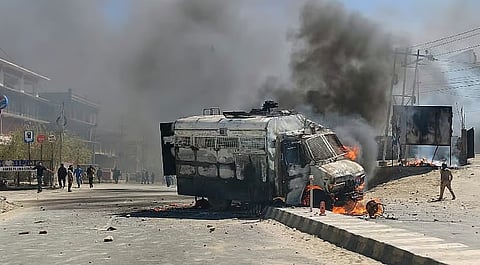
The decision fulfilled a decades-long demand of the people of Leh: the carving out of Ladakh as a separate Union Territory (UT). Six years later, the same streets witnessed the bloodiest of protests in the region’s history, with four deaths and 80 injuries during a violent clash on September 24 last.
Two days after the violence, the police arrested climate activist Sonam Wangchuk under the National Security Act (NSA) for allegedly inciting the youth who went on a rampage.
Wangchuk continues to be in prison. The Union home ministry has just announced a judicial probe panel into the riots headed by retired Supreme Court judge B S Chauhan, addressing one of the demands of the protesters. A proposed silent march in Ladakh, too, has been foiled.
The euphoria of 2019 has given way to deep resentment, as Ladakh grapples with unfulfilled promises, loss of constitutional safeguards, and a growing demand for statehood and inclusion under the Sixth Schedule of the Constitution. Short of the Sixth Schedule, the Centre announced a domicile policy that reserves 85% of government jobs for locals. But Ladakhis say it is grossly insufficient.
The Sixth Schedule
The Sixth Schedule under Article 244 provides for the formation of autonomous administrative divisions - Autonomous District Councils (ADCs) that have legislative, judicial, and administrative autonomy within a state. It contains special provisions for the administration of tribal areas in the four north-eastern states of Assam, Meghalaya, Tripura, and Mizoram.
These councils, comprising up to 30 members (26 elected, 4 nominated by the Governor), have legislative, judicial and administrative powers. They can enact laws on land, forests, water, village administration, and social customs (subject to Governor’s assent), manage schools, markets, and infrastructure, and collect certain taxes.
Why Ladakhis want it
With over 97% of its 2,74,289 residents (2011 census) belonging to the Scheduled Tribes, Ladakh’s cultural and demographic fabric is uniquely tribal. The abrogation of Article 35A in 2019 removed protections for land and job rights, raising fears of demographic dilution by outsiders. Sixth Schedule inclusion would provide constitutional safeguards, empowering ADCs to protect tribal customs, land ownership and cultural heritage.
“To qualify for the Sixth Schedule, an area must have at least 50-60% tribal population. In Ladakh, over 95% of our population is tribal, so we meet the criteria,” said Gelek Phunchok, leader of the Leh Apex Body (LAB), an influential coalition of political, social and religious groups. The Sixth Schedule would empower local councils to make laws protecting land, jobs, and cultural heritage, addressing fears of demographic change and environmental harm in a region with a fragile ecosystem.
In 2020, the then tribal affairs minister Arjun Munda recommended Sixth Schedule status for Ladakh, and the National Commission for Scheduled Castes and Scheduled Tribes echoed this after reviewing a Parliamentary Standing Committee report. The BJP included the Sixth Schedule in its 2019 Lok Sabha and 2020 Leh Hill Council election manifestos. However, LAB leaders accuse the BJP of going back on this promise.
Sensitive location
Spanning 59,146 sq km with a population of just 2,74,289 (2011 census), Ladakh is a sparsely populated, high-altitude desert nestled between Pakistan and China, making it strategically vital for India. The region has two districts: Buddhist-majority Leh (population: 1,33,487) and Muslim-majority Kargil (population: 1,40,802). While Leh celebrated the UT status in 2019, Kargil, like the Kashmir Valley, was critical of the move, indicating early divergence in the region’s response.
“People in Leh thoughtlessly rejoiced and celebrated the formation of the UT on August 5, 2019,” said Chering Dorjay, co-chair of LAB. The abrogation of Article 370, which had provided J&K special autonomy, and Article 35A, which protected local land and job rights, was seen as a necessary step to achieve UT status. Residents of Leh believed it would free them from the administrative dominance of J&K. However, the absence of a legislative assembly in the new UT structure soon sowed seeds of discontent.
No legislature
Unlike the J&K UT, which was granted a legislature, Ladakh was designated a UT without one. “We had been demanding a UT with a legislature, but what we got disappointed people,” Dorjay explained.
Without a legislative body, Ladakh’s governance falls under the control of the Lieutenant Governor (L-G) and bureaucrats, leaving local leaders with little say in policy or budget allocation. The Ladakh Autonomous Hill Development Councils (LAHDCs) in Leh and Kargil, which manage only about 10% of the region’s budget, have limited powers, further fueling frustration.
The abrogation of Article 35A also stripped Ladakh of constitutional protections that had safeguarded its land and jobs from outsiders.
“We realised that Article 370 was actually protecting us,” Dorjay said. “Now, outsiders can settle here, buy land, and compete for jobs, threatening our unique identity and fragile ecosystem.” Ladakhis fear demographic changes and environmental degradation if large-scale industries or tourism projects are introduced without safeguards.
Turning point
The protests on September 24 marked a tragic turning point. What began as a peaceful LAB-led demonstration spiraled into violence, with youth protesters torching BJP offices, Hill Council buildings, and police vehicles. Phunchok described the violence as an “outburst of emotions” of the unemployed youth.
“When Ladakh was part of J&K, we had access to the J&K Public Service Commission for cadre-based recruitment. Since the UT’s creation, no separate PSC has been established, and no gazetted appointments have been made,” he said. Of the 6,000-7,000 jobs promised after the UT’s formation, only 1,000-1,200 vacancies have been filled. The University of Ladakh, a potential source of employment, has relied on contractual hiring rather than permanent posts, further accentuating unrest.
Academician Sidiq Wahid noted that the initial euphoria in Leh faded as residents realised the UT status was “hollow”.
“They discovered that the rights they had under Article 370 were gone. The lack of progress on jobs and governance led to growing impatience, especially among the youth,” he said.
Centre’s response
In response to the agitation, the Union home ministry formed a high-powered committee comprising Ladakh MP Mohmad Haneefa, LAB and KDA leaders, and ministry officials, to hold talks. After a May 27 meeting, the Centre introduced a domicile policy requiring 15 years of residency (from 2019) to qualify for UT domicile and reserved 85% of government jobs for locals. However, these measures failed to address the core demands for statehood and Sixth Schedule status, leading to a deadlock. Wangchuk’s 35-day hunger strike, launched on September 10, aimed to pressure the Centre to resume talks. Although the government invited leaders for discussions on October 6, LAB and KDA demanded an earlier date, and Wangchuk continued his strike.
The September 24 violence halted dialogue with the Centre. LAB and KDA demanded a judicial inquiry into the violence, release of detainees, dropping of charges, and compensation for victims for resuming talks. While calm has since returned to Leh, with curfews lifted and half of the detainees bailed out, tensions simmer. KDA co-chairman Asgar Karbalai said, “This silence is not normalcy; it may be a calm before the storm.”
Sonam Wangchuk factor
Among those who initially celebrated the UT status was Sonam Wangchuk, a renowned climate activist and innovator. In 2019, he praised Prime Minister Narendra Modi for fulfilling Ladakh’s “longstanding dream”. When its implications became clear, Wangchuk emerged as a vocal critic. He began advocating for the inclusion of Ladakh under the Sixth Schedule.
Wangchuk joined forces with LAB and the Kargil Democratic Alliance (KDA), a coalition of political, religious, trade, and student groups from Kargil. Together, they launched a unified agitation for a four-point agenda: statehood for Ladakh, Sixth Schedule status, a separate Public Service Commission (PSC) for job recruitment, and two Lok Sabha seats for the region. This rare alliance between the Buddhist-dominated Leh and Muslim-majority Kargil marked a significant shift, as the two districts had historically been at odds.
Wangchuk’s activism took a dramatic turn this year. He led hunger strikes and a peaceful march to New Delhi to press for dialogue with the Central government. However, following violent protests on September 24, Wangchuk was detained under the stringent National Security Act (NSA).
The Union home ministry and the L-G’s administration accused him of inciting the youth through provocative speeches. Investigations are also on into his alleged links to Pakistan, based on his participation in a climate conference organised by Pakistan’s Dawn newspaper and the United Nations. Wangchuk, now incarcerated in Jodhpur jail, remains a polarising yet central figure in Ladakh’s struggle.
