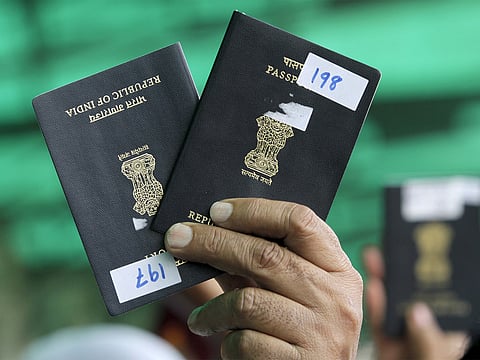

A senior External Affairs Ministry (MEA) official on Wednesday reiterated a legally correct but politically consequential distinction: a passport is a travel document, and not, by itself, conclusive proof of citizenship. The clarification was not new. But it revived an old and uncomfortable question in public discourse -- how can a document issued only after verifying citizenship not be treated as conclusive proof of citizenship?
On paper, the legal framework might be clear. Passports are issued under the Passports Act, 1967, while citizenship is governed by the Citizenship Act, 1955. One regulates a document that also enables international travel. The other defines a person’s legal status as a citizen of India. Yet the lived reality is more complex. For most Indians, a passport is not just a travel document. It is one of the most authoritative expressions of nationality issued by the state. It carries the name of the Republic of India, is globally recognised, and is issued only after a detailed verification process. That is why the MEA’s clarification, though legally precise, appears counter-intuitive to many citizens. If a passport is not conclusive proof of citizenship, the natural question follows: what is?
Why did MEA say this?
A passport serves two functions: it facilitates international travel and identifies the holder as it attests the holder’s nationality. Citizenship, however, is a legal status defined exclusively under the Citizenship Act, 1955. The existence of a passport does not, by itself, resolve all possible legal disputes regarding citizenship. The government’s position rests on a technical but important distinction. A passport is evidence that the state accepted a claim of citizenship at the time of issuance. It is not, however, a legal declaration that cannot be questioned under any circumstance.
Doesn’t the law require citizenship before issuing a passport?
Yes. In most cases, it does. Section 5 of the Passports Act, 1967 empowers authorities to issue passports only after verifying an applicant’s credentials and conducting such inquiries as deemed necessary. More importantly, Section 6(2)(a) mandates that a passport must be refused if the applicant is not a citizen of India. This creates an ordinary and reasonable assumption: that anyone holding an Indian passport has already been found to be a citizen by the government after due scrutiny.. In most everyday contexts, this assumption holds true. That is precisely why passports are widely treated as strong proof of nationality.
Then why isn’t a passport treated as conclusive proof of citizenship?
Because a passport does not create citizenship. Rather it reflects it. The issuance of a passport is an administrative determination based on documents and declarations at a given point in time. It is not an irreversible legal certification of citizenship under all circumstances. In rare but legally significant situations -- fraudulent documentation, mistaken identity, disputed parentage, illegal migration, or forged records - the underlying question of citizenship may still need to be examined independently under the Citizenship Act. In such cases, courts do not treat a passport as the final word. It becomes strong evidence, but not an unchallengeable proof.
Can India issue a passport to a non-citizen?
Yes, in limited circumstances.
Section 20 of the Passports Act allows the Central government to issue a passport or travel document to a person who is not an Indian citizen if it is considered necessary in the public interest. Government guidelines also provide for specific cases where non-citizens may be issued travel documents. Although such cases are rare, they reinforce an important legal point: possession of a passport cannot, in isolation, be treated as absolute proof of citizenship in every possible legal scenario. This legal flexibility is one reason that holds back elevating passports to conclusive status in disputes.
Is there a frequently cited court case?
Indian courts have consistently held that citizenship must be determined under the Citizenship Act and not inferred from documents alone. A frequently cited example is the Bombay High Court’s decision in Babu Abdul Ruf Sardar v. State of Maharashtra. The case involved an individual accused of illegal entry and alleged fraudulent documentation. While rejecting bail, the court observed that possession of documents such as Aadhaar, PAN card, voter identity card, or even a passport does not, by itself, establish Indian citizenship. The court emphasised a key principle: citizenship is a legal status determined under the Citizenship Act, and documents are only pieces of evidence in that determination.
If a passport is not conclusive, what proves citizenship?
There is no single answer.
Unlike many countries that issue a universal citizenship certificate, India does not have a single document automatically issued to every citizen that conclusively establishes citizenship in all contexts. In 2020, when Parliament was asked whether documents such as Aadhaar, voter ID, PAN cards, passports or birth certificates could be treated as definitive proof of citizenship, the Union government declined to designate any one document as conclusive. It reiterated that citizenship is governed by the Citizenship Act, 1955.
So how is citizenship established?
Indian law recognises many ways to citizenship: by birth, descent, registration, naturalisation, or incorporation of territory. Because citizenship can arise through different routes, the evidence required to establish it also varies. Courts and authorities therefore now rely on a combination of documents depending on the facts of each case.
A birth certificate may establish the place of birth and parentage. School records may support identity and continuity. Voter rolls may indicate long-term residence and recognition by electoral authorities. Land records and ancestral documents may help establish lineage. Citizenship certificates, where issued, serve as direct proof for those who acquired citizenship through registration or naturalisation.
A passport, in this chain, is strong corroborative evidence, but not the sole determinant. In disputes, the authorities assess the totality of evidence rather than relying on a single document.
Then, is there a citizenship certificate for all Indians?
No. India does not issue a universal citizenship card or certificate to all citizens. Citizenship certificates exist only for those who acquire citizenship through registration or naturalisation. The vast majority of Indians, who are citizens by birth, do not possess any standalone citizenship certificate. This absence is at the heart of the current paradox: citizenship is universal, documentation isn’t.
Why does this issue matter now?
For decades, citizenship was rarely questioned in ordinary administrative life. Citizens interacted with the state through a web of documents — birth certificates, voter IDs, passports, school records and ration cards. But that consensus has weakened in recent years. Citizenship verification exercises, migration-related disputes, and documentation-driven processes have brought new scrutiny to old records. The Assam NRC exercise, in particular, highlighted how fragile documentation systems can become when citizenship is subjected to strict legal examination. Small inconsistencies in names, dates or spelling have had disproportionate consequences for many individuals. Against this backdrop, the MEA’s clarification is not just legal housekeeping. It touches a deeper administrative reality: India relies on fragmented documentation to establish something as fundamental as citizenship.
Does this reduce the importance of a passport?
No. A passport remains one of the most rigorously verified documents issued by India. It is globally trusted because other countries rely on India’s verification process. In practical terms, it is often the strongest and most widely accepted evidence of Indian nationality an individual can carry.
Does the MEA clarification change the passport's role in electoral roll verification?
No. Election Commission officials have clarified that passport continues to be one of the 12 valid supporting documents applicants may submit during the ongoing Special Intensive Revision (SIR) of electoral rolls to establish their eligibility for inclusion. There has been no change in policy. They also stressed that a passport has never been treated as conclusive proof of citizenship on its own but as one of several supporting documents considered by the Electoral Registration Officer, who examines the overall evidence before taking a decision. Passports were similarly accepted during the Bihar SIR, Assam's special revision exercise and subsequent electoral roll revision drives.
What is the larger lesson?
The real issue is not the passport; it’s the system around it. India’s civil registration architecture evolved unevenly over decades. Birth records in many parts of the country remain incomplete or inconsistent. Older documentation often contains discrepancies in names, dates and places of birth. Archival systems are fragmented across institutions. The result is a system where citizenship is rarely proved through a single authoritative document, but instead seen as reconstructed through multiple records in many cases. That may work in normal circumstances.
