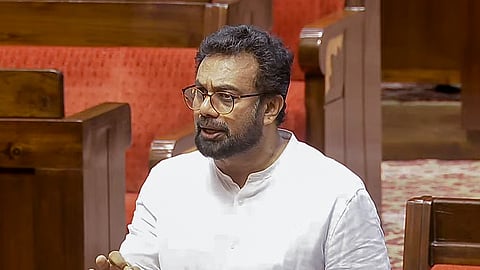

LUCKNOW: Amid the controversy over the alleged embezzlement of donations at the Ram temple in Ayodhya, CPI(M) Rajya Sabha MP John Brittas has written to Union Home Minister Amit Shah urging the Centre to reconsider its stand that the Shri Ram Janmabhoomi Teerth Kshetra Trust is not a public authority under the Right to Information (RTI) Act.
Sharing the letter via X on Sunday, Brittas said it was not prudent to keep the trust outside the ambit of the RTI Act merely because the government described it as an "autonomous" body, when it had been constituted through a government-approved scheme, vested with land acquired under a parliamentary law and continued to have serving IAS officers in its governing framework.
He urged the Union government to revisit its earlier position, saying: "Trusts that enjoy unparalleled public faith must also uphold the highest standards of public transparency and accountability."
Referring to a Central Information Commission (CIC) order dated 6 June 2025 holding that the trust was not a "public authority" under Section 2(h) of the RTI Act, Brittas said the decision had relied substantially on the Ministry of Home Affairs' stand and requested the ministry to review its position in the interest of transparency and public accountability.
In his letter, Brittas said the trust's origins were unique.
Following the Supreme Court's November 2019 Ayodhya judgment, the Centre framed the scheme governing the trust, constituted it through a gazette notification and vested in it the acquired land.
He added that the trust's initial structure comprised 15 members, of whom 12 were nominated by the Centre while the remaining three were chosen at its first meeting.
Brittas argued that the broader question was whether a trust created by the government pursuant to a Supreme Court judgment and vested with property by the Centre should remain outside the accountability framework envisaged under the RTI Act.
He questioned the interpretation accepted by the CIC that the trust could not be regarded as having been established or constituted by a government notification because the notification was issued in compliance with the Supreme Court's directions.
"Section 2(h)(d) simply refers to a body established or constituted by a Government notification or order; it does not distinguish between a notification issued pursuant to a judicial direction and one issued independently by the Government," he said.
Citing Supreme Court judgments in D.A.V. College Trust and Management Society v. Director of Public Instructions (2019) and Thalappalam Service Cooperative Bank Ltd. v. State of Kerala (2013), as well as the Delhi High Court's 1 July judgment declaring the National Stock Exchange a public authority under the RTI Act, Brittas argued that institutions deriving their legal existence and public character from government action should receive a purposive interpretation that advances transparency.
He also highlighted the continued presence of serving government officials in the trust's governing framework, including nominees of the Centre and the Uttar Pradesh government, and the Ayodhya district magistrate. The Centre's current representative on the trust, he noted, is an Additional Secretary in the Ministry of Home Affairs.
"If the Trust is entirely private in character and wholly beyond the sphere of public accountability, why did the Government itself considers it necessary to continue governmental representation in its governing structure?" he asked.
While these representatives may not have voting rights, Brittas said their statutory inclusion reflected the trust's public character and the government's continuing institutional association with its administration.
He further argued that the trust administered one of the country's most revered religious institutions, managed land acquired under a parliamentary enactment and vested through a government notification, and received contributions from millions of devotees in India and abroad.
"The public character of the Trust also arises from the nature of the functions entrusted to it. It administers one of the country's most revered religious institutions, manages land acquired under a Parliamentary enactment and vested through government notification, and receives contributions from millions of devotees across India and abroad," he said.
He added that the "extraordinary confidence" reposed by the public in the trust naturally carried with it an equally compelling expectation of transparency in governance, financial administration, contracts and the utilisation of donations.
Drawing a comparison with the Shri Mata Vaishno Devi Shrine Board, Brittas said institutional autonomy and public accountability were not mutually exclusive, as major religious institutions established under statutory or government frameworks continued to enjoy autonomy in religious matters while functioning within transparent administrative and financial systems.
Brittas urged the Home Ministry to reconsider its stand and place a revised position before the jurisdictional high court so that the trust's status under the RTI Act could receive an authoritative judicial determination.
The Shri Ram Janmabhoomi Teerth Kshetra Trust is at the centre of a controversy over the alleged embezzlement of donations offered by devotees.
