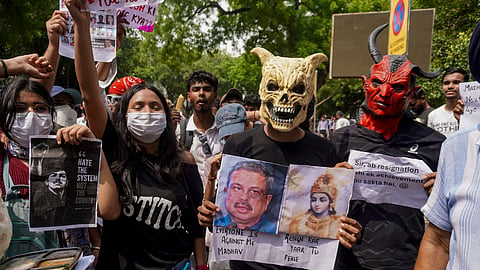

NEW DELHI: The resignation of Union Education Minister Dharmendra Pradhan marked the end of a 36-day protest at Delhi's Jantar Mantar, but for many of the young demonstrators, it was not the end of a movement. If anything, they said, it was the beginning of a generation finding its collective voice.
As celebrations gradually gave way to reflection, protesters spoke not just about what they had achieved, but about what they hoped would come next.
“This is what we wanted,” said one protester, Ilyana. “But what should never be forgotten is that one issue brought this entire country together. It should remain a lesson for the next time people disagree with a government's actions. And the government should remember for life how important it is to remain for the people.”
Many described the victory as deeply personal.
“My parents kept telling me that nothing would happen. Today I'll go home and tell them that my generation has won. I don't think they'll ever stop me from joining a peaceful protest again. In fact, many parents must be regretting not allowing their children to come here,” said another supporter, Vinay.
For 37-year-old doctor Misha Bharti, who joined the protest despite being a mother to a four-year-old daughter, the movement carried significance beyond the immediate issue of the NEET paper leak.
“I am a millennial mother, and I am proud that one day I will be able to tell my daughter that I stood here thinking about her future. This wasn't just a protest. It became a revolution.”
Others hoped the resignation would send a strong message on accountability.
Pooja, a third-year BA student who travelled from Varanasi to Delhi for the protest, said she hoped those involved in examination irregularities would realise there are consequences.
“Everyone responsible for paper leaks or malpractice should develop a sense of fear and accountability. People in positions of authority must understand that they are answerable for their actions. If I am responsible for something, I should be held accountable.”
Rahul, another student from Varanasi, said the movement should now push for broader reforms.
“Our educational institutions need better infrastructure, better facilities and a transparent examination system. Students should be able to focus on learning without worrying whether someone else will benefit from corruption,” he said.
Meanwhile, Samreen Irshad from Batla House said, “The victory means we cannot go silent again. If thousands of young people can come together once, they can do it again for jobs, education, accountability and every issue that concerns our future.”
The sentiment resonated beyond Jantar Mantar. Sonam Wangchuk's wife posted on X, “If anyone has shown what it means for India to be a Vishwaguru, it is our Gen Z. They have lived Sanatan Dharma, not preached it.”
Meanwhile, CJP chief spokesperson Saurav Das also said it is not the end of the movement.
“Whoever becomes the new education minister should know the youth are watching. They will demand accountability. We will meet the education minister soon. The government has promised to hold a meeting within a month and then we will see what happens,” he said.
(With inputs from Nitin Rawat)
